How much testosterone should I take to feel normal again without wrecking my health?
Too little and you feel nothing.
Too much and you risk side effects, mood swings, and long-term issues.
Finding the right TRT dosage isn’t about chasing high numbers. It’s about steady levels, symptom relief, and lab results that make sense.
There’s no single “perfect” number that works for everyone.
Age, body fat, metabolism, and delivery method all change your ideal TRT dosage.
TRT Dosage Basics: Where Most People Start
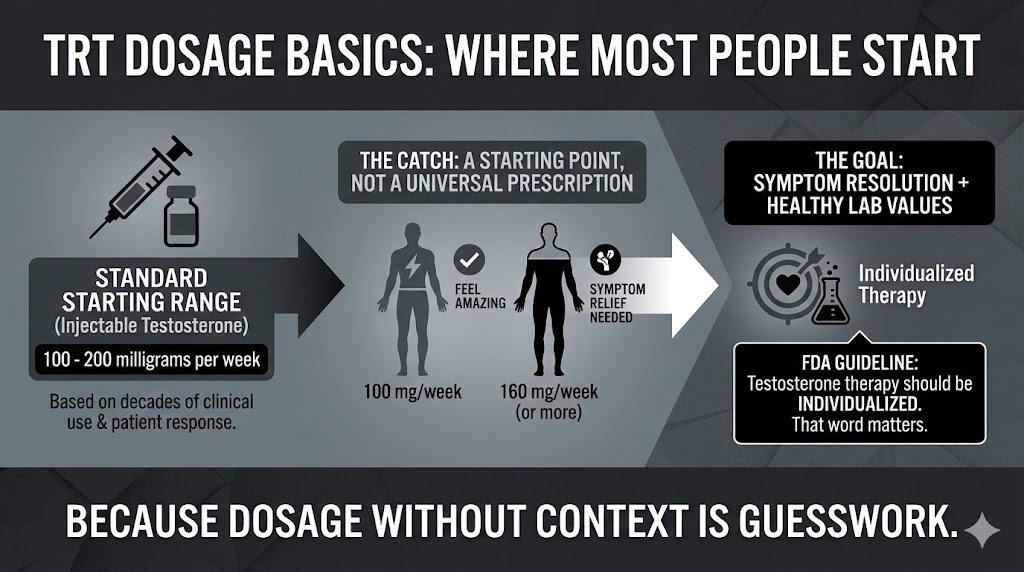
If you’re brand new to therapy, you’ll notice that most providers begin with a standard TRT dosage range. For injectable testosterone, that often means 100 to 200 milligrams per week. That’s not random. It’s based on decades of clinical use and patient response.
But here’s the catch. That range isn’t a prescription for everyone. It’s a starting point. Some men feel amazing at 100 mg per week. Others need closer to 160 mg to see symptom relief. The goal isn’t the dose itself. The goal is symptom resolution with healthy lab values.
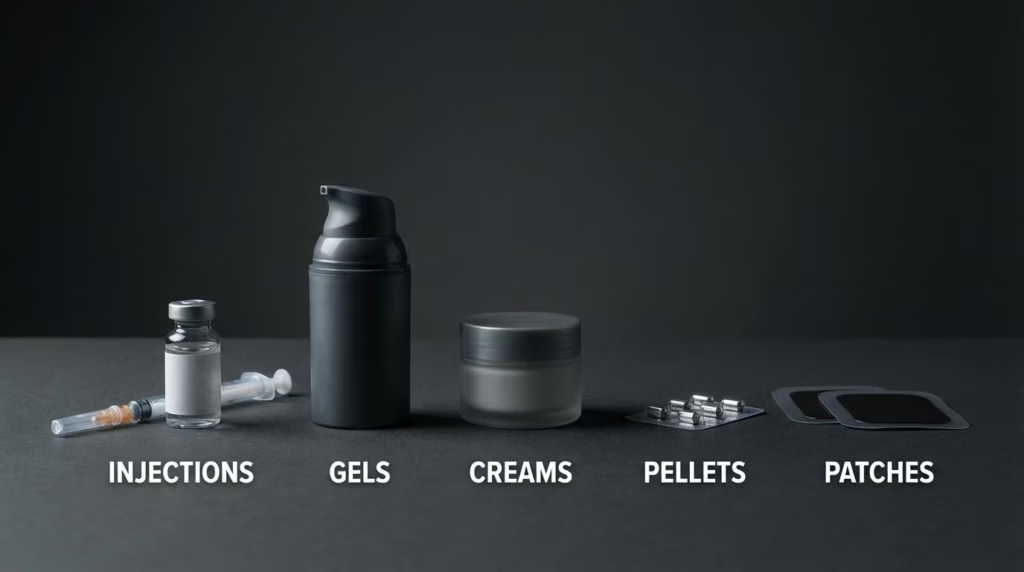
Not all testosterone delivery systems behave the same. Your TRT dosage depends heavily on how you administer it.
With injections, weekly dosing is common. Many patients split their weekly TRT dosage into two smaller injections to keep levels steady. For example, instead of 160 mg once per week, they inject 80 mg twice weekly. That often reduces mood swings and energy crashes.
Topical gels are different. A typical gel TRT dosage might range from 50 to 100 mg applied daily. Absorption varies by person, so bloodwork becomes even more important.
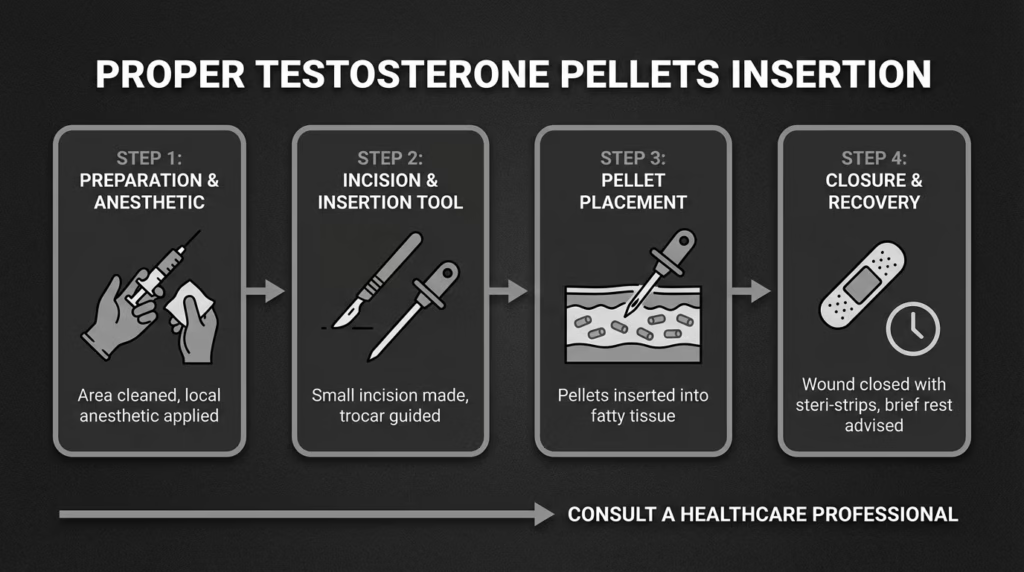
Pellets work on longer cycles. Providers calculate pellet insertion amounts based on body weight and baseline testosterone levels. Adjustments only happen every few months.
TRT Dosage and Bloodwork: The Numbers That Actually Matter
Here’s where people mess up.
They chase a high number on their lab sheet instead of dialing in the right TRT dosage for their body. Total testosterone matters, yes. But so do free testosterone, estradiol, hematocrit, and SHBG.
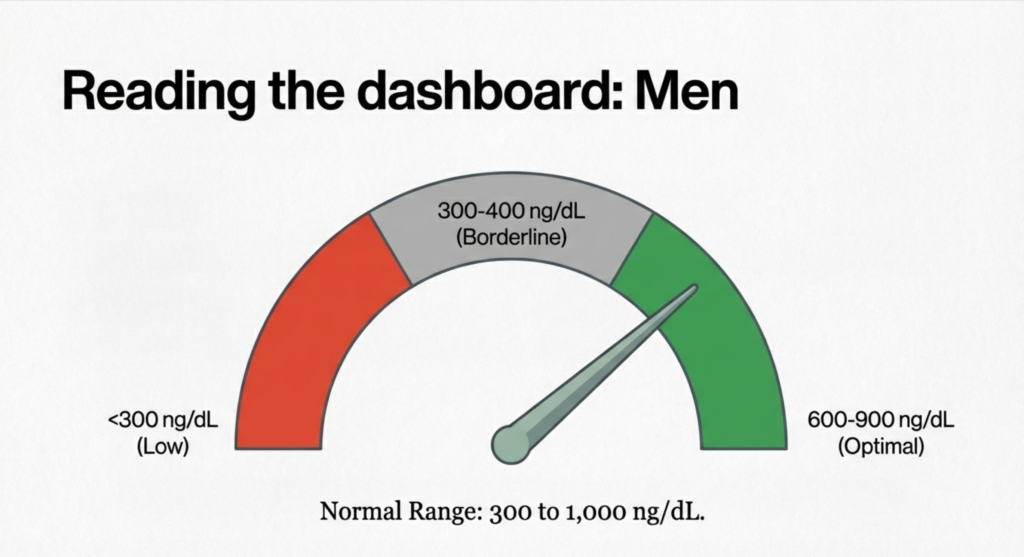
Most providers aim for total testosterone levels between 600 and 900 ng/dL. That’s a common target zone. But some men feel their best at 550. Others don’t feel relief until 850. That’s why adjusting TRT dosage based on symptoms plus labs makes more sense than labs alone.
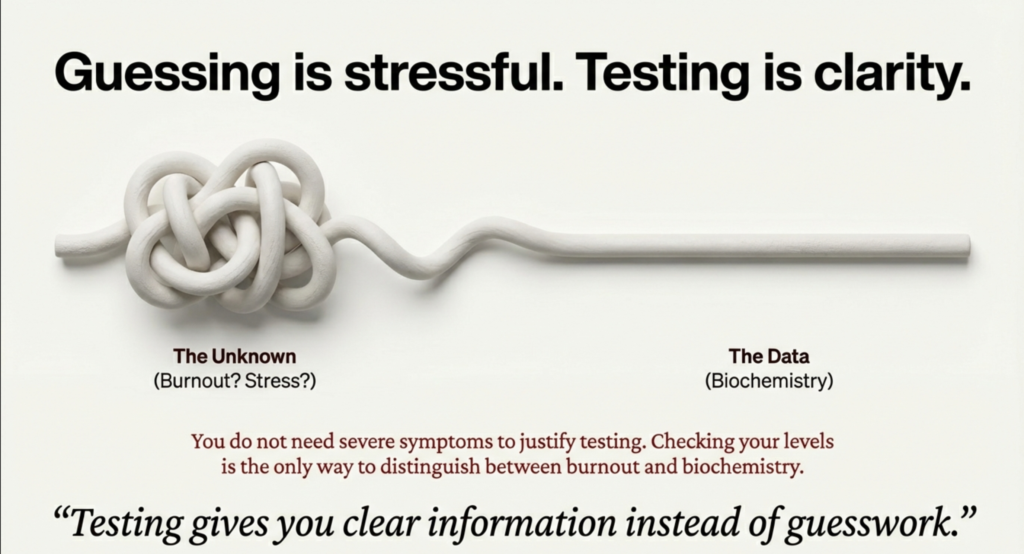
Because guessing your TRT dosage without labs is like driving blindfolded. It might work for a mile. Then it won’t.
Adjusting TRT Dosage: When and Why Changes Happen
Most people don’t nail their ideal TRT dosage on day one. And that’s normal.
Adjustments happen for three main reasons. First, symptoms persist. Maybe energy improved but libido didn’t. Second, labs drift out of range. Hematocrit might climb. Estradiol might spike. Third, side effects appear.
When that happens, providers don’t usually double your dose. They tweak it. A small 10 to 20 mg shift in weekly TRT dosage can make a big difference. Patience matters here. Hormone levels stabilize over weeks, not days.
That transition period is where most confusion happens.
And here’s my hot take. If a clinic never checks your labs or never adjusts your TRT dosage, that’s a red flag. Therapy should evolve with you.
TRT Dosage and Side Effects: Finding the Balance
More isn’t better. I’ll say it again. More isn’t better.
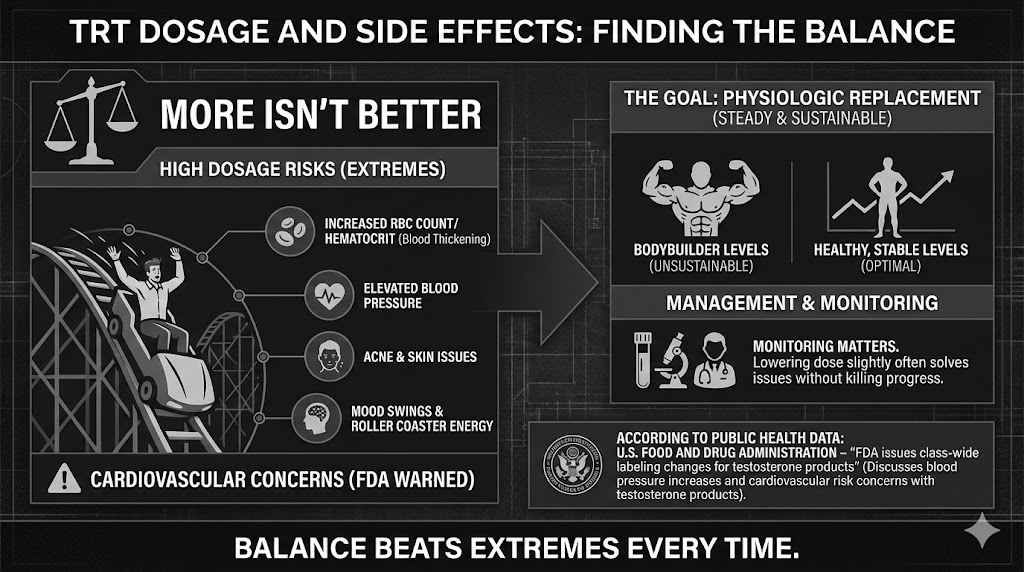
High TRT dosage levels can increase red blood cell count, blood pressure, acne, and mood swings. You might feel strong for a while. Then you feel irritable. Or tired again. That roller coaster usually points to dosing issues.
Elevated hematocrit is common with aggressive TRT dosage plans. That’s why monitoring matters. Sometimes lowering the dose slightly solves the problem without killing your progress.
According to public health data: U.S. Food and Drug Administration – “FDA issues class-wide labeling changes for testosterone products” (discusses blood pressure increases and cardiovascular risk concerns with testosterone products)
Extremely high testosterone levels carry cardiovascular concerns.
Your goal isn’t bodybuilder levels. It’s physiologic replacement. Steady. Sustainable.
Balance beats extremes every time.
TRT Dosage for Different Age Groups
Age plays a role in how your body responds to TRT dosage, but not in the way most people assume.
Younger men with clinically low testosterone may respond quickly to moderate dosing. Older men often metabolize hormones differently and may require smaller adjustments to maintain stable levels.
That doesn’t mean older patients automatically need less TRT dosage. It means monitoring becomes even more important. Liver function, cardiovascular risk, and overall health shape dosing decisions.
Some providers use weight-based formulas when calculating initial TRT dosage, especially for pellets. Others prefer symptom-driven titration.
TRT Dosage Myths
Myth one: Higher TRT dosage equals faster muscle gain. Not true. Gains depend on training, diet, sleep, and genetics. Testosterone helps, but it’s not magic.
Myth two: Everyone should aim for 1,000 ng/dL. Why? That number looks impressive. But it’s not required for symptom relief in most men.
Myth three: You should feel amazing in one week. Hormones take time. Your body needs weeks to adapt to a new TRT dosage.
Here’s the truth. Smart therapy is boring. Consistent labs. Small adjustments. Gradual improvement.
Because guessing leads to frustration. Strategy leads to results.
Conclusion: TRT Dosage Is Personal, Not One-Size-Fits-All
If you take one thing from this guide, let it be this: TRT dosage is not a fixed number. It’s a process.
Your ideal TRT dosage depends on symptoms, labs, delivery method, and how your body responds over time. Most men start between 100 and 200 mg per week with injections, or equivalent dosing in gels or pellets. From there, small adjustments shape the outcome.
Don’t chase extreme numbers. Don’t compare your dose to someone on a forum. Focus on steady energy, improved mood, healthy labs, and long-term safety.
Work with a provider who monitors you. Test regularly. Adjust patiently.
Because the right TRT dosage isn’t about being high. It’s about feeling like yourself again — consistently, safely, and for the long run.
TRT stands for testosterone replacement therapy. It’s a medical treatment that restores your testosterone levels when your body stops making enough on its own. About 4 to 5 million men in the United States have clinically low testosterone, but only about 5% are getting treated for it. That’s a lot of guys running on fumes, thinking this is just what getting older feels like.
This guide is going to walk you through the whole thing—what TRT is, how it works, signs of low testosterone, what it costs, and how to get started.
What Is Testosterone Replacement Therapy?
Three words, each doing exactly what it says. Testosterone: the hormone. Replacement: putting it back. Therapy: doing so in a controlled, medical, someone-with-a-degree-is-watching kind of way.
Your body is supposed to produce testosterone on its own. The testes handle manufacturing. The brain handles management, sending signals from the hypothalamus and pituitary gland that say, essentially, “Make more” or “That’s enough.” It’s a tidy little operation. It runs in the background like a thermostat. You never think about your thermostat until the house gets cold.
But sometimes the operation slows down. The factory produces less. The management office sends weaker signals. The supply drops below what your body needs, and you feel it in your energy, your mood, your muscles, your sex drive, your ability to think clearly, and your motivation to do literally anything after 3 PM.
TRT is the medical solution. A doctor confirms your testosterone is genuinely low through blood work, prescribes a specific dose, and monitors you with regular labs to make sure levels come back to where they belong. It’s not steroids. And it’s not some masculinity supplement. It’s a correction—your body needs a certain amount of a certain thing, stopped making enough, and now a doctor is helping you get back to baseline.
This is one of the most common questions beginners have, and it’s a fair one, because from the outside the two things look similar. Both involve testosterone. Both involve needles, sometimes. But the resemblance ends there.
TRT uses small, medically supervised doses to bring your testosterone back to a normal, healthy range—typically 500 to 900 ng/dL. Anabolic steroid abuse uses doses that are 10 to 100 times higher than that to push testosterone far beyond normal levels. TRT is prescribed by a doctor, monitored with blood work, and adjusted based on how your body responds. Steroid abuse is self-administered, often stacked with other drugs, and monitored by nobody.
Think of it this way: TRT is putting the right amount of oil back in your engine. Steroids are flooding the engine and hoping the extra pressure makes you go faster. One is maintenance. The other is a gamble.
Signs and Symptoms of Low Testosterone
Here’s the tricky part. Low testosterone doesn’t show up wearing a name tag. It doesn’t tap you on the shoulder and introduce itself. What it does is much sneakier: it disguises itself as a dozen other things you already have a ready explanation for.
You’re tired all the time? Must be work. Your sex drive disappeared? Must be stress. You can’t focus? Must be your phone. You’re gaining weight around your middle? Must be age. You feel vaguely sad and you don’t know why? Must be… the news. The economy. The general condition of being a person in the 2020s.
And maybe it is those things. But low testosterone is also an explanation, and it’s one that a lot of men never consider because nobody told them to.
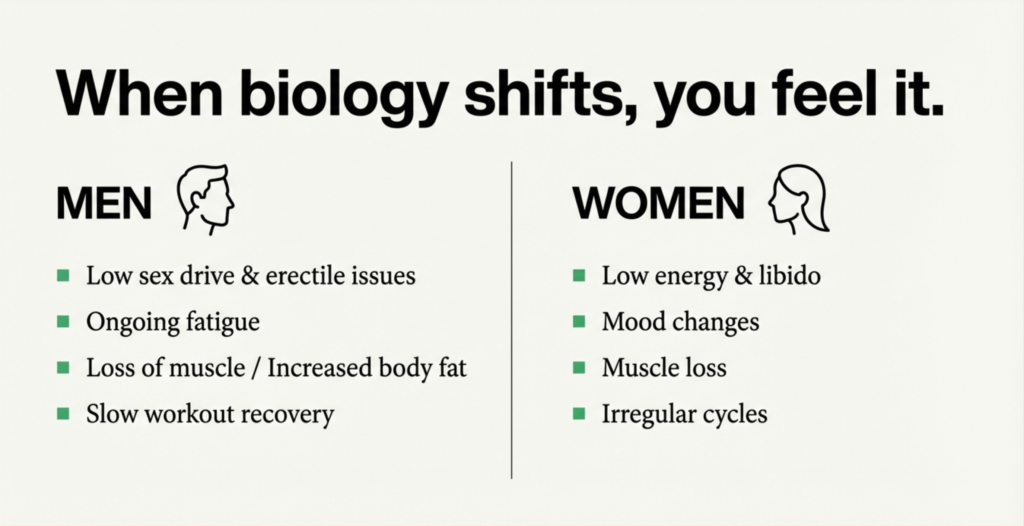
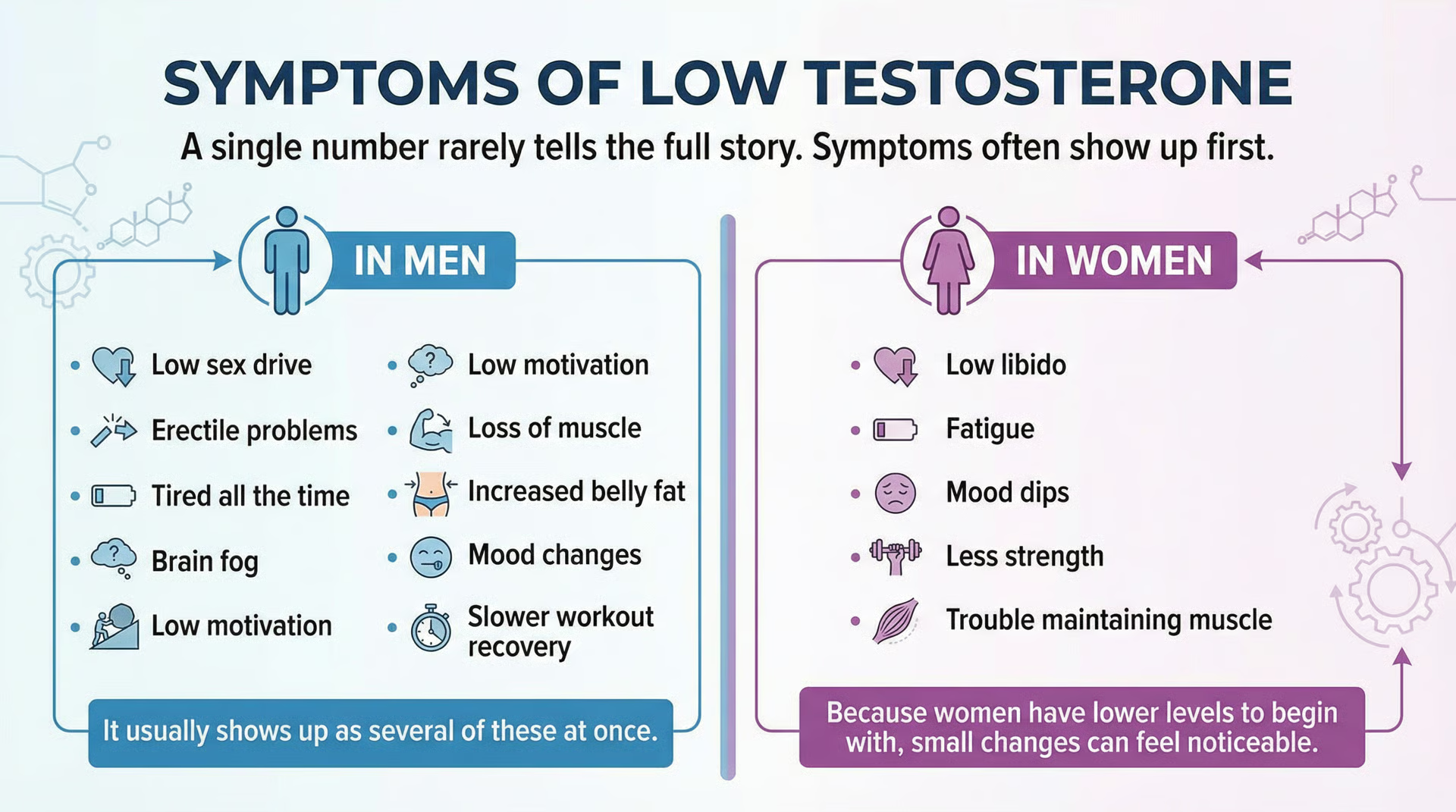
The most common symptoms of low testosterone include persistent fatigue that doesn’t improve with sleep, reduced or absent sex drive, difficulty getting or maintaining erections, loss of muscle mass despite consistent exercise, stubborn weight gain around the midsection, irritability or low-grade depression without an obvious cause, brain fog and poor concentration, and disrupted sleep.
If you’re reading that list and checking off three or four items and feeling a small, uncomfortable ping of recognition—that’s worth paying attention to. Not panicking about. Just paying attention to.
Normal Testosterone Levels by Age
Testosterone is measured via blood test, and the result comes back as a number in nanograms per deciliter (ng/dL). You do not need to know what a nanogram is. You just need to know where your number falls.
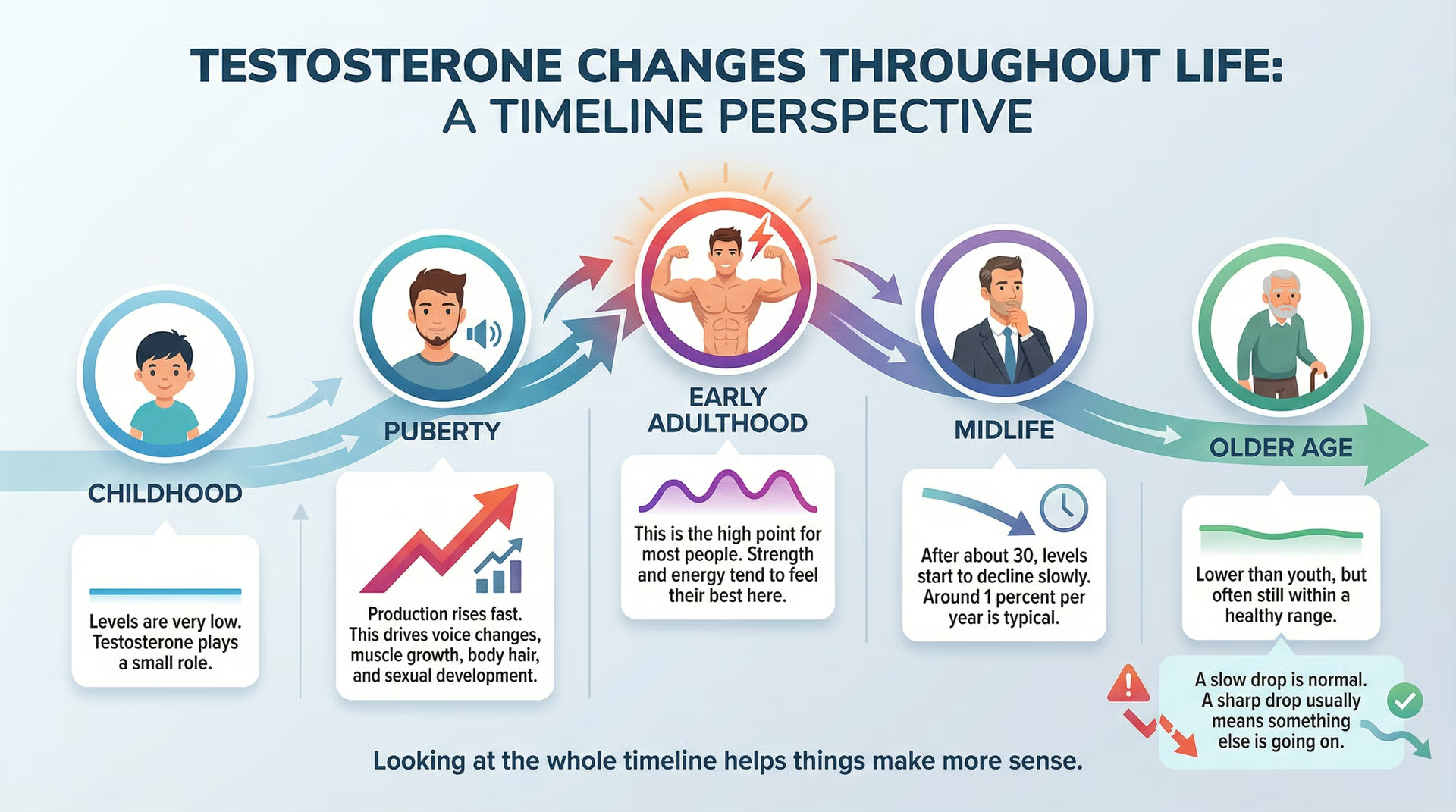
According to the American Urological Association, low testosterone is defined as a total testosterone level below 300 ng/dL. Your testosterone peaks in your late teens to early twenties—that period of your life when you had inexplicable confidence and terrible judgment—and then declines about 1% per year after age 30.
Here’s what the typical range looks like:
Age
Typical Total Testosterone (ng/dL)
18–25
400–700
26–35
350–650
36–45
300–600
46–55
250–550
55+
200–500
A critical nuance: the number is not the diagnosis. The number plus the symptoms is the diagnosis. A man at 310 ng/dL who feels fantastic is not a candidate for TRT. A man at 310 who hasn’t slept well in eight months and forgot what motivation feels like probably is. Context is everything.
This is the part of the guide that separates the people who are going to do something from the people who are going to bookmark this page and never look at it again. No judgment—we’ve all got a folder full of those bookmarks. A graveyard of good intentions.
But if you’re going to do something, here’s what it looks like: you ask your doctor, or a men’s health clinic, to order a testosterone blood panel. That’s the whole action item. Make a call. Schedule a lab visit.
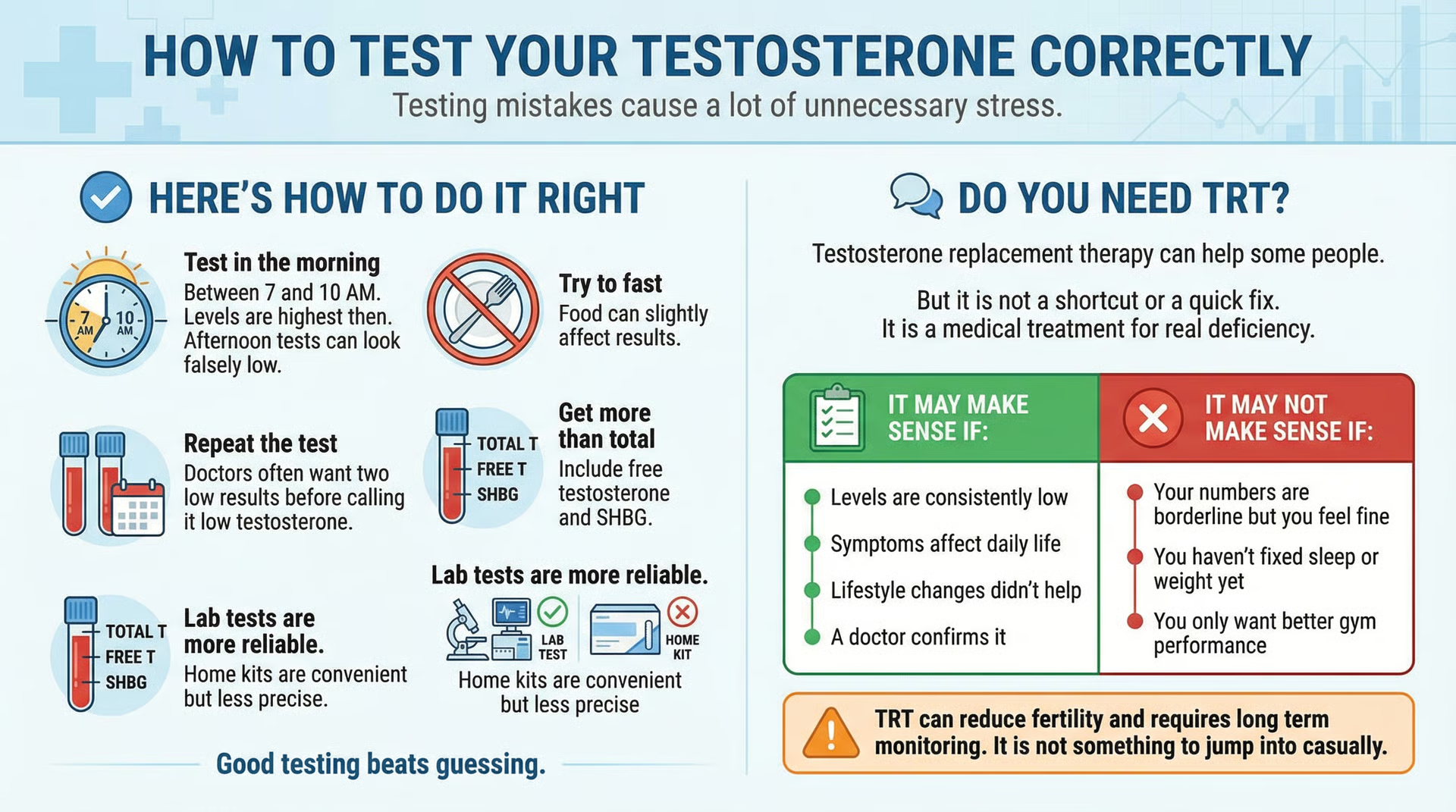
The blood draw happens in the morning—between 7 and 10 AM—because that’s when your testosterone is at its daily peak. You fast beforehand (no food, just water). The test measures your total testosterone, free testosterone (the portion your body can actually use, as opposed to the portion bound up to proteins and just riding around in your bloodstream like a passenger on a bus who fell asleep and missed their stop), and usually a handful of other markers: LH, FSH, estradiol, and a complete blood count.
One rule that matters: the American Urological Association requires two separate blood draws, on two separate mornings, both showing low testosterone, before confirming a diagnosis. One bad morning could be a fluke—stress, poor sleep, the universe messing with your lab results on that particular Tuesday. Two bad mornings means something is actually going on.
How Does TRT Work?
You’ve been diagnosed. Two blood draws. Both low. Symptoms match. Your doctor says the words “testosterone replacement therapy.” Now what?
The mechanics are simple. Your doctor prescribes a specific amount of testosterone. You take it on a regular schedule. Your levels come back up to a healthy range—the Endocrine Society’s clinical practice guidelines target 500 to 900 ng/dL. Your body starts running on the correct amount of the thing it’s supposed to be running on, and over the following weeks and months, things shift.
TRT Treatment Options
The part people really want to know is how the testosterone gets into your body. There are several options:
Method
How It Works
How Often
Intramuscular Injections (Cypionate/Enanthate)
Testosterone injected into the muscle or under the skin with a small needle. Cheapest and most common method.
1–3 times per week
Topical Gels or Creams (AndroGel, Testim)
Applied to the skin and absorbed into the bloodstream. No needles. Risk of transfer to partners/kids via skin contact.
Every day
Testosterone Pellets (Testopel)
Rice-grain-sized pellets inserted under the skin in a quick office procedure. Dissolve slowly over months.
Every 3–6 months
Testosterone Patches
Medicated patch delivers testosterone through the skin. Some guys find them irritating—literally, the skin gets itchy.
Every day
Most people start with injections of testosterone cypionate. It’s the most common TRT delivery method, and it just works. It’s also the cheapest option by a wide margin and backed by more clinical data than any alternative.
TRT Results: What to Expect and When
TRT does not work like flipping a light switch. It works like a sunrise. Slowly, and then all at once, and then you look around and realize the whole room is brighter and you can’t pinpoint the exact moment it happened.
Based on clinical research, including the landmark Testosterone Trials published in theNew England Journal of Medicine, here’s what the typical timeline looks like: energy and mood improvements within 3 to 4 weeks (you don’t feel like a superhero—you feel like the version of you that doesn’t need a third coffee), improved sex drive and erectile function within 3 to 6 weeks, body composition changes (more muscle, less belly) within 3 to 6 months, and full bone density benefits within 12 to 24 months.
Your doctor will check your blood work at about 6 weeks to see how you’re responding, again at 3 months to fine-tune the dose, and then every 6 to 12 months for as long as you’re on therapy. This ongoing monitoring is not optional. It’s the thing that makes TRT safe instead of reckless.
Benefits of TRT
When testosterone replacement therapy works—and for most men with genuinely low testosterone, it does—the benefits are the kind of thing that make you wonder why you waited so long.
More energy. Not jittery, supplement-fueled energy. Just… enough. Enough to get through the day without feeling like you’re dragging a weighted sled. Your sex drive comes back from wherever it went. Your mood levels out—the unexplained irritability fades, the low-grade depression lifts. You build muscle again when you work out, instead of just getting sore. The stubborn midsection fat starts responding to things you’re already doing. Your thinking gets clearer. You sleep better.
Research supported by the Endocrine Society confirms these outcomes when TRT is administered properly and monitored with regular blood work. Not everyone experiences every benefit. But for a man who’s been operating at 60% for months or years, the collective effect can feel like getting your life handed back to you.
TRT Side Effects and Risks
Every medical treatment has potential side effects. TRT is no exception. The good news is that most are mild, predictable, and fixable by adjusting the dose. The key word is “mostly,” which is why you need a doctor watching the numbers—not a guy in a forum.
The most common TRT side effects include elevated red blood cell count (your blood gets thicker, which is why your doctor monitors something called hematocrit), acne and oily skin (usually temporary, settles within the first few months), mild water retention or bloating, breast tissue tenderness or slight swelling (happens when some testosterone converts to estrogen, which your body naturally does), and reduced sperm production.
That last one is important. If you’re planning to have kids, tell your doctor before you start. Exogenous testosterone suppresses sperm production, sometimes significantly. There are workarounds—your provider can prescribe hCG alongside TRT to maintain fertility—but only if they know about it up front.
Is TRT Safe? The Cardiovascular Question
If you’ve spent any time researching TRT online, you’ve encountered alarming headlines about testosterone and heart risk. Here’s what the science actually says.
The TRAVERSE trial, published in the New England Journal of Medicine in 2023, was one of the largest randomized controlled studies ever conducted on TRT. The finding: testosterone replacement therapy did not increase the risk of major cardiovascular events like heart attacks or strokes in men with low testosterone. In February 2025, the FDA removed its black box cardiovascular warning from prescription testosterone products based on these results. This was a landmark shift that has meaningfully reshaped how doctors evaluate TRT safety.
Who Should Not Take TRT
Testosterone replacement therapy is not appropriate for everyone. Your doctor will advise against it if you have a history of prostate or breast cancer, untreated severe sleep apnea, uncontrolled heart failure, a hematocrit above 54%, or if you’re actively trying to conceive without adjunct therapy. These aren’t necessarily permanent disqualifiers—your doctor may address the underlying issue and revisit TRT later—but they’re essential to discuss before starting.
I’m putting this section here because almost every other guide buries it or skips it, as if discussing money somehow cheapens the medical conversation. It doesn’t. You’re a grown person. You want to know what things cost. Here’s what things cost:
Treatment Type
Estimated Monthly Cost (Without Insurance)
Testosterone Cypionate (generic injectable)
$30–$80
Compounding Pharmacy Cream
$50–$120
Telehealth TRT Clinic (all-inclusive)
$150–$350
Brand-Name Gel (AndroGel, Testim)
$200–$500
Testosterone Pellets (Testopel)
$125–$335/month (inserted every 3–6 months)
The most affordable route—by a lot—is generic testosterone cypionate from a regular pharmacy. With a GoodRx coupon, you’re looking at under $30 for a vial that lasts about two months. That’s less than your streaming subscriptions.
Does Insurance Cover TRT?
Many insurance plans cover testosterone replacement therapy when you have a documented diagnosis of hypogonadism—meaning two blood tests confirming low testosterone plus clinical symptoms. Coverage varies by plan, so call your insurer and ask about formulary status, prior authorization requirements, and whether they cover monitoring labs. Even without insurance, the injectable route is genuinely affordable. The expensive versions of TRT are a choice, not a requirement.
How to Get Started with TRT
If you’re still reading—and if the thing in your chest right now is a small, cautious flicker of “this might actually apply to me”—here’s what you do. Four steps. None complicated.
Step 1: Get a blood test.
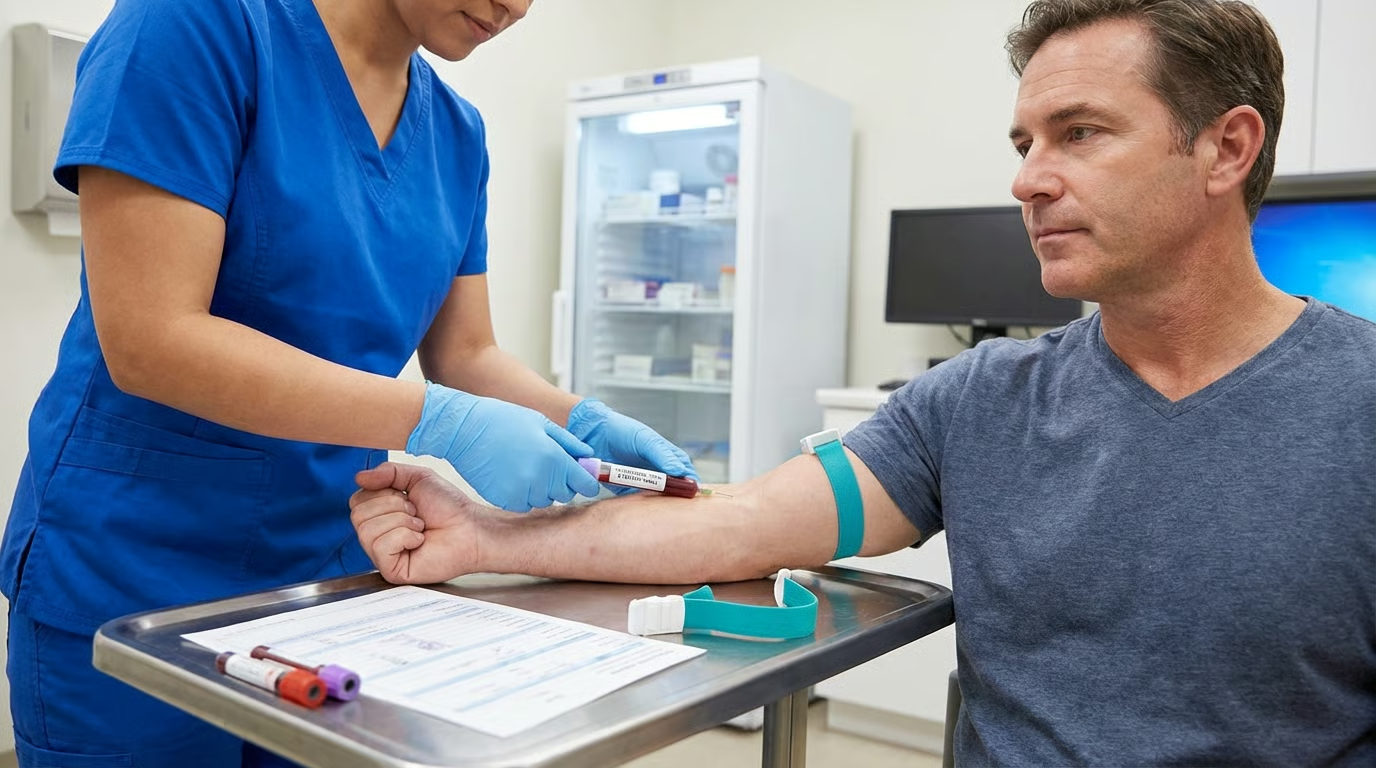
Call your doctor, go to a men’s health clinic, or use a telehealth platform. Say the words “I’d like to get my testosterone levels checked.” They’ll order a blood panel. You go to a lab in the morning, fasting, between 7 and 10 AM. Five minutes. One arm. You’ll survive it.
Step 2: Get a second blood test.
If the first result comes back low, you do it again on a different morning. Two tests, two mornings. One bad result could be a fluke. Two bad results means something is going on.
Step 3: Talk to a qualified provider.
If both results confirm low testosterone, sit down with a provider who knows what they’re doing—a urologist, an endocrinologist, a sharp primary care doc, or a reputable telehealth clinic. They’ll review your numbers, explain your options, walk through the risks, and help you decide. If at any point the provider seems uninterested in your blood work or rushes through the risks, find a different provider.
Step 4: Start treatment and follow up.
Your doctor will check your blood at 6 weeks, again at 3 months, and then every 6 to 12 months. They’ll adjust your dose based on your levels and how you feel. This is an ongoing relationship between you, your provider, and your lab results. Not a prescription you fill once and forget about.
[For a deeper dive into dosing protocols, lab monitoring, insurance details, and telehealth vs. in-person options, see our complete TRT Guide.]
Frequently Asked Questions About TRT
Is TRT the same as steroids?
No. TRT uses small, doctor-prescribed doses to restore testosterone to normal levels (500–900 ng/dL). Anabolic steroid abuse uses doses 10 to 100 times higher to push levels far beyond normal. TRT is medically supervised and monitored. Steroids, when abused, are neither as it is a Schedule III controlled substance.
How long do you stay on TRT?
For most men, TRT is a long-term or lifelong treatment. Your body reduces its own testosterone production while you’re on therapy, so stopping means your levels will drop until natural production recovers—which can take months. Some men use TRT temporarily while addressing underlying causes like obesity or sleep apnea, but the majority stay on it indefinitely under medical supervision.
Can TRT affect fertility?
Yes. Exogenous testosterone suppresses sperm production, sometimes significantly. If you’re planning to have children, tell your doctor before starting. Options like hCG (human chorionic gonadotropin) can be prescribed alongside TRT to help maintain sperm production and testicular function.
What happens if you stop taking TRT?
Your testosterone levels will drop, often below where they were before you started, because your body’s natural production has been suppressed during treatment. Most men experience a return of low testosterone symptoms. Recovery of natural production can take weeks to months. Your doctor can help you taper off safely if needed.
Do you need a prescription for TRT?
Yes. Testosterone is a Schedule III controlled substance in the United States. You need a prescription from a licensed physician, which requires a documented diagnosis of low testosterone confirmed by blood work. You cannot legally obtain testosterone for TRT without one.
The Bottom Line
Here’s the simplest version of everything you just read.
Testosterone is a hormone your body needs. Sometimes your body stops making enough. When that happens, you feel worse in a bunch of ways that are easy to blame on other things. Testosterone replacement therapy is a medical treatment that puts your levels back to normal, under a doctor’s supervision, with regular blood work to keep everything on track. It’s well-studied, it’s effective, and it’s more affordable than most people think.
The hardest part is the first part. Not the needle. Not the lab visit. The hardest part is deciding that the way you’ve been feeling isn’t just “how it is now.” It’s admitting something might be off, and that the manly thing to do isn’t to push through it—it’s to find out what’s wrong.
So if any of this sounded familiar—if you’ve been running at half-speed and calling it normal—go get a blood test. It costs you one early morning and a needle prick. If your testosterone is fine, you’ve ruled something out and you can move on. But if it’s not fine, you now know exactly what the problem is, exactly what the solution looks like, and exactly where to start.
That’s the whole point of a beginner’s guide. Not to make you an expert. Just to make sure the next step—whatever it turns out to be—is one you can take with your eyes open and your feet on solid ground.
The guys who actually fix this aren’t smarter than you. They just stopped waiting.
Limitless Alternative Medicine does the labs, the diagnosis, and the treatment plan — all under one roof, with doctors who specialize in exactly this.
When people start testosterone therapy, one question comes up fast: testosterone injections vs gel vs pellets. Which one actually works best? Which one fits your life without turning it upside down?
Here’s the thing. Most clinics talk science. Few talk real life. You don’t just want numbers on a lab report. You want steady energy. Better mood. Solid workouts. A sex drive that doesn’t disappear at 3 p.m. And you don’t want a complicated routine you’ll quit in three weeks.
This guide breaks down testosterone injections vs gel vs pellets. What each method feels like day to day, what it costs, how safe it is, and who it tends to work best for. By the end, you’ll know exactly which route makes sense for you and your schedule.
Testosterone Injections vs Gel vs Pellets vs Patches: How Each Method Works
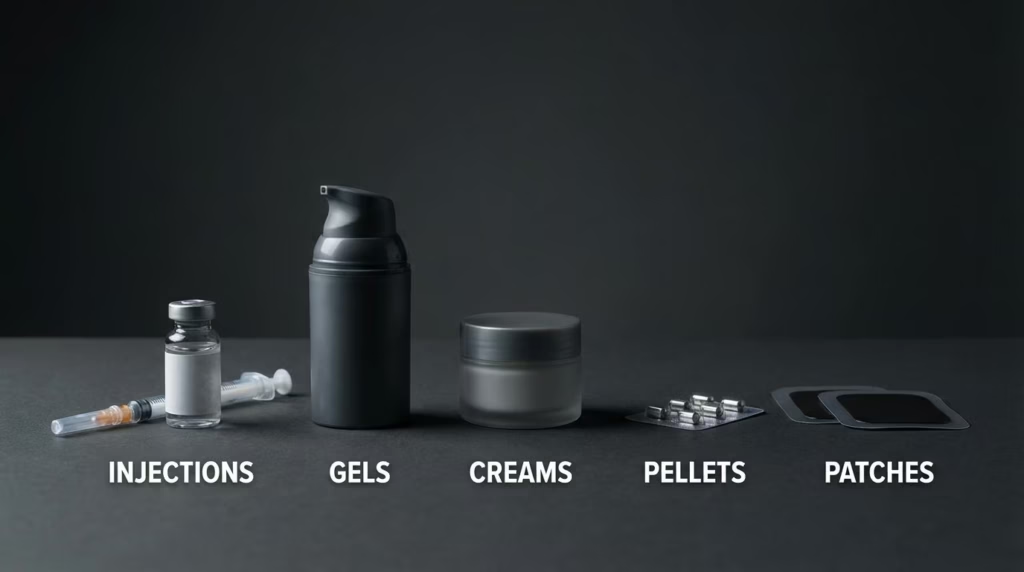
Before comparing testosterone injections vs gel vs pellets, you need a simple picture of how each delivers testosterone into your body. They all raise levels, but the delivery system changes everything.
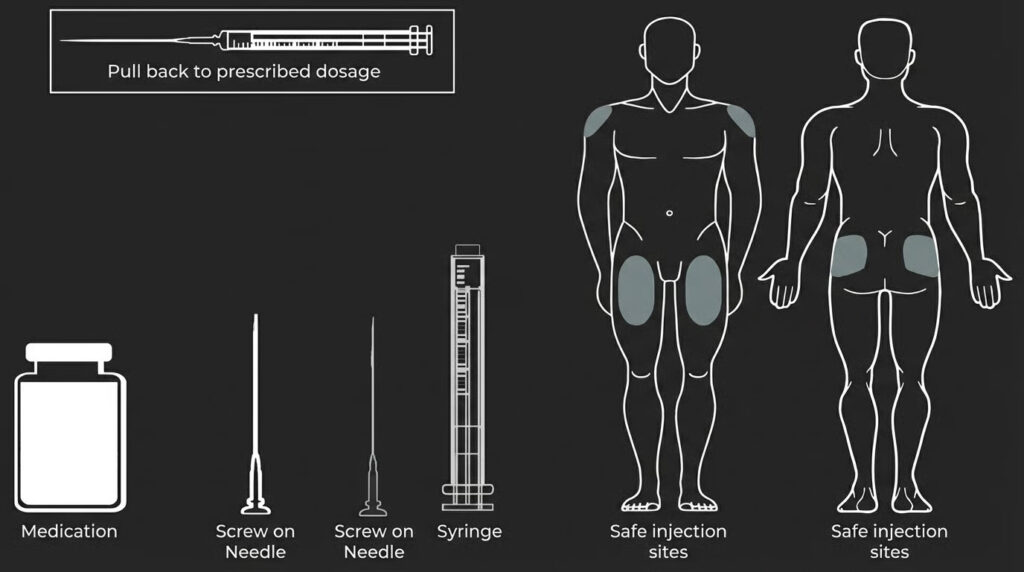
Injections go straight into muscle or fat. You inject once or twice weekly. Testosterone enters quickly, then slowly declines until your next dose. Think of it like refilling a tank.
Gels/Creams absorb through your skin. You rub them on daily, usually shoulders or arms. Levels rise gradually and stay fairly even, assuming you apply consistently.
Pellets are tiny implants placed under the skin by a provider. They release testosterone slowly for three to six months. No daily work. No weekly shots.
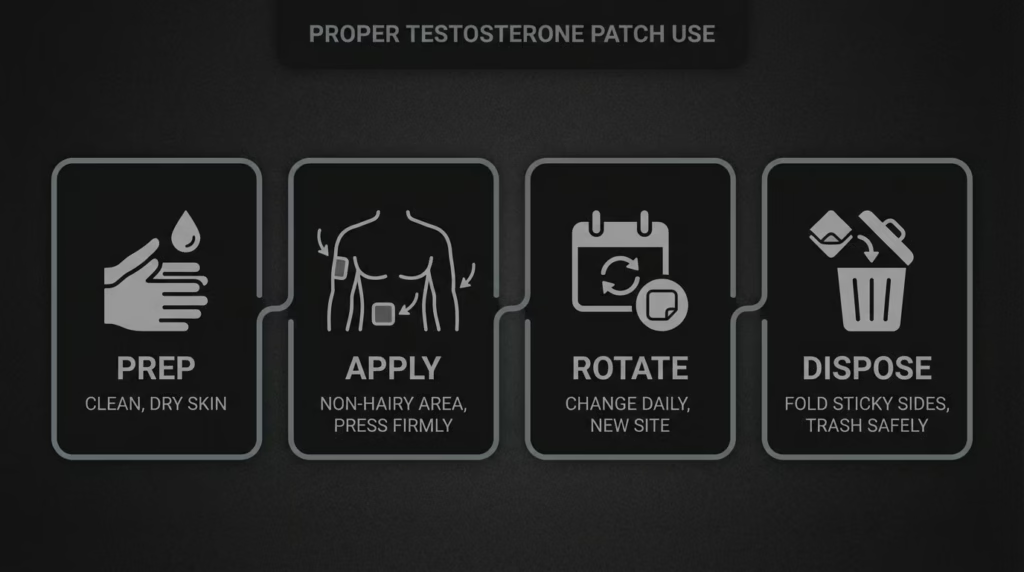
Patches are worn on the skin, usually roatetd between sites. They deliver consistent 24-hour release with consistency and stability throughout the day. No weekly shots or ups and downs on how you feel.
Testosterone Injections: The Most Popular and Cost-Effective Option
When people compare testosterone injections vs gel vs pellets, injections usually win on price and control. There’s a reason clinics prescribe them first. They work. Plain and simple.
Most men inject once or twice per week using testosterone cypionate or enanthate. You control your dose, and you can adjust fast if something feels off. Energy spikes within days. Strength returns quickly. Libido often rebounds in week one or two.
But it’s not perfect.
Some people feel “peaks and valleys.” Day two feels amazing. Day six feels flat. Splitting doses helps, but you still notice fluctuations. And yes, you’ve got to be okay with needles.
The upside? Cost. Injections are often the cheapest form of TRT. They’re also widely studied. Organizations like the U.S. Food and Drug Administration approve injectable testosterone, and it’s been used for decades.
Bottom line. If you’re comfortable learning a quick weekly routine, injections are hard to beat.
Testosterone Gel: Easy, Needle-Free, and Steady
Now let’s talk about the quieter option in the testosterone injections vs gel vs pellets debate. Gel doesn’t get flashy reviews, but some people swear by it.
You apply it every morning. Takes 30 seconds. Done.
Because it absorbs slowly through skin, hormone levels stay smoother than injections. Many users report fewer mood swings and less crash. It feels… natural. Like your body just decided to cooperate again.
Sounds perfect, right?
Well, there’s a catch. You must apply daily. Miss a day and levels dip fast. Plus, there’s transfer risk. If someone touches the application site too soon, they could absorb testosterone. That’s not great for partners or kids.
Gels also cost more than injections and insurance coverage varies. That surprises people.
Still, if needles make you tense or you want steady levels with zero medical gear, gel can be a great fit.
Testosterone Pellets: Set It and Forget It
Pellets are the wildcard in testosterone injections vs gel vs pellets. Some people love them. Others try once and never go back.
Here’s how they work. Your provider inserts small pellets under the skin, usually in the hip or glute. The procedure takes about 10 minutes. After that, testosterone releases slowly for months.
No daily gel. No weekly shots. Nothing to remember.
Honestly, that freedom feels amazing.
But there’s less flexibility. If the dose is too high or too low, you can’t easily adjust. You’re stuck until the pellets dissolve. Minor soreness after insertion is common too.
Cost tends to be higher, and you need in-office visits. Still, if convenience is everything and you hate maintenance, pellets might be worth it.
Testosterone Patches: A Middle-Ground Option Worth Considering
When people debate testosterone injections vs gel vs pellets, patches rarely get mentioned. That’s a bit unfair. They sit quietly in the middle and, for some folks, they’re actually a sweet spot.
A testosterone patch sticks to your skin and releases hormone slowly over 24 hours. You apply a fresh one daily, usually on your back, thigh, or upper arm. No needles. No messy gel. Just peel, stick, and move on with your day.
Sounds simple, right? It usually is.
Because delivery is steady, patches can produce smoother testosterone levels than weekly injections. Many users say mood and energy feel more stable, with fewer ups and downs. It’s similar to gel in that way, just less hands-on once applied.
But let’s be honest. There are trade-offs.
Skin irritation is the big one. Redness, itching, or small rashes happen more often with patches than with gels. Some people rotate sites and do fine. Others get annoyed fast and quit. Adhesion can also be tricky if you sweat a lot or train hard.
Cost usually lands between injections and gels. Not dirt cheap, but not the most expensive either. Insurance coverage varies, so it’s worth checking before committing.
So where do patches fit in the testosterone injections vs gel vs pellets decision?
They’re great if you want steady levels like gel, but without worrying about transferring medication to a partner or kids. They’re also useful for people who hate needles but don’t want daily liquid application.
Patches aren’t flashy, but they’re practical. And sometimes practical is exactly what you need.
Side Effects and Safety: What Most Clinics Don’t Explain Well
When comparing testosterone injections vs gel vs pellets, safety matters more than convenience. You don’t want great energy at the expense of your health.
All methods share similar risks. Elevated red blood cell count. Acne. Possible fertility suppression. These aren’t scary if monitored, but you must test regularly.
Bloodwork every three to six months isn’t optional. It’s how you stay safe.
Delivery method does change some side effects. Injections can cause swings. Gel may irritate skin. Pellets can bruise or get infected at the insertion site.
No option is risk-free. But when done right, TRT is generally well tolerated.
Money and routine matter more than people admit. You can pick the “best” protocol on paper and still quit if it annoys you daily.
So let’s talk real life.
Injections are usually cheapest. A few dollars per week if you pay cash. Gels cost more, especially brand names. Pellets are often the most expensive upfront but spread across months.
Convenience flips that order. Pellets win for ease. Gel comes next. Injections require the most hands-on effort.
Ask yourself simple questions. Do you travel a lot? Hate needles? Forget daily habits? Want tight dose control?
Your answers matter more than online opinions.
Testosterone Injections vs Gel vs Pellets: How to Choose Your Best Fit
By now, you’ve probably noticed something. The testosterone injections vs gel vs pellets debate isn’t about which is “best.” It’s about which you’ll actually stick with.
If you want control and low cost, injections win. For smooth levels and no needles, gel makes sense. If you want zero maintenance, pellets are appealing.
I’ll be blunt. Most people start with injections. They’re flexible and affordable. After a year, some switch once they know their body better.
And that’s okay. TRT isn’t permanent in one form. You can pivot.
Conclusion: Testosterone Injections vs Gel vs Pellets Comes Down to Your Life
So where do we land with testosterone injections vs gel vs pellets?
There isn’t a magic winner. There’s only what fits you.
If you don’t mind weekly shots and want maximum control, injections are practical and proven. It provides you with a simple daily routine and steady levels, gel feels smooth and predictable. If you crave freedom from both, pellets offer long stretches without thinking about hormones at all.
Think about your habits, budget, and tolerance for maintenance. Then choose the method you’ll actually follow. Because consistency beats perfection every time. When it comes to testosterone injections vs gel vs pellets, the best option is the one you’ll stick with for the long haul.
Because TRT isn’t about the “perfect” method. It’s about momentum.
Book the consult. Get the bloodwork. Start the protocol.
Then improve it over time.
That’s how you build energy, strength, and drive that compound for years instead of months.
Maybe your gym progress stalled or your doctor mentioned “low T” on a lab report.
And now you’re wondering if testosterone therapy is the fix.
But how does TRT work?
It’s actually simple biology.
Your body isn’t making enough testosterone, so therapy brings levels back to a healthy range. That’s it at a high level. But the details matter. Dosage, delivery method, monitoring, and expectations can make or break your results.
This guide walks you through it step by step. No fluff. No scare tactics. Just straight talk so you can decide if TRT makes sense for you.
What Testosterone Actually Does in Your Body (And Why Levels Matter)
Before you can answer how does TRT work, you need to understand what testosterone does in the first place. This hormone isn’t just about muscle or libido like most ads suggest. It helps regulate mood, bone density, red blood cell production, fat storage, and even how sharp your brain feels. When levels drop, the whole system slows down like a phone stuck in low-power mode.
Think of testosterone as a volume knob. Too low and everything feels muted. Energy dips, workouts drag, sleep suffers, and motivation fades. You might still function, but you’re not operating at full strength. That’s why doctors don’t treat symptoms alone. They look at labs and how you feel together.
If you want a deeper look at the science of low levels and age ranges, check out Normal Testosterone Levels by Age. Seeing numbers in context helps you know whether you’re truly low or just tired.
Research from The National Institutes of Health, also shows how broad testosterone’s role really is. It’s not just a “men’s hormone.” It’s a whole-body regulator.
So when someone asks how does TRT work, the real answer starts here. You’re not chasing a cosmetic boost. You’re restoring a basic biological signal your body depends on every day.
How Does TRT Work Inside Your Body? The Simple Mechanism
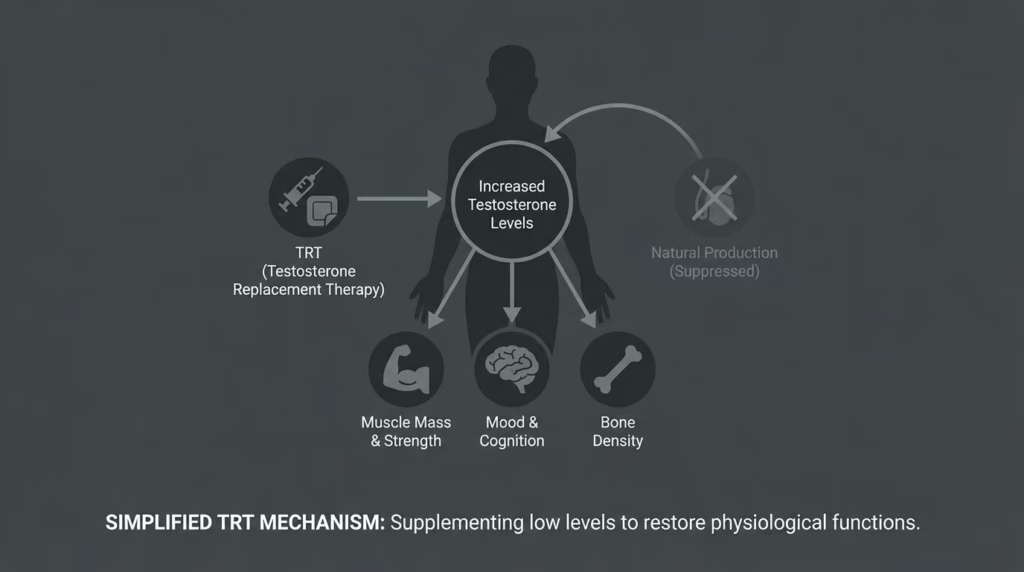
Let’s break it down without the medical jargon. How does TRT work at the most basic level? You replace the testosterone your body isn’t making enough of. That added hormone enters your bloodstream, binds to receptors in your cells, and tells your tissues to behave like they did when levels were normal.
Once testosterone hits those receptors, things start changing quietly. Muscle protein synthesis improves. Fat metabolism picks up. Your brain gets stronger neurotransmitter support. Red blood cell production increases. It’s not magic. It’s chemistry doing what it’s supposed to do.
Here’s the catch people miss: your body also notices the extra hormone and may reduce its own production. That’s why medical supervision matters. Dosing too high or too fast can throw off your natural feedback loops. This isn’t a “more is better” situation. It’s about balance.
If you’re brand new to the topic, you might want to start with the Complete Guide to TRT. It lays out expectations so you don’t fall for internet myths.
Who Is TRT Actually For? Signs You Might Be a Candidate
Not everyone who feels tired needs therapy. Coffee exists for a reason. But there’s a difference between “had a bad week” tired and “something’s wrong” tired. If you’re constantly drained, losing strength despite training, gaining belly fat out of nowhere, or dealing with low libido and brain fog, it’s worth asking how does TRT work for someone like you.
Doctors usually look for both symptoms and blood tests. Two separate morning labs showing low testosterone is standard. One low reading alone doesn’t mean much. Sleep, stress, or illness can temporarily tank numbers.
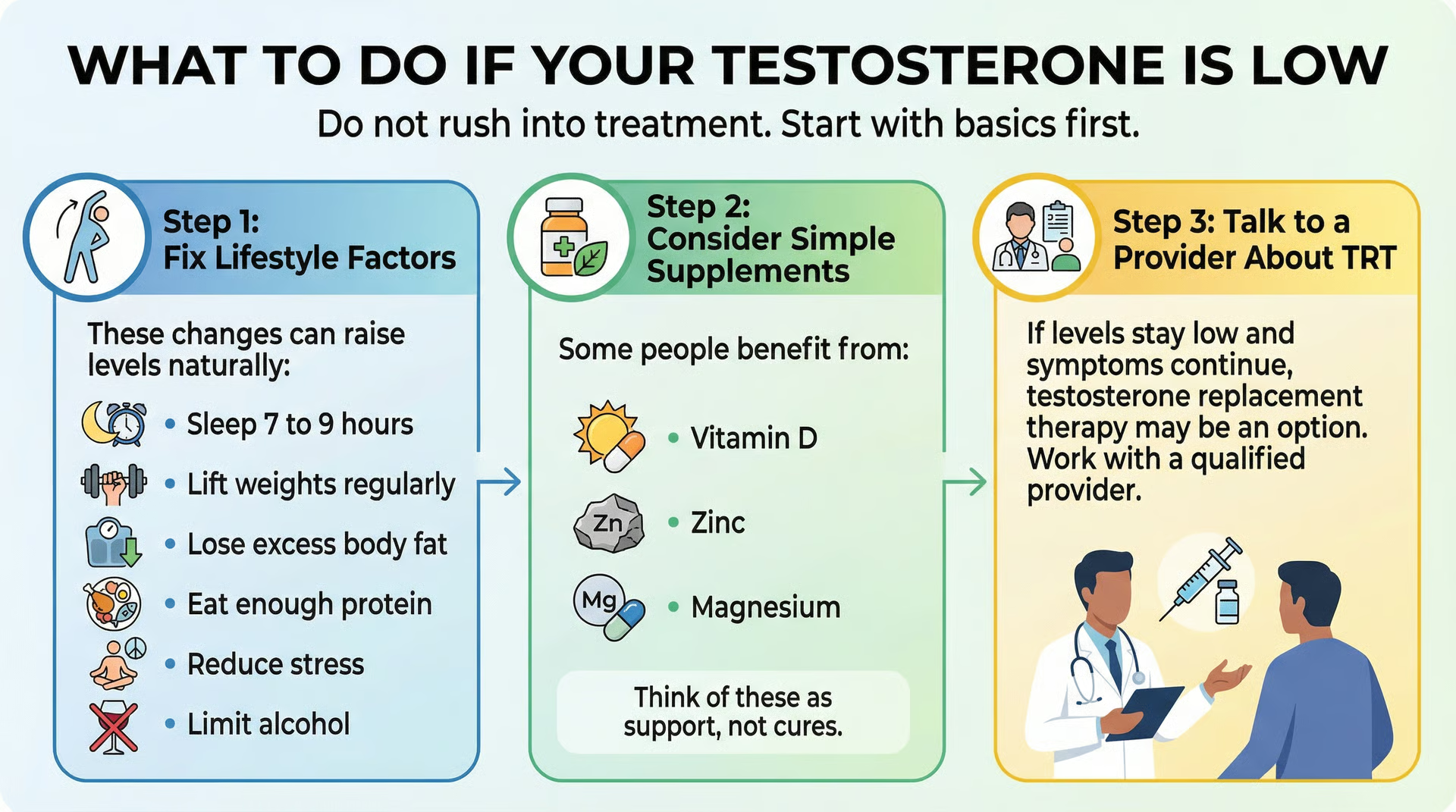
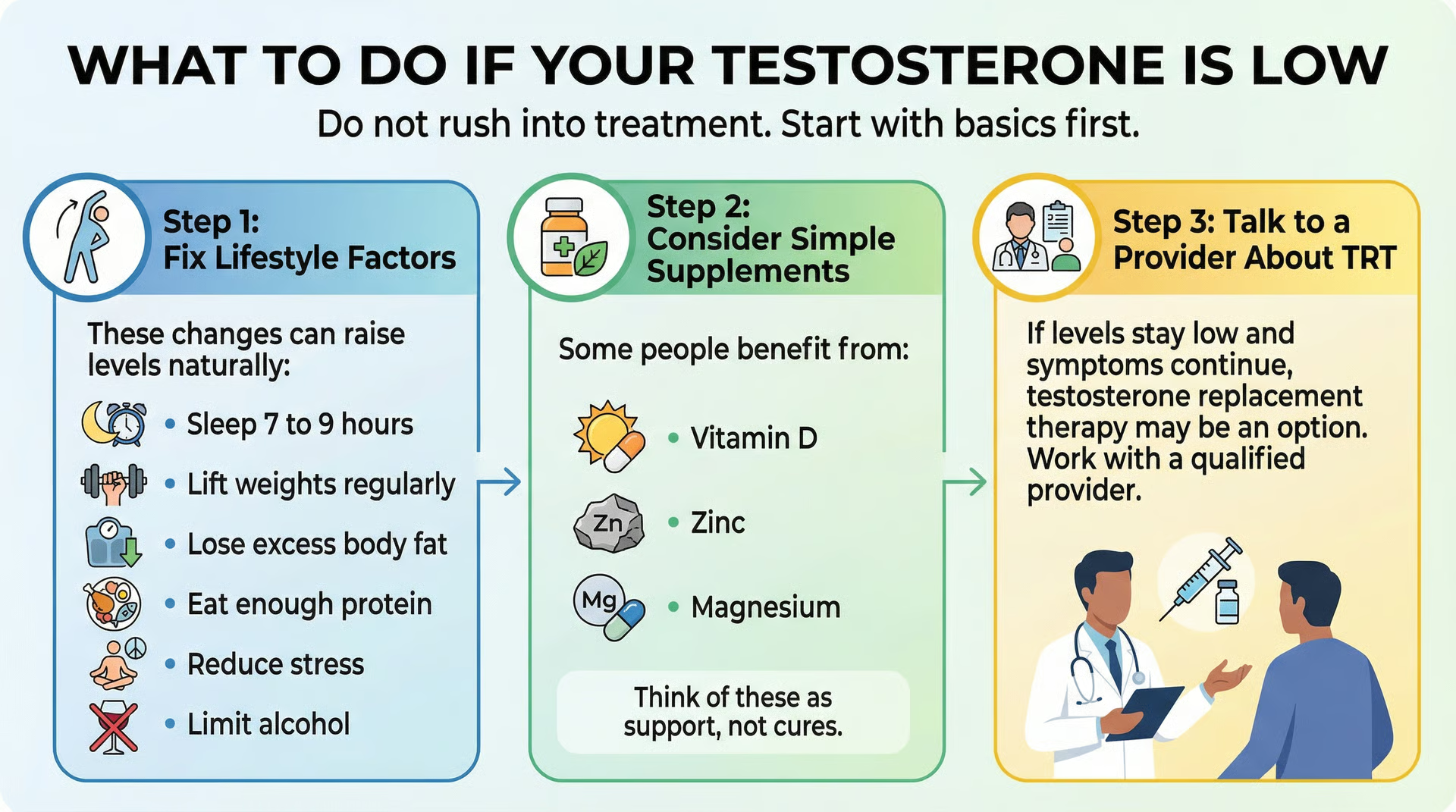
Lifestyle still comes first. Sleep more. Lift weights. Eat protein. Lose excess fat. You’d be surprised how many people fix mild issues naturally.
At that point, asking how does TRT work stops being theoretical. It becomes personal. And that’s when a real evaluation matters.
The Different Types of TRT: Injections, Gels, and More
Once you understand how does TRT work, the next question is how you’ll actually take it. There isn’t just one method. Each option delivers testosterone differently, and each has pros and cons.
Injections
Shots are the most common and often the most affordable. You inject once or twice a week, levels rise, then slowly taper until the next dose. Many people like the control and steady results.
Gels and creams
Topicals absorb through the skin daily. They’re easy but can transfer to partners or kids if you’re careless. Consistency matters. Miss a day and levels dip fast.
Pellets and patches
Pellets last months but require a small procedure. Patches are simple but can irritate skin. Fewer people use them, but they’re options.
None of these change how does TRT work biologically. They just change delivery speed and convenience. Your doctor helps you pick based on lifestyle and budget.
What Changes to Expect (And What Not to Expect)
Let’s be honest. Some marketing makes TRT sound like a superhero serum. It’s not. How does TRT work in real life? Gradually. Quietly. Over months.
In the first few weeks, many people notice better sleep and mood. Libido often improves early too. Around months two to three, strength and recovery start climbing. Body composition changes take longer, especially if diet and training aren’t dialed in. TRT supports effort. It doesn’t replace it.
What doesn’t happen? You don’t wake up shredded. You don’t gain twenty pounds of muscle without lifting. And you don’t feel euphoric 24/7. Anyone promising that is selling fantasy.
If you’re focused on maximizing results, it is important to build a nutrition plan that can help you match your hormones with smart eating.
So again, how does TRT work? It creates the conditions for normal function. You still have to show up and do the work.
Safety, Side Effects, and Monitoring
This section matters more than any sales pitch. How does TRT work safely? With monitoring. Period.
Testosterone can raise red blood cells, affect cholesterol, and suppress natural production. None of these are automatically dangerous, but they need tracking. Good clinics run labs every few months and adjust doses. Bad ones just refill prescriptions and hope for the best. Don’t trust the second group.
Common side effects can include acne, fluid retention, or mood swings when doses are too high. Fertility can also drop because your body slows its own sperm production. If kids are in your future, say that upfront. There are ways to protect fertility.
When someone casually asks how does TRT work, they often ignore this safety piece. But long-term success depends on labs, communication, and realistic dosing. Treat it like healthcare, not a shortcut.
Cost, Commitment, and Long-Term Thinking
Here’s the uncomfortable truth. Starting therapy isn’t like taking a short course of antibiotics. How does TRT work long term? It works as long as you’re on it. Stop, and levels usually fall back to baseline.
That means cost matters. Medication, labs, and appointments add up. Some insurance plans help. Others don’t. Budget realistically so you’re not forced to quit halfway through.
It’s also a lifestyle decision. Weekly injections. Routine labs. Paying attention to sleep and training. For many people it’s worth it, but you should go in clear-eyed.
Personally, I think TRT makes sense when symptoms are real and numbers confirm it. But chasing it because a podcast said “optimize everything”? That’s shaky logic. Ask yourself why you want it.
When you understand how does TRT work, you realize it’s maintenance, not a quick fix. And maintenance requires commitment.
Conclusion: So, How Does TRT Work and Is It Right for You?
By now you’ve seen the big picture. How does TRT work? It replaces missing testosterone, restores normal signaling, and helps your body function the way it used to. It’s steady, predictable biology, not a miracle. When paired with training, sleep, and smart nutrition, it can feel life-changing. When used carelessly, it’s just another hassle.
If symptoms and labs both point to low levels, talk with a qualified provider and get real data. If your numbers are fine, focus on lifestyle first. Either way, knowledge beats guesswork. The more you understand how does TRT work, the easier it is to make a decision you won’t regret six months from now.
Here’s the deal. You can keep feeling like garbage and wondering “what if,” or you can get your levels checked and actually do something about it. Limitless Alternative Medicine makes it stupid simple — labs, consult, treatment plan, done. No waiting rooms. No BS. Go to limitlessaltmed.com and book a free consultation. Worst case, you find out you’re fine. Best case, you get your life back.
Complex health issues, insurance users, hands-on preference
Monthly Cost
$99–$250 (all-inclusive)
$150–$500+ (varies by billing)
Speed to Start
2–3 weeks
1–3 months
Lab Work
Local draw or at-home kit
On-site or local lab
Insurance
Rarely accepted
Often accepted
Physical Exams
Video-only
Full in-person exam
An online TRT clinic wins on convenience and cost predictability. In-person care wins on hands-on exams and insurance coverage. The best choice depends on your health complexity, budget, and lifestyle.
What Is an Online TRT Clinic? How It Works
An online TRT clinic delivers testosterone replacement therapy through telehealth instead of a physical office. You handle consultations via video call, get lab orders sent to a local testing center (or use an at-home kit), and have prescriptions shipped directly to your door.
Here’s the typical process:
Online intake — Answer questions about symptoms like fatigue, low libido, brain fog, or stubborn weight gain
Lab work — Complete bloodwork at a local lab or with an at-home collection kit
Provider review — A licensed physician reviews your results and symptoms
Treatment plan — If you qualify, you receive a personalized TRT protocol
Medication delivery — Testosterone and supplies ship to your home monthly
The convenience factor is the main draw. For men juggling careers, families, and packed schedules, an online TRT clinic removes the friction of office visits, waiting rooms, and pharmacy trips.
But convenience alone isn’t everything. The quality of care matters just as much—and that varies significantly between providers.
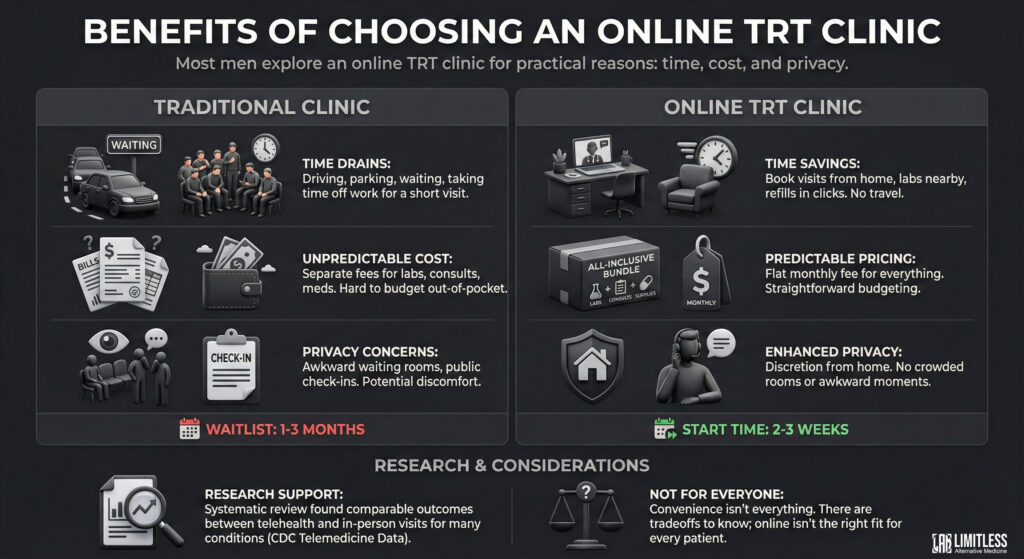
Most men explore an online TRT clinic for practical reasons: time, cost, and privacy.
Time Savings
Traditional clinics require driving, parking, waiting, and often taking time off work—all for a 10-minute conversation. An online TRT clinic eliminates that. You book visits from home, complete labs at a nearby facility, and handle refills with a few clicks.
Predictable Pricing
Many telehealth TRT providers bundle everything—labs, consultations, medications, and supplies—into a flat monthly fee. That makes budgeting straightforward, especially if you’re paying out of pocket.
Privacy
Some men feel uncomfortable discussing low testosterone in a crowded waiting room. Telehealth offers discretion. You talk to your provider from home with no awkward check-in moments.
Faster Start Times
Most online services initiate treatment within two to three weeks. Local endocrinologists and urologists often have waitlists stretching one to three months. When you’re exhausted and foggy every day, that difference matters.
Research continues to support the effectiveness of virtual care for appropriate patients. A systematic review published during the pandemic found comparable outcomes between telehealth and in-person visits for many conditions (CDC Telemedicine Data).
Still, an online TRT clinic isn’t the right fit for everyone.
Still, convenience isn’t everything. There are tradeoffs you need to know.
When In-Person TRT Visits Make More Sense
Telehealth works well for straightforward cases. But sometimes face-to-face care is the smarter move.
Complex Health Histories
If you have cardiovascular disease, diabetes, sleep apnea, or a history of prostate issues, in-person evaluation adds a layer of safety. Physical exams catch things video calls can’t—blood pressure readings, body composition changes, and other clinical signs.
Preference for Human Connection
Some men simply trust in-person conversations more. That rapport with a physician you can shake hands with matters to them. If that’s you, honor it.
Accountability
When you physically show up to appointments, you’re less likely to skip labs or delay follow-ups. With an online TRT clinic, it’s easy to procrastinate. “I’ll schedule labs next week” becomes three months.
Insurance Coverage
Many brick-and-mortar clinics accept insurance. Most online TRT services operate on a cash-pay model. If your coverage is solid, in-person care might actually cost less long-term.
If you want to know how insurance fits into TRT costs, check this breakdown: Does Insurance Cover TRT
Initial consultation, blood work, unlimited support, customized prescription, all follow-up appointments and labs Fin vs Fin
—
Premium concierge experience; any dosage
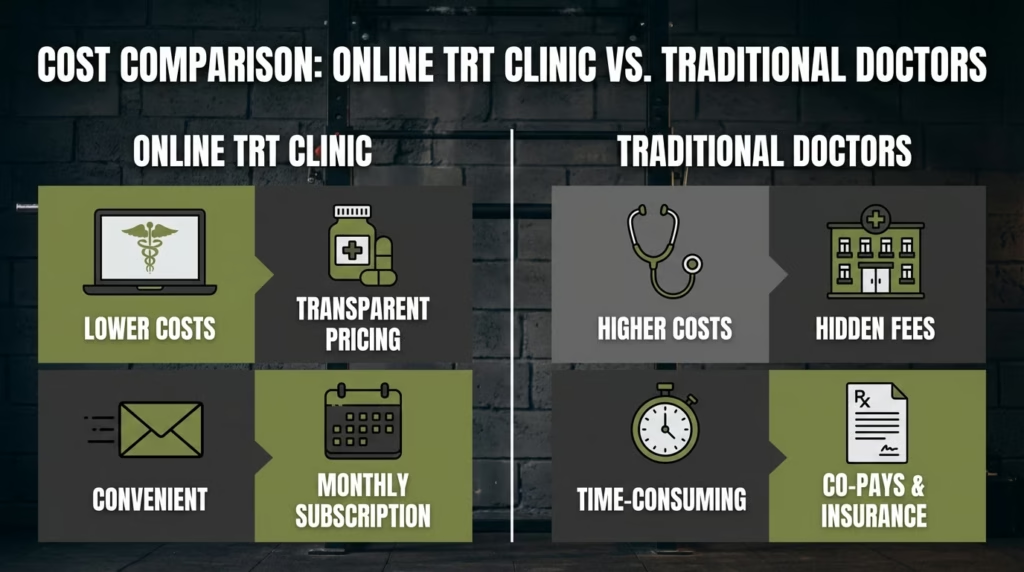
Most online TRT clinics charge $99 to $250 per month depending on medication type, dosing, and included services.
Traditional In-Person Costs
In-person clinics typically bill separately:
Initial consultation: $150–$300
Lab work: $100–$400 (depending on panel)
Follow-up visits: $75–$200 each
Medication: $40–$200/month (varies by pharmacy and type)
One month might cost $90 with insurance. The next might hit $400 if labs are due.
The Real Comparison
If you’re self-paying: An online TRT clinic usually wins. Bundled pricing removes surprises.
If insurance covers most costs: Traditional clinics can be surprisingly affordable. Run the math on your specific plan.
Watch for hidden fees: Some online services charge extra for needles, shipping, “premium support,” or specific medications. Read the fine print.
Is an Online TRT Clinic Safe? Monitoring & Quality
This is the part that matters most. Testosterone therapy changes your hormones. That means proper monitoring is non-negotiable.
What Good Monitoring Looks Like
A responsible online TRT clinic should order labs:
Before treatment — Baseline total testosterone, free testosterone, estradiol, hematocrit, PSA, lipid panel, liver enzymes, metabolic panel
6–8 weeks after starting — To assess response and adjust dosing
Every 3–6 months ongoing — To ensure safety and optimize levels
Lab Markers to Track
Marker
Why It Matters
Total Testosterone
Primary measure of therapy effectiveness
Free Testosterone
The usable, unbound portion
Hematocrit
TRT can thicken blood; elevated levels increase clot risk
Estradiol (E2)
Testosterone converts to estrogen; imbalances cause side effects
PSA
Monitors prostate health
Lipid Panel
TRT can affect cholesterol
Liver Enzymes
Monitors metabolic health
Red Flags to Avoid
If any online TRT clinic does the following, walk away:
Prescribes testosterone without lab work
Doesn’t require follow-up labs after starting
Has no licensed physicians on staff (only “coaches”)
Won’t let you speak directly with a clinician
Pushes unnecessarily high doses
A quality telehealth provider can be just as thorough as an in-person clinic. But not all platforms are equal. Some are essentially prescription mills. That’s risky.
An online trt clinic can be just as safe as in-person care. But only if it’s run responsibly.
Normal Testosterone Levels by Age
Understanding where your levels fall helps you evaluate whether treatment makes sense.
Total Testosterone Reference Ranges (ng/dL)
Age
Normal Range
Low T Cutoff
20–24
409–558
Below 409
25–29
413–575
Below 413
30–34
359–498
Below 359
35–39
352–478
Below 352
40–44
350–473
Below 350
45+
300–600 (varies)
Below 300
Source: Journal of Urology (2022), American Urological Association
The traditional 300 ng/dL cutoff was developed from studies of older men. Research now shows younger men have higher normal ranges—and may experience symptoms even when technically “in range.”
Many men start noticing low T symptoms when levels drop into the 400s, even though that’s technically “normal.”
Choosing Based on Your Lifestyle
Here’s where things get personal.
Choose an Online TRT Clinic If You:
Travel frequently for work
Hate waiting rooms and prefer texting over phone calls
Want predictable monthly costs
Value privacy and discretion
Have a straightforward health history
Choose In-Person Care If You:
Have complex health conditions requiring physical exams
Prefer face-to-face accountability
Have good insurance coverage
Want access to additional services (ultrasound, comprehensive panels)
Stick to routines better with scheduled office visits
The Hybrid Approach
Some men use both. They manage prescriptions through an online TRT clinic for convenience but see a local urologist or endocrinologist annually for comprehensive exams. That combination can offer the best of both worlds.
Think about your real behavior—not your ideal behavior. Choose the setup you’ll actually stick with.
How to Choose the Right Online TRT Clinic
If telehealth is your move, don’t just pick the first ad you see.
Evaluation Checklist
✅ Licensed physicians — Not just “health coaches” or nurse practitioners working independently ✅ Comprehensive lab panels — At least 8–10 markers before treatment ✅ Clear follow-up protocol — Labs at 6–8 weeks, then every 3–6 months ✅ Direct clinician access — Can you message or call your provider? ✅ Transparent pricing — No hidden fees for supplies, shipping, or consultations ✅ Personalized dosing — Protocols adjusted based on your labs and symptoms ✅ Positive reviews — Look for mentions of follow-up care, not just fast shipping
Questions to Ask Before Signing Up
Are there any additional costs beyond the monthly fee?
How often will I have lab work done?
Who reviews my labs—a physician or someone else?
Can I message my provider directly between appointments?
A solid online trt clinic should feel like healthcare, not a supplement store. If it feels sketchy, trust your gut.
Online TRT Clinic Red Flags: What to Avoid
Not every telehealth provider operates responsibly. Here’s what should make you pause:
Red Flag
Why It’s a Problem
No lab work required
Can’t safely prescribe without baseline data
“One-size-fits-all” dosing
TRT requires individualized protocols
No follow-up labs scheduled
Impossible to monitor safety or effectiveness
Only “coaches” available
You need licensed physicians making medical decisions
Pressure tactics or urgency
Legitimate providers don’t rush you
Unusually low prices
May indicate corner-cutting on care quality
No clear refund or cancellation policy
Sign of poor business practices
Frequently Asked Questions
Is an online TRT clinic legitimate?
Yes, when properly run. Legitimate online TRT clinics employ licensed physicians, require comprehensive lab work before prescribing, and monitor patients with regular follow-up testing. Look for providers with transparent protocols and real physician oversight—not just coaches reading scripts.
How much does an online TRT clinic cost per month?
Most online TRT clinics charge between $99 and $250 per month. This typically includes consultations, lab coordination, and medication. Some providers bundle everything; others charge separately for labs or specific medications. Traditional in-person care may cost more or less depending on insurance coverage.
Can I get TRT without seeing a doctor in person?
Yes. Federal telehealth regulations allow qualified physicians to prescribe testosterone after a virtual consultation and lab review. You’ll complete bloodwork at a local lab or with an at-home kit, then consult via video call. Most states permit this model, though regulations vary.
How fast can I start TRT through an online clinic?
Most patients begin treatment within two to three weeks of their initial consultation. This includes time for lab work and provider review. Traditional specialists often have waitlists of one to three months.
Do online TRT clinics accept insurance?
Most do not. The majority operate on a cash-pay model with transparent monthly pricing. However, you may be able to submit claims for out-of-network reimbursement depending on your plan. Some providers like OnMen (Canada) offer insurance integration.
What labs are required before starting TRT?
A responsible provider will order: total testosterone, free testosterone, estradiol, hematocrit, PSA, complete metabolic panel, lipid panel, and liver enzymes at minimum. Some clinics test 40+ markers for a more complete picture.
Is online TRT as safe as in-person treatment?
When properly monitored, yes. Safety depends on protocol quality—not location. The key factors are comprehensive baseline labs, regular follow-up testing, and responsive clinician oversight. A good online TRT clinic can provide all of these.
Final Verdict: Online TRT Clinic or In-Person?
If you want the short version:
An online TRT clinic usually wins on convenience, speed, and predictable costs. It’s ideal for men with straightforward health profiles who value flexibility and privacy.
In-person care often wins on hands-on exams, insurance coverage, and face-to-face trust. It’s better for men with complex health histories or those who prefer traditional medical relationships.
Neither option is perfect. Neither is wrong.
What matters most is consistent labs, responsible dosing, and a provider who actually listens. That can happen through a screen or across a desk.
Choose the setup you’ll actually follow through with. Because the best testosterone treatment plan is the one you’ll keep.
Want the convenience of online TRT with real clinical oversight? Limitless Alternative Medicine offers virtual consultations, at-home lab kits, and personalized protocols — all from providers who actually listen. [Book your free consultation] and see if TRT is right for you.
Why TRT Blood Test Requirements Matter for Safe Treatment
TRT blood test requirements exist because low testosterone shares symptoms with about two dozen other conditions. Depression. Thyroid dysfunction. Sleep apnea. Diabetes. They all do a very convincing impression of low T. Without proper bloodwork, your provider would essentially be guessing.
There’s also a safety component that doesn’t get talked about enough. Reputable clinics won’t touch you without baseline labs because they need to know where you started. If six months down the road your red blood cell count spikes or your liver enzymes go haywire, they need that original data to compare against. It protects you. It protects them. It’s the boring, responsible thing that makes all the exciting stuff possible later.
The Endocrine Society’s Clinical Practice Guideline on Testosterone Therapy (the closest thing this field has to a bible) specifically recommends that hypogonadism should only be diagnosed in men who have both symptoms consistent with testosterone deficiency and consistently low serum testosterone confirmed on at least two separate morning draws. Two. Not one. Because even your hormones have bad days.
Complete TRT Blood Test Panel: Every Lab You Need
Here’s a quick-reference summary of every test in a full TRT blood test panel, followed by a detailed breakdown of what each one tells your doctor.
TRT Blood Test Requirements: Summary Table
Test
What It Measures
Why It Matters for TRT
Total Testosterone
All testosterone (bound + free)
Determines if levels are clinically low
Free Testosterone
Unbound, usable testosterone
Often low even when total T is “normal”
SHBG
Protein that binds testosterone
Explains the gap between total and free T
Estradiol (E2)
Primary male estrogen
Baseline needed to manage aromatization on TRT
CBC (Complete Blood Count)
Red/white blood cells, hematocrit
TRT raises hematocrit — must monitor for clot risk
CMP (Comprehensive Metabolic Panel)
Liver, kidney, blood sugar, electrolytes
Confirms organs can safely process exogenous testosterone
Lipid Panel
Cholesterol and triglycerides
TRT can shift lipid profiles in either direction
PSA (Prostate-Specific Antigen)
Prostate health marker
Baseline needed to monitor prostate during treatment
LH & FSH
Pituitary signaling hormones
Distinguishes primary from secondary hypogonadism
Thyroid Panel (TSH, Free T3, Free T4)
Thyroid function
Rules out thyroid dysfunction mimicking low T
Prolactin
Pituitary hormone
Elevated levels suppress testosterone; may indicate adenoma
Vitamin D
Vitamin D status
Deficiency linked to lower testosterone production
Ferritin
Iron storage
Low iron causes fatigue often mistaken for low T
Total Testosterone and Free Testosterone: The Core TRT Blood Tests
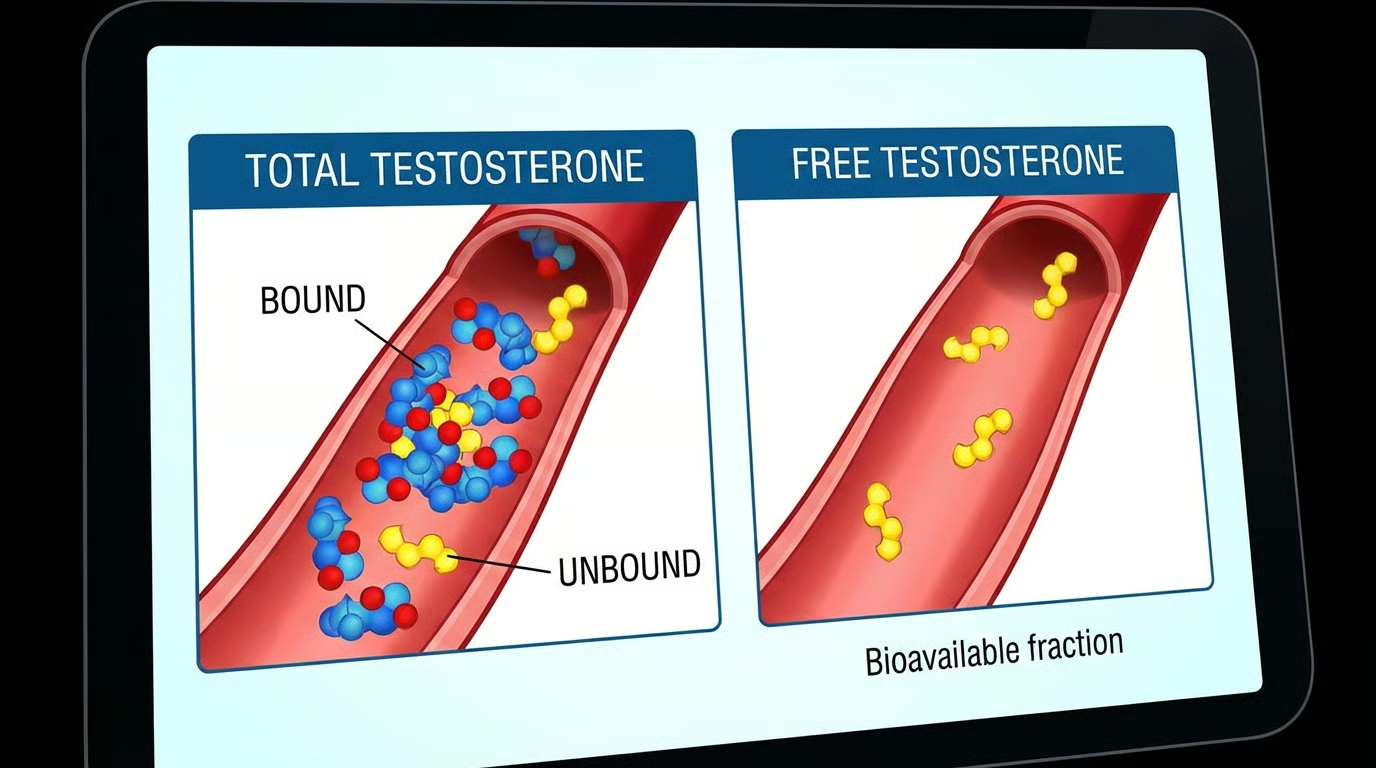
Total Testosterone is the headliner. This measures all the testosterone in your bloodstream, both the stuff bound to proteins and the stuff floating free. Most labs call anything between 300–1,000 ng/dL “normal,” but there’s an enormous, contentious, surprisingly emotional debate about what “normal” even means. A 35-year-old sitting at 310 ng/dL is technically in range. He’s also probably feeling like a phone at 4% battery. Context matters. A good provider looks at your number in relation to your age, your symptoms, your life. Not just whether it clears some arbitrary threshold.
Free Testosterone is, arguably, the more important number, and it’s the one a lot of providers forget. Only about 2–3% of your testosterone is actually “free,” meaning available for your body to use. The rest is bound to proteins like SHBG and albumin, just riding around doing nothing, like a guy on a bus who missed his stop and is too polite to say anything. You could have decent total testosterone and rock-bottom free T, and you’d still feel terrible. Make sure this is on your panel.
SHBG and Estradiol: The Hormones That Shape Your TRT Protocol
Sex Hormone-Binding Globulin (SHBG) is the protein that determines how much of your testosterone is free versus bound. High SHBG grabs your available testosterone and holds it hostage. Low SHBG can signal other metabolic issues. Either way, this number helps your doctor understand the full equation, not just the headline.
Estradiol (E2) is a form of estrogen, and yes, men produce it. When you start TRT, your body converts some testosterone into estradiol through a process called aromatization, which is a lovely word for something that can become not-lovely fast. Too much estradiol: water retention, mood swings, breast tissue growth. Too little: joint pain, brain fog, a general feeling of wrongness. Baseline levels help your provider calibrate treatment and decide whether you’ll need an aromatase inhibitor down the road.
Blood Health and Safety Markers Required Before Starting TRT
Here’s where we shift from “what’s your testosterone doing” to “can your body actually handle this.” These are the tests that keep you safe. They’re not glamorous. They will never be the subject of a podcast. They matter enormously.
CBC: The TRT Blood Test That Monitors Clot Risk
Complete Blood Count (CBC) matters, and here’s why: TRT stimulates red blood cell production. That’s a well-documented effect. Sounds fine, right? More red blood cells, more oxygen delivery, more vitality? Sure, up to a point. Past that point, your blood gets thicker. And thicker blood is not the win it sounds like. Thicker blood means higher risk of clots, stroke, cardiovascular events. The kind of things that make you wish you’d been more careful.
A 2022 study published in The Journal of Urology looked at data from over 74 million patients and found that men who developed secondary polycythemia (hematocrit at or above 52%) while on testosterone therapy had a 35% increased risk of major adverse cardiovascular events and venous thromboembolism in the first year of treatment. Thirty-five percent. That’s not a rounding error. That’s why your doctor needs a baseline CBC and why they’ll keep checking it.
Metabolic Panel, Lipids, and PSA: Organ Function Before TRT
Comprehensive Metabolic Panel (CMP) covers liver function, kidney function, blood sugar, and electrolytes. Your liver processes testosterone. If your liver enzymes are already elevated, if your liver is already, metaphorically, working a double shift, piling TRT on top would be reckless. Same for kidneys. These organs are doing hard, unglamorous, essential work. Your provider needs to know they’re up to the task before adding to their workload.
Lipid Panel checks cholesterol and triglycerides. Testosterone can shift your lipid profile, sometimes for the better, sometimes not. If you’ve already got borderline cholesterol, your doctor might want to address that before or alongside starting therapy. This isn’t gatekeeping. This is making sure you don’t solve one problem by creating another.
Prostate-Specific Antigen (PSA) is required for men over 40, and frankly it’s smart for anyone starting TRT. Testosterone does not cause prostate cancer. That old myth has been largely put to rest. But testosterone can accelerate existing prostate conditions, which is a meaningful distinction. A baseline PSA gives your provider a reference point for all future monitoring.
Additional TRT Blood Tests Most Clinics Skip
Here’s where you find out how good your clinic actually is. The budget operations check your total T, maybe your CBC, and call it a day. A thorough provider goes further. And you should insist on it, even if it means being the slightly annoying patient. Be the slightly annoying patient. Your health is worth a little social discomfort.
LH and FSH: Diagnosing the Cause of Low Testosterone
Luteinizing Hormone (LH) and Follicle-Stimulating Hormone (FSH) tell your doctor why your testosterone is low, which turns out to be a fairly important question. Is the problem in your testes (primary hypogonadism) or in your brain’s signaling system (secondary hypogonadism)? This distinction changes everything. Secondary hypogonadism might respond to clomiphene or hCG, potentially making TRT unnecessary altogether. Without LH and FSH testing, you’re skipping a diagnostic step that could save you years of injections.
Thyroid Panel: Ruling Out the Most Common TRT Misdiagnosis
Thyroid Panel (TSH, Free T3, Free T4) is one I feel strongly about. Thyroid dysfunction mimics low testosterone almost perfectly. Fatigue. Weight gain. Brain fog. Low libido. The overlap is uncanny. I’ve seen forum after forum full of guys who jumped on TRT when their real issue was hypothyroidism. A simple, inexpensive thyroid panel could’ve saved them months of unnecessary medication and the particular frustration of treating the wrong thing.
Prolactin: The Overlooked TRT Blood Test That Can Save Your Health
Prolactin gets overlooked with startling frequency. Elevated prolactin suppresses testosterone production and causes symptoms like low sex drive and, in some cases, breast tissue growth. Here’s the thing that makes this one urgent: high prolactin sometimes indicates a pituitary adenoma. That’s a benign brain tumor. It sounds terrifying, but it’s actually very treatable if you catch it. The Pituitary Society’s international consensus statement, published in Nature Reviews Endocrinology, notes that prolactinomas account for roughly half of all pituitary adenomas and respond remarkably well to dopamine agonist medications like cabergoline. But you have to know it’s there first. Don’t skip this test.
Vitamin D and Ferritin: Deficiencies That Mimic Low Testosterone
Vitamin D and Ferritin might seem like they wandered in from a different appointment, but they’re connected to testosterone production in ways that matter. Vitamin D deficiency is linked to lower testosterone levels. Low ferritin (your iron storage marker) causes fatigue that looks identical to low T fatigue. Sometimes correcting these deficiencies improves testosterone on its own. No injections. No protocol. Just your body working the way it wants to when you give it what it needs.
How to Prepare for Your TRT Blood Tests
You can’t roll out of bed at 3 PM, grab a large coffee, and expect your bloodwork to mean anything. How and when you get your blood drawn matters. A lot. Testosterone fluctuates throughout the day, and certain behaviors can tilt your results in directions that don’t represent reality.
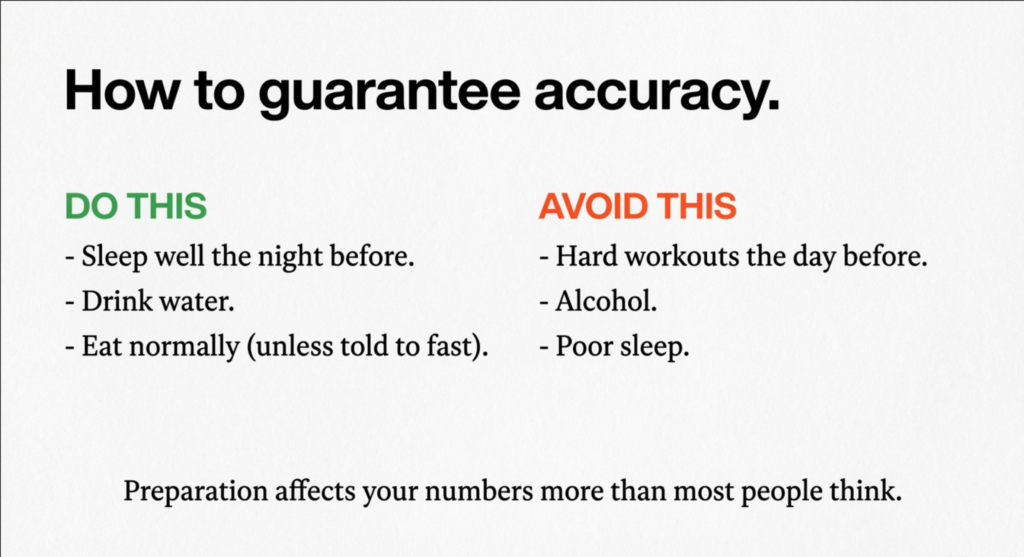
Get your blood drawn in the morning. Ideally between 7 AM and 10 AM. Testosterone peaks in the early morning hours and can drop 30–40% by afternoon. Test in the evening and you might look hypogonadal on paper when you’re actually fine.
Fast for 8–12 hours beforehand. This isn’t just for the lipid panel. Eating can temporarily affect hormone levels too. Water is fine, and actually helpful (hydrated veins are cooperative veins). But skip the food, the sugary drinks, and definitely the alcohol the night before.
Sleep well the night before. This sounds like your mother talking, but she’s right. Poor sleep tanks testosterone levels temporarily. One bad night can drop your T by 10–15%. If you pulled an all-nighter or got four hours because anxiety about the appointment kept you staring at the ceiling, your results won’t reflect your real baseline.
Skip intense exercise for 24–48 hours before your test. Heavy lifting spikes testosterone temporarily, which sounds great until you realize it gives your doctor a falsely elevated reading. You want your resting baseline, the real number, not your post-deadlift peak.
Tell your doctor about everything you’re taking. Medications, supplements, all of it. Opioids and corticosteroids affect hormone levels. Biotin (which hides in a surprising number of men’s multivitamins) can actually interfere with lab assays and produce false readings. Full disclosure upfront saves everyone headaches later.
What Happens After Your TRT Blood Test Results Come Back
So you’ve done the bloodwork. You’ve waited the agonizing 3–7 days, which is enough time to convince yourself of approximately forty different diagnoses. Now you’re staring at numbers that may or may not make sense.
Your provider reviews the full panel, not just your testosterone number in isolation. They’re looking for patterns. Relationships. Stories the numbers tell when you read them together. Low total T plus low LH might point to a pituitary issue. Low free T with high SHBG tells a different story than low free T with normal SHBG. Elevated liver enzymes might mean you need additional workup before anyone talks about treatment. It’s all connected, and a good doctor treats it that way. For a deeper look at how these markers interact and why interpretation is more nuanced than simple reference ranges, the PMC review on challenges in testosterone measurement and data interpretation is an excellent resource.
Most providers will want two separate low testosterone readings before diagnosing hypogonadism. That’s not them being difficult. It’s standard medical practice. Testosterone fluctuates day to day based on stress, sleep, illness, whether you had a fight with your brother, whether the dog kept you up. A single low reading could be a fluke. Two confirms a pattern.
If your results confirm low testosterone, your provider will discuss treatment options based on your specific situation. TRT is not one-size-fits-all. Your age, fertility goals, other health conditions, and the type of hypogonadism you have all factor into the protocol they recommend. Some guys thrive on injections. Others prefer topical gels or pellets. The initial bloodwork guides that decision.
Once you start treatment, expect more bloodwork. Typically at the 6-week mark, then at 3 months, 6 months, and annually after that. Your doctor will track testosterone levels, hematocrit, PSA, liver function, and estradiol to make sure everything stays in a safe range. Ongoing monitoring is just as important as the initial TRT blood test requirements. Maybe more so.
TRT Blood Test Requirements: FAQ
What blood tests are required before starting TRT? A full TRT blood test panel includes total testosterone, free testosterone, SHBG, estradiol, CBC, comprehensive metabolic panel, lipid panel, PSA, LH, FSH, thyroid panel (TSH, Free T3, Free T4), prolactin, vitamin D, and ferritin. Some clinics only test total testosterone and CBC. That’s not thorough enough for safe treatment.
Why do I need two testosterone tests before starting TRT? Testosterone levels fluctuate from day to day based on sleep, stress, illness, and other factors. A single low reading could be an anomaly. The Endocrine Society recommends two separate morning blood draws with consistently low results before diagnosing hypogonadism and prescribing treatment.
What time of day should I get my TRT blood test? Between 7 AM and 10 AM, fasting. Testosterone peaks in the early morning and can drop 30–40% by afternoon. An evening test could show falsely low levels that don’t represent your actual baseline.
Do I need to fast before TRT blood work? Yes. Fast for 8–12 hours before your draw. This ensures accurate lipid panel and metabolic marker readings, and prevents food intake from temporarily affecting hormone levels. Water is fine and encouraged.
What testosterone level qualifies for TRT? Most guidelines use a total testosterone below 300 ng/dL as the threshold for diagnosing low testosterone, though the Endocrine Society and other organizations acknowledge that symptoms should be present alongside low lab values. A man at 310 ng/dL with real symptoms may still be a candidate depending on his free testosterone, SHBG, and overall clinical picture.
How often do I need blood tests after starting TRT? Typically at 6 weeks after starting, then at 3 months, 6 months, and annually thereafter. Your doctor will monitor testosterone levels, hematocrit, PSA, liver function, and estradiol to ensure treatment stays safe and effective.
Can TRT cause high red blood cell count? Yes. TRT stimulates red blood cell production, which can raise hematocrit levels. If hematocrit climbs above 52–54%, blood becomes thicker and the risk of blood clots, stroke, and cardiovascular events increases. This is why CBC monitoring throughout treatment is essential.
What if my testosterone is low but my doctor only checked total T? Ask for a full panel. Total testosterone alone doesn’t tell the full story. Free testosterone, SHBG, LH, FSH, and thyroid markers are all necessary to determine whether you truly have hypogonadism, what’s causing it, and what the right treatment approach is.
Final Thoughts on Meeting Your TRT Blood Test Requirements
I understand the impulse to skip ahead. When you feel lousy (truly, deeply lousy in that way where your own life starts to feel like something happening to someone else) the last thing you want is another obstacle between you and feeling better. Another appointment, another copay, another week of waiting.
But meeting your TRT blood test requirements isn’t an obstacle. It’s the opposite. It’s the thing that makes everything that comes after work. These labs confirm you actually need therapy, that your body can handle it safely, and that your provider has the data to get your protocol right. Not approximately right, but right for you, specifically, in your particular body with its particular history.
Don’t cut corners on this. Find a provider who runs full panels, not just a total testosterone check. Ask questions about every test they order. Ask questions about every result they explain. You are, after all, putting a powerful hormone into your body, into the only body you will ever have, and you deserve to go in understanding exactly where things stand.
Your TRT blood test requirements are your roadmap. They tell you where you’re starting. They help your doctor chart the course. They give you benchmarks to measure whether this whole thing is actually working. Treat them as the foundation they are, and you’ll be set up for the best possible version of what comes next.
Which, if you’re lucky and careful and willing to do the boring parts, might just be pretty good.
These problems often get blamed on aging or stress. Sometimes that’s true. Sometimes your hormones are the issue.
Testosterone affects strength, mood, focus, metabolism, and sex drive. When it drops, you feel it.
Testing is simple, fast, and affordable. Here’s how to do it step by step.
TL;DR: Quick Summary
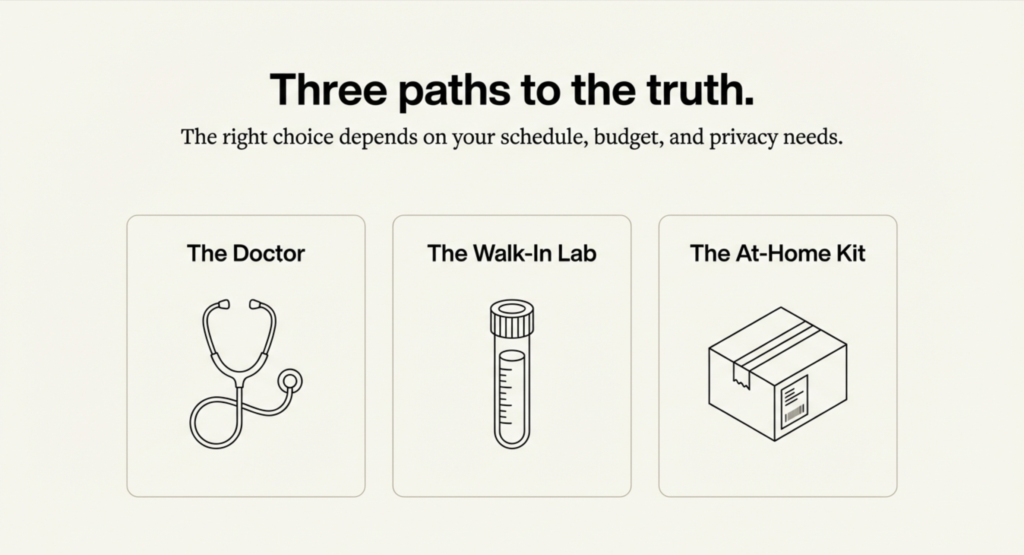
The most accurate way to test testosterone is a morning blood test between 7 and 10 AM that checks total and free testosterone. You can test through your doctor, a walk-in lab like Quest or Labcorp, or an at-home finger-prick kit. Sleep well, avoid hard workouts and alcohol the day before, and test early in the day. If results are low, repeat the test to confirm before starting treatment.
Normal Adult Male Total Testosterone Reference Ranges
Age Group
Range (ng/dL)
Source
Notes
19-39 years (non-obese)
264-916
Endocrine Society / Journal of Clinical Endocrinology & Metabolism (2017)
Harmonized reference range from 4 cohort studies (9,000+ men). Gold standard research.
19+ years (general)
300-1,000
Baptist Health / American Urological Association
Widely cited clinical guideline
19-49 years
249-836
University of Iowa Healthcare Laboratory
Clinical laboratory reference
50+ years
193-740
University of Iowa Healthcare Laboratory
Clinical laboratory reference
20-24 years
409-558 (middle tertile)
Journal of Urology / NHANES Study (2022)
Age-specific normative values from National Health and Nutrition Examination Survey
25-29 years
413-575 (middle tertile)
Journal of Urology / NHANES Study (2022)
Age-specific normative values
30-34 years
359-498 (middle tertile)
Journal of Urology / NHANES Study (2022)
Age-specific normative values
35-39 years
352-478 (middle tertile)
Journal of Urology / NHANES Study (2022)
Age-specific normative values
40-44 years
350-473 (middle tertile)
Journal of Urology / NHANES Study (2022)
Age-specific normative values
40-49 years
252-916
LabCorp Research Study
Age-adjusted reference range
50-59 years
215-878
LabCorp Research Study
Age-adjusted reference range
60-69 years
196-859
LabCorp Research Study
Age-adjusted reference range
70-79 years
156-819
LabCorp Research Study
Age-adjusted reference range
Adult Female Total Testosterone Reference Ranges
Life Stage/Age
Range (ng/dL)
Source
Notes
Premenopausal (General)
10-55
LabCorp / Healthline
Most commonly cited clinical range
Premenopausal (18+ years)
8-48
University of Iowa Healthcare
Clinical laboratory reference
Premenopausal (20s-40s)
15-70
North Pointe OB/GYN / SingleCare
Clinical practice range
Premenopausal (Age 30)
15-46
Journal of Clinical Endocrinology & Metabolism (2011)
Research study of 161 healthy cycling women
Premenopausal (Peak, 20s-early 30s)
10-55
Wisp / Clinical Guidelines
When levels are typically highest
Postmenopausal (General)
7-40
Healthline / AUA
Most commonly cited range
Postmenopausal (50+ years)
2-41
University of Iowa Healthcare
Clinical laboratory reference
Postmenopausal
5-25
North Pointe OB/GYN
Clinical practice range (narrower)
Ages 20-80 (full spectrum)
10-57 (converted from 0.35-1.97 nmol/L)
Journal of Clinical Endocrinology & Metabolism (2012)
Mass spectrometry study, 985 women
What matters most
Under 300 ng/dL in men is often considered low
Levels slowly drop about 1 percent per year after 30
Test in the morning
Repeat low results before worrying
Symptoms matter as much as the number
Sleep, lifting weights, and losing excess fat often fix borderline cases
If you want the details behind those numbers, keep reading!
Most people don’t think about testosterone until something feels off.
Energy drops. Workouts feel harder. Sex drive fades. Mood feels flat. Recovery slows down.
Then comes the search for answers.
You look up your lab result and wonder what “normal” even means.
The problem is that most articles either sound like a medical textbook or like a supplement ad. Neither is helpful.
So let’s keep this simple and practical.
What is testosterone?
Testosterone is a hormone your body makes naturally.
Men produce most of it in the testes. Women make smaller amounts in the ovaries and adrenal glands.
Even though it gets labeled the “male hormone,” both men and women need it.
It helps regulate:
Muscle mass
Strength
Energy
Sex drive
Mood
Bone density
Red blood cell production
Focus and motivation
Think of testosterone like a support hormone. It helps many systems work the way they should.
When levels drop too low or rise too high, things start to feel different.
Testosterone levels by age
The first thing people ask is simple.
“What number should I have?”
The answer depends on your age.
Testosterone peaks in early adulthood and then slowly declines. That decline is normal and expected.
Here are the typical ranges.
Normal testosterone levels in men
Age
Range (ng/dL)
20 to 29
300 to 1,000
30 to 39
300 to 950
40 to 49
300 to 900
50 to 59
300 to 850
60+
250 to 800
Most labs flag anything under 300 as low.
But this is important. A range is not a diagnosis. It is just a reference.
Two men can both sit at 320. One feels great. The other feels exhausted.
Numbers help. How you feel matters too.
Normal testosterone levels in women
Group
Range (ng/dL)
Adult women
15 to 70
After menopause
3 to 41
Women operate within a much smaller range. Small shifts can have noticeable effects.
How testosterone changes throughout life
Looking at the whole timeline helps things make more sense.
Childhood
Levels are very low. Testosterone plays a small role.
Puberty
Production rises fast. This drives voice changes, muscle growth, body hair, and sexual development.
Early adulthood
This is the high point for most people. Strength and energy tend to feel their best here.
Midlife
After about 30, levels start to decline slowly. Around 1 percent per year is typical.
Older age
Lower than youth, but often still within a healthy range.
A slow drop is normal. A sharp drop usually means something else is going on.
Why testosterone drops faster for some people
Age explains part of the story. Lifestyle explains the rest.
Here are the common causes that push levels down more than they should.
Poor sleep
Testosterone is made during sleep. If you cut sleep short, production falls.
Even a week of bad sleep can lower levels.
Extra body fat
Fat tissue converts testosterone into estrogen. More fat means less available testosterone.
High stress
Chronic stress raises cortisol. High cortisol suppresses testosterone.
Heavy drinking
Alcohol interferes with hormone production.
Illness or medications
Diabetes, thyroid issues, opioid medications, and some antidepressants can affect levels.
Sitting all day
Muscle activity helps signal hormone production. Inactivity does not.
In short, age sets the baseline. Daily habits determine where you land within that range.
Total vs free testosterone
This part confuses a lot of people.
Most lab tests show “total testosterone.”
But not all of that is usable.
Some testosterone is attached to proteins. That portion is not active.
Only a small amount is “free” and ready for your body to use.
So you can have a normal total number but still feel low if free testosterone is reduced.
If you’re testing, ask for:
Total testosterone
Free testosterone
SHBG
These together give a clearer picture.
Symptoms of low testosterone
A single number rarely tells the full story.
Symptoms often show up first.
In men
Common signs include:
Low sex drive
Erectile problems
Tired all the time
Brain fog
Low motivation
Loss of muscle
Increased belly fat
Mood changes
Slower workout recovery
It usually shows up as several of these at once.
In women
Symptoms can include:
Low libido
Fatigue
Mood dips
Less strength
Trouble maintaining muscle
Because women have lower levels to begin with, small changes can feel noticeable.
Symptoms of high testosterone
High levels are less common without medication or supplements, but they can happen.
In men
Acne
Irritability
Sleep problems
Fertility issues
In women
Facial hair growth
Irregular periods
Acne
Voice changes
Very high numbers usually point to outside hormones or certain medical conditions.
How to test your testosterone correctly
Testing mistakes cause a lot of unnecessary stress.
Here’s how to do it right.
Test in the morning
Between 7 and 10 AM. Levels are highest then. Afternoon tests can look falsely low.
Try to fast
Food can slightly affect results.
Repeat the test
Doctors often want two low results before calling it low testosterone.
Get more than total
Include free testosterone and SHBG.
Lab tests are more reliable
Home kits are convenient but less precise.
Good testing beats guessing.
Do you need TRT?
Testosterone replacement therapy can help some people.
But it is not a shortcut or a quick fix.
It is a medical treatment for real deficiency.
It may make sense if:
Levels are consistently low
Symptoms affect daily life
Lifestyle changes didn’t help
A doctor confirms it
It may not make sense if:
Your numbers are borderline but you feel fine
You haven’t fixed sleep or weight yet
You only want better gym performance
TRT can reduce fertility and requires long term monitoring. It is not something to jump into casually.
How to support healthy testosterone naturally
Most people see improvement by fixing basic habits.
Nothing complicated. Just consistent.
Sleep
Seven to nine hours every night.
Lift weights
Strength training two to four times per week.
Lose excess fat
Even small weight loss can help.
Eat enough protein and healthy fats
Hormones need raw materials.
Get sunlight or vitamin D
Low vitamin D often lines up with low testosterone.
Manage stress
Daily stress management matters more than you think.
Limit alcohol
Moderation helps protect hormone levels.
These steps will not double your testosterone overnight. But they often move people from borderline to normal.
Frequently asked questions
Is 300 testosterone low?
Borderline. Some people feel fine there. Others feel symptoms.
What time is best to test?
Morning.
How fast does testosterone decline?
About 1 percent per year after age 30.
Can women have low testosterone?
Yes. It can affect energy and libido.
Should I focus on numbers or symptoms?
Both together.
When to see a doctor
Talk with a professional if you notice:
Ongoing fatigue
Sexual problems
Mood changes
Muscle loss
Abnormal lab results
Hormones affect many systems. Getting proper testing is better than guessing.
If you would like to get your testing done. Consider Limitless Alternative Medicine. A Professional, thorough and cost-effective choice. Start today.
Key takeaways
Testosterone is not mysterious.
It rises when you are young. It slowly drops with age. That is normal.
Healthy ranges are broad:
Men: roughly 300 to 1,000 ng/dL Women: roughly 15 to 70 ng/dL
Most people do not need medication. They need better sleep, regular strength training, stress control, and accurate testing.
Start with those basics.
If problems remain, then talk with a doctor.
Simple habits solve more than most people expect.
Sources:
Travison et al. (2017) – “Harmonized Reference Ranges for Circulating Testosterone Levels in Men of Four Cohort Studies in the United States and Europe” – Journal of Clinical Endocrinology & Metabolism, 102(4):1161-1173
Mulhall et al. (2022) – “What Is a Normal Testosterone Level for Young Men? Rethinking the 300 ng/dL Cutoff for Testosterone Deficiency in Men 20-44 Years Old” – Journal of Urology
American Urological Association (2018) – Evaluation and Management of Testosterone Deficiency Clinical Guideline
TL;DR: Online scripts make it possible to get legitimate prescriptions through virtual doctor visits without stepping into a clinic. Licensed providers still review symptoms and medical history before deciding if medication makes sense. It’s convenient when used correctly, works well for many common conditions, and falls short when in-person care is actually needed.
Online scripts used to feel like a loophole. Something people turned to when they had no other option.
Now? They’re just… normal.
For a lot of patients, virtual doctor visits are part of how they manage everyday health.
Sometimes it’s the only option that fits into real life.
You log in. You explain what’s going on. If it makes sense, a prescription goes straight to your pharmacy. No commute. No sitting in a waiting room with bad daytime TV and a stack of outdated magazines.
What throws people off is how structured these visits actually are. They aren’t casual. Providers still dig into your history, your symptoms, and your meds. They still say no when something doesn’t add up. And that part? That’s what makes it real healthcare, not a shortcut.
This guide breaks down how online scripts actually work, when they’re useful, when they aren’t, and why expectations usually matter more than the tech itself.
What Online Medical Consultations Really Are
An online medical consultation is still a medical visit.
Just without the exam table. You’re at home.
The provider is wherever they’re licensed to practice whether it’s video, phone, or secure chat, the format changes, but the responsibility doesn’t.
Online scripts come from real clinicians: physicians, nurse practitioners, and physician assistants. They’re legally allowed to prescribe. And they’re on the hook for what they prescribe.
A lot of people expect these visits to feel rushed. However, in real-world settings, they often feel tighter and more focused. Less small talk. More direct questions. Some patients find that jarring. Others like it.
Guidelines don’t disappear just because the visit is virtual. Providers still check allergies, current meds, past conditions, and risk factors before writing online scripts. If something feels off, they slow down. They ask more. Or they send you somewhere in person. That’s not telemedicine failing, that’s medicine doing its job.
Online scripts work best when the diagnosis leans more on your story than on a physical exam. That still covers a surprising amount.
Things like UTIs, acne, allergies, sinus infections, skin rashes, birth control, and mild anxiety or depression show up a lot in virtual care. Chronic conditions too, blood pressure, diabetes refills, thyroid meds, especially when things are already stable.
Clinics see this all the time. People often explain symptoms better when they’re not stressed or rushed. Being at home helps. They’re not watching the clock. They’re not nervous in a sterile room.
If a service promises prescriptions with no questions, that’s not convenience. That’s a red flag. Real online scripts always come after real evaluation.
Step-by-Step: How to Get Online Scripts from a Virtual Doctor Visit
The process isn’t complicated, but people still manage to derail it.
First, you pick a platform. Some do general care. Others focus on specific issues. Picking the wrong one wastes time.
Then there’s the intake form. This is where a lot of visits quietly fall apart. Providers rely on what you write here. Missing info slows things down. Sometimes it ends the visit before it really starts.
Next is the visit itself, video, phone, or chat. They’ll ask questions. The follow-ups matter. In practice, patients who rush, downplay symptoms, or give vague answers are more likely to walk away without online scripts. Being clear helps more than being urgent.
If treatment makes sense, the prescription goes electronically to your pharmacy. Some platforms mail meds. Some don’t. You’re usually notified quickly. If the provider thinks you need in-person care, they’ll say why. That explanation matters more than the outcome.
Most frustration comes from one bad assumption: that every visit should end with a prescription. That’s not how it works.
Choosing the Right Platform
Not all telemedicine platforms are built the same. Some chase speed. Others focus on long-term care.
If you want reliable online scripts, check licensing first. Providers must be licensed in your state or region. No loopholes.
Pricing should be clear. So should prescribing policies. When a platform is vague about what they will and won’t prescribe, that’s usually on purpose. You don’t have to stick around to find out why.
Pharmacy integration matters more than it sounds. Limited pharmacy options cause delays. Reviews can help, but they’re messy. A lot of one-star reviews come from people who didn’t get the prescription they wanted. That doesn’t always mean the care was bad.
From experience, platforms that allow follow-up messages work better over time. Questions come up. Side effects happen. Access after the visit matters.
Expert analysis backs this up. Continuity of care improves outcomes in virtual settings.
Online scripts often cover antibiotics for simple infections, topical meds, hormonal birth control, and maintenance prescriptions. Mental health meds can be available, but screening is tighter. Providers move slowly here, and for good reason.
What’s usually off the table at first: opioid painkillers, benzodiazepines, and ADHD stimulants. Some exceptions exist once care is established. Rules vary by location. Providers don’t override them just because someone is frustrated.
Denials sting. That’s normal. But most of the time, they reflect the limits of virtual care, not a lack of concern. Without exams, labs, or imaging, some calls just aren’t safe to make.
When you know the boundaries going in, the whole process feels less tense. Online scripts stop being guarantees and start being what they actually are: tools.
Safety, Privacy, and Legal Considerations
Online scripts live inside real regulations. Providers must be licensed. Platforms must protect data. Identity checks and medical history reviews aren’t optional. When a site skips them, that’s a problem.
Privacy still worries people. Fair enough. Reputable platforms follow health data laws like HIPAA in the US. Other countries have their own rules. Reading a privacy policy before sharing sensitive info isn’t dramatic. It’s smart.
Prescribing rules change. Emergencies loosen things. Then they tighten again. Platforms that keep up usually communicate better. According to a government report, oversight of telehealth prescribing has increased in recent years. That oversight creates friction, but it also keeps people safer.
Cost, Insurance, and Convenience Factors
Predictable pricing is why many people stick with online scripts. A lot of platforms charge flat fees. No surprise bills. Insurance coverage is all over the place. Some plans fully cover telemedicine. Others barely touch it.
Medication prices still depend on your pharmacy and insurance. Online scripts don’t magically make drugs cheaper. What they do cut are indirect costs, missed work, travel, and waiting.
Convenience does most of the work here. Parents notice first. Caregivers too. Anyone with an unpredictable schedule. That relief adds up.
Ultra-low pricing, though, should make you pause. Cutting costs often means cutting corners. And this is still healthcare.
Common Mistakes That Delay
This is where things quietly break.
Incomplete intake forms cause most delays. Providers can’t write online scripts without enough context. Asking for a specific drug by name is another misstep. It shifts the tone of the visit fast.
Tech issues matter too. Bad internet ruins video visits. If a provider can’t assess you, they won’t prescribe.
Then there’s follow-up. Some platforms message after the visit for clarification. Ignoring those messages freezes everything. Telemedicine moves fast when patients do. Miss a step, and it feels broken.
The Future of Online Scripts and Virtual Care
Virtual care isn’t disappearing. It’s settling into place.
As tools improve, providers can monitor patients more accurately from home. Remote devices already help manage chronic illness. That makes the safer expansion of online scripts possible.
Rules will keep changing. Some loosen. Others tighten. The goal doesn’t move much: access without unnecessary risk.
Patients are driving most of this. Once virtual care fits into daily life, it’s hard to give up. It won’t replace in-person medicine, but It doesn’t need to since it just fills a gap.
Knowing where it fits is what makes it useful.
Conclusion
Online scripts have changed how people handle everyday healthcare. When used well, virtual visits save time and reduce friction without lowering medical standards. They shine with common conditions, routine refills, and cases that don’t need hands-on exams. They aren’t shortcuts, and they aren’t meant to be.
When you understand the limits, the whole experience feels steadier. Pick reputable platforms. Be honest in your visits. Accept when in-person care is the right move. When expectations match reality, online scripts stop feeling risky and start feeling practical.
Let’s Get You Started
If waiting rooms keep getting in your way, virtual care might fit better. Our platform connects you with licensed providers who review symptoms carefully and issue online scripts when it makes sense. Schedule a virtual visit and see if online care actually works for you.
Frequently Asked Questions About Online Scripts
Are online scripts legal?
Yes. When prescribed by licensed providers in your region, online scripts follow the same legal rules as in-person prescriptions.
How fast can I get online scripts after a virtual visit?
Sometimes within minutes. Delays usually mean the provider needs more info or your pharmacy is closed.
Can I get antibiotics through online scripts?
Sometimes. Only when symptoms and history support it. Not just because you ask.
Do insurance plans cover online scripts and virtual visits?
It depends on the plan. Some do. Some don’t. Checking first saves frustration.
What happens if a provider denies online scripts?
They usually explain why and suggest next steps. It’s about safety, not control.
If you’ve been researching hormone therapy, you’ve probably run into one big question: How to Buy Testosterone Safely and Legally without wrecking your health or doing something shady. It’s true, a lot of men feel off, whether it’s: low energy, bad workouts, brain fog and they’re trying to figure out what’s actually going on. Telemedicine hormone therapy keeps popping up as an option, but it can feel confusing or even risky if you don’t understand how it works.
Here’s the thing: testosterone therapy isn’t magic, and it’s not supposed to be a black-market hustle either. When done right, it’s medical care. Legit. Structured. Legal. This guide breaks down exactly how telemedicine hormone therapy works, what the process really looks like, and how to buy testosterone safely and legally fits into all of it.
How to Buy Testosterone Safely and Legally Starts With Real Medical Oversight
Let’s be honest. If someone tells you that how to buy testosterone safely and legally is as easy as clicking “add to cart,” that’s a red flag. Testosterone is a controlled substance. That’s not negotiable. The legal path always starts with a licensed medical provider, as outlined by the FDA’s own guidance on prescription testosterone requirements https://www.fda.gov/drugs/drug-safety-and-availability/fda-issues-class-wide-labeling-changes-testosterone-products.
Telemedicine clinics don’t skip this step. They replace the traditional in-office visit with a remote one, but the rules stay the same. You meet with a clinician, then you talk symptoms, they go over medical history. They’re looking for patterns, not vibes. Fatigue alone doesn’t cut it.
This matters because testosterone therapy affects your entire endocrine system. Do it without oversight and you’re guessing with your health. That’s why legitimate clinics insist on lab work before prescribing anything. No labs? Walk away.
The Lab Testing Process (And Why It’s Non-Negotiable)
Before anyone prescribes testosterone, blood work happens. Period.
Most telemedicine clinics mail you a lab kit or send you to a local draw center. They’re not just checking testosterone, either. Expect total testosterone, free testosterone, SHBG, estradiol, hematocrit, PSA, and sometimes thyroid markers.
Why does this matter? Because symptoms don’t always equal low testosterone. Stress, sleep deprivation, diet, and even depression can mimic it. Labs separate feeling bad from hormonal dysfunction. That’s a good thing.
Clinics that skip comprehensive labs are cutting corners. And corners in hormone therapy come back to bite.
How Telemedicine Hormone Therapy Actually Works Day to Day
Once labs confirm you’re a candidate, telemedicine hormone therapy becomes pretty straightforward. This is where knowing how to buy testosterone safely and legally starts to feel practical instead of abstract.
You’ll review results with a clinician. Not a sales rep. Not a chatbot. A real medical provider. They’ll explain where your levels sit compared to reference ranges and, more importantly, symptom correlation. Then comes the treatment plan.
Most men start with injectable testosterone because it’s predictable and cost-effective. Prescriptions are sent to a licensed pharmacy. Testosterone arrives legally, labeled, and dosed. No mystery vials. No weird payment apps.
Follow-up labs usually happen at 8–12 weeks. This checks how your body responds, not just whether testosterone went up. Hematocrit matters. Estradiol matters. Ignoring these leads to side effects people love to blame on TRT itself.
Telemedicine clinics typically schedule regular check-ins. Adjustments happen. Doses change. Injection frequency might shift. This is normal medicine, not failure.
How to Buy Testosterone Safely and Legally vs. Black-Market Shortcuts
Let’s address the elephant in the room. Some men consider underground testosterone because it’s cheaper or faster. But comparing that to How to Buy Testosterone Safely and Legally isn’t even fair.
Black-market testosterone has no quality control. Doses are guesses. Contamination happens. And if something goes wrong, there’s no doctor to call. Worse, possession without a prescription can be illegal depending on jurisdiction.
Legal telemedicine therapy costs more upfront, sure. But you’re paying for labs, expertise, and safety. Shortcuts feel smart until they aren’t.
Telemedicine Clinics vs. Traditional In-Office Clinics
So why telemedicine at all? For many men, access. Not everyone lives near a hormone clinic. Telemedicine removes geography from the equation while keeping medical standards intact.
A large review published in National Library of Medicine found that telemedicine outcomes are comparable to in-person care for many medical services https://pmc.ncbi.nlm.nih.gov/articles/PMC8430850/
The best clinics operate just like in-office practices. Same labs with prescribing authority and follow-ups. The difference is convenience.
Costs, Insurance, and What You’re Really Paying For
Here’s where expectations matter. How to Buy Testosterone Safely and Legally isn’t always cheap.
Data from the Kaiser Family Foundation shows wide variability in insurance coverage and out-of-pocket healthcare costs https://www.kff.org/health-costs/.
Many telemedicine clinics operate on a monthly model covering consults, labs, and medication. Insurance coverage varies. Some plans cover labs but not treatment.
The real question isn’t cost alone. It’s value.
How to Buy Testosterone Safely and Legally Without Getting Scammed
Scams exist because demand exists. Knowing how to buy testosterone safely and legally means spotting warning signs early.
Clinics that teach how to buy testosteronesafely and legally will bring this up before treatment starts. That’s informed consent.
Conclusion
When it comes down to it, buying testosterone isn’t about loopholes or hacks. It’s about choosing real medical care in a modern format. Telemedicine hormone therapy works because it keeps the rules that matter—labs, oversight, monitoring—while removing barriers that frustrate patients.
Done right, it’s structured, transparent, and boring in the best way possible. No drama. No guesswork. Just data-driven treatment and ongoing support. If you’re considering hormone therapy, don’t rush. Ask questions. Demand clarity. And remember that learning how to buy testosterone safely and legally is less about speed and more about doing it right the first time.
STILL HAVE QUESTIONS?
Don’t hesitate to ask us! Our knowledgeable team is here to provide the answers you need. Feel free to reach out to us at anytime.
We use cookies to ensure that we give you the best experience on our website. If you continue to use this site we will assume that you are happy with it.