Most younger men don’t wake up one morning with ED. Causes of ED under 40 often show up before a man is ready to name them. A lot of guys still assume erection problems belong to older men, not someone in their twenties or thirties. Yet in everyday life, plenty of younger men struggle quietly and put on a brave face.
You hear this in clinics. You hear it after a few beers. And sometimes at 2 a.m., when someone finally talks. Most men aren’t angry then. They’re uneasy. Embarrassed. Sometimes shaken after one bad night.
Here’s the part most people miss. Erectile dysfunction before forty usually isn’t about being “less of a man.” In real life, it’s messier than that. Stress, habits, hormones, and mental overload pile up little by little. Alcohol, sleep, screens, relationships, health issues — all of it stacks quietly before anyone takes it seriously.
Sometimes your body sends an early warning. Not to punish you. Just to get your attention. It can feel brutal when it lands. It can also be the jolt you actually needed.
What follows isn’t neat or glossy. It’s closer to a real conversation with someone who sees this play out in real lives, not just journal articles.

Causes of ED Under 40 and What Your Body is Saying
When you’re under forty, erections depend on a lot of things working at once. Blood flow, nerves, hormones, and your brain all have to line up in the same moment. If one piece slips, the whole thing wobbles.
In practice, stress does more damage than most men realize. High stress tightens blood vessels before you even notice. Your body flips into alert mode, which is terrible for sex. Poor sleep does something similar overnight, quietly dulling your response.
Add energy drinks, junk food, and hours of sitting, and you’ve got problems brewing long before you feel sick. Most men don’t notice until one rough night in bed makes it impossible to ignore. Then it feels sudden. Even though it wasn’t.
Your body isn’t betraying you. It’s sending a signal. A loud one.
Now, about porn. This tends to surprise patients. Heavy use doesn’t physically damage your penis, but it can retrain how your brain expects arousal to work. Screens deliver instant novelty in a way real partners never can. Real bodies move more slowly than videos. Your nervous system gets impatient.
Masturbation itself isn’t the issue. The pattern and intensity usually are. If you need extreme visuals just to stay hard, your brain might need a reset more than your body does. Guys, panic here. Still, small changes can make a difference within weeks. Cutting back feels awkward. Then things often get clearer.
Hidden health problems show up earlier than people think. High blood pressure, prediabetes, and insulin resistance appear in men who still feel “young.” Even mild blood sugar swings can blunt the nerve signals that trigger erections. Cholesterol can restrict blood flow long before you feel unwell.
Some men only learn this after struggling in bed. That moment hurts. It also pushes them to finally get checked, which can protect their heart as much as their sex life.

Is it “All in My Head”? Understanding Performance Anxiety in Your 20s and 30s
Performance anxiety rarely arrives dramatically. It usually starts after one awkward moment. Then your mind keeps replaying it like a broken loop.
Your heart races. Your muscles tense. And the erection disappears right on cue. That loop makes anxiety the real problem.
Most men try to muscle through it with willpower. That almost never works. Slowing down, breathing, and lowering expectations usually helps more. You don’t have to prove anything in your own bedroom.
That’s where relationships get tricky. If you’ve been arguing, distant, or holding resentment, your body registers that before your mind catches up. Desire doesn’t reboot like a phone after a fight.
Still, many men expect perfect performance even when emotional trust is shaky. That expectation often backfires. Reconnecting emotionally, even in small ways, often fixes things sexually without a big talk.
Cultural ideas about masculinity make this worse. A lot of men are taught they should always be ready, hard, and dominant. That’s a story, not biology. Real bodies fluctuate with stress, mood, and sleep.
Treating every soft moment as a personal failure traps you in a nasty loop. Letting that belief go feels uncomfortable at first. Then, strangely freeing.
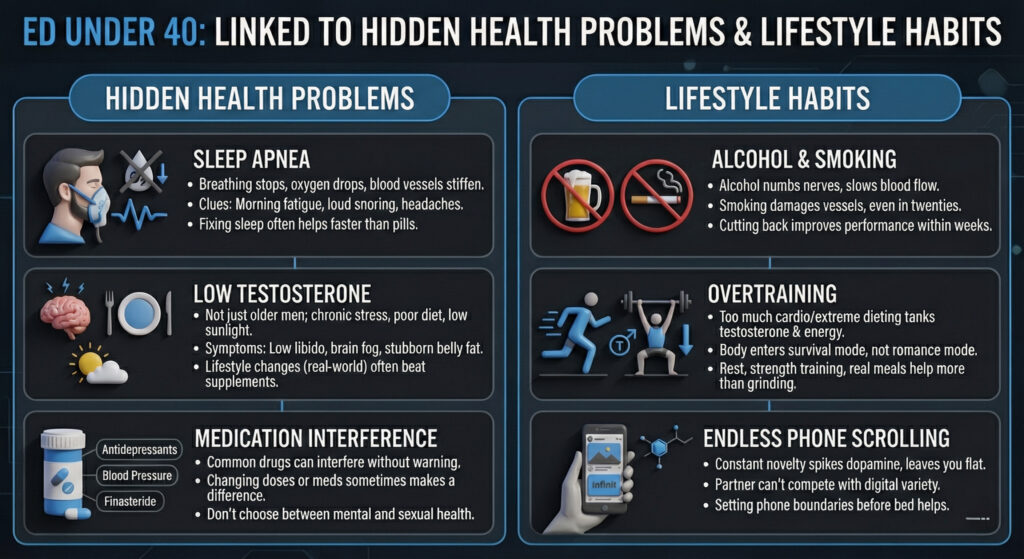
Causes of ED Under 40 Linked to Hidden Health Problems
Sleep apnea is a classic hidden culprit. Even very fit men can have it. When breathing stops at night, oxygen drops, and blood vessels stiffen. Over time, that wears down the same systems on which erections depend.
Morning fatigue, loud snoring, and headaches are common clues, but plenty of men shrug them off. Fixing sleep can help erections faster than most pills.
See: Sleep Apnea and Erectile Dysfunction – Medical News Today
Low testosterone isn’t just an older man’s problem. Chronic stress, poor diet, and too little sunlight can drag levels down in younger men. Low libido, brain fog, and stubborn belly fat often show up together.
In real-world settings, lifestyle changes usually move the needle more than supplements alone. Still, some men need medical support. There’s nothing weak about that. Testing replaces guessing, which most guys quietly appreciate.
Medications can also interfere with erections without warning. Antidepressants, blood pressure drugs, and finasteride are common examples. Many doctors rush through side effects. Changing doses or medications sometimes makes a real difference. You shouldn’t have to choose between mental health and sexual health.
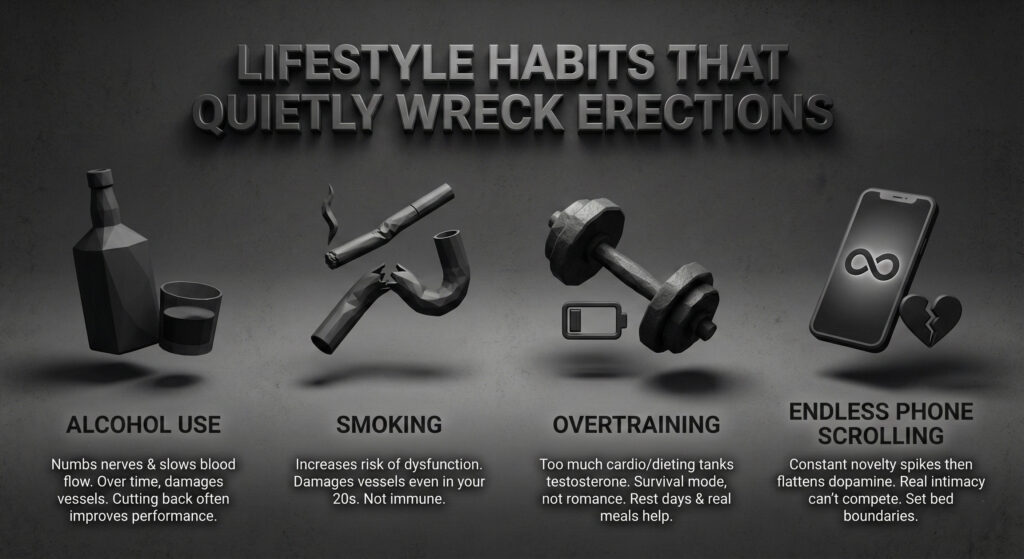
Lifestyle Habits That Quietly Wreck Erections
Alcohol hits harder than men like to admit. In the moment, it numbs nerves and slows blood flow. Over time, smoking damages vessels even in your twenties. A lot of guys assume they’re immune because they’re young. They’re not. Cutting back often improves performance within weeks.
Smoking increases the risk of erectile dysfunction
Overtraining is another trap. Too much cardio or extreme dieting can tank testosterone and energy. Your body reads that as survival mode, not romance mode.
Rest days, steady strength training, and real meals usually help more than grinding harder. Bigger muscles don’t guarantee stronger erections. Not even close.
Endless phone scrolling also matters more than men think. Constant novelty spikes dopamine, then leaves you flat when real intimacy shows up. A partner can’t compete with infinite digital variety. Setting phone boundaries before bed helps, even if it feels irritating at first.
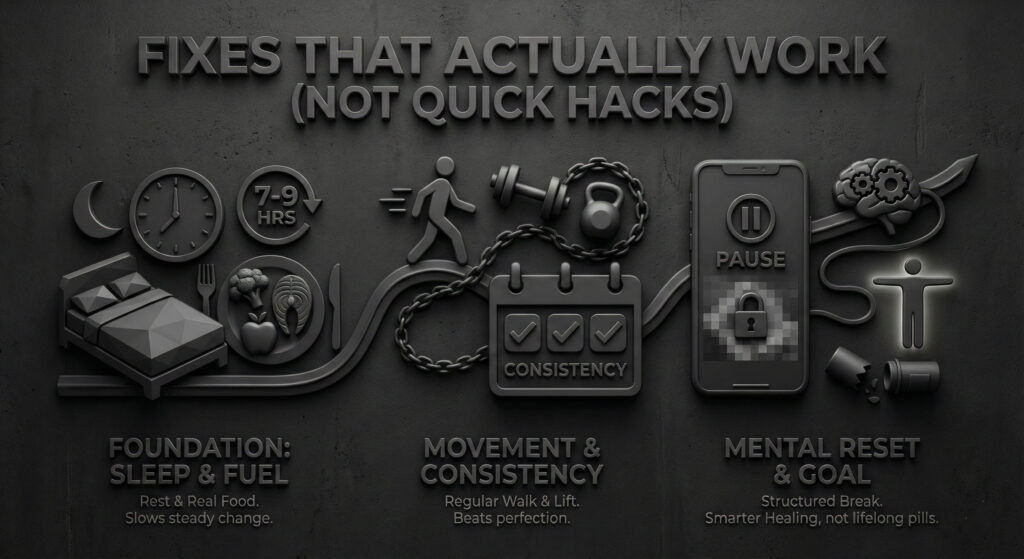
Fixes That Actually Work
Start simple before reaching for pills. Seven to nine hours of sleep most nights changes more than people expect. Real food, regular walking, and lifting a few times a week move things slowly but steadily.
It sounds boring. It still works.
Consistency beats perfection.
Taking a structured break from porn can reset how your brain responds to arousal.
The goal isn’t lifelong pills. It’s smarter healing. For a deeper dive, see the PubMed article: Sex Therapy for Sexual Dysfunction.
How To Talk About This Without Shame
Start with your partner, not just Google. Pick a calm moment, not right after sex. Say what you’re feeling without blame. Most partners respond with empathy once they understand you’re trying.
With a doctor, be specific. Explain when it started, what helps, and what makes it worse. Be honest about stress, sleep, porn, and alcohol. Doctors can’t help what they don’t know. Clear details get clearer answers.
Remember, millions of men deal with this at some point. You’re not broken or weird. You’re human. Opening up feels risky. It’s often the first real step toward change.
To Conclude!
Causes of ED under 40 almost never come from one single thing. It’s usually a slow build — stress piling on habits, habits nudging health, health shaping mindset, all of it drifting together without much warning. That can feel heavy when you finally see it. But there’s a quiet upside most men don’t clock at first: nothing here is written in stone.
Small shifts matter more than people assume. Better sleep. Real food. Moving your body in ways that don’t feel like punishment. A hard, honest talk with your partner that you’ve been avoiding for weeks. Sometimes that alone changes more than any prescription.
Here’s the part I keep coming back to. Most younger men dealing with erection problems don’t need panic, bravado, or another Google spiral at 2 a.m. They need patience, a bit of humility, and someone who tells them straight. You’re not behind. You’re not broken. Your body is talking early enough for you to do something about it.
If you listen, adjust, and keep showing up for yourself, things can shift. Slowly at first. Then more clearly. Your confidence — and your sex life — can come back stronger than you expect.
Take Control of Your Sexual Health Now
Close the tabs. Put the phone down. Especially at 2 a.m.
If any of this hits close to home, don’t sit alone with it. Explore our guides, tools, and real-world resources made for men who actually live busy, messy, imperfect lives. No hype. No quick fixes. Just practical help you can use.
Start today. One small step is enough to begin.
Don’t guess with your health. Our doctors specialize in identifying whether your ED is lifestyle-based or hormonal. Book a 15-minute Discovery Call and get a medical-grade plan.
See how we rank with some other Telehealth companies: Best Telehealth Sites 2026
Frequently Asked Questions: ED Under 40
Can porn cause erectile dysfunction in my 20s or 30s?
Yes. Here’s the thing: your brain is remarkably good at learning. You taught it, over many patient hours, to expect a certain kind of stimulation — high-intensity, infinitely varied, never asking how your day went. And now your brain, which is if nothing else a consistent student, has learned that lesson thoroughly. What doctors are calling Porn-Induced ED is essentially a dopamine calibration problem. Real intimacy feels, to the trained brain, kind of slow. Kind of ordinary. The good news: a structured digital reset — 30 to 90 days, typically — tends to recalibrate things. The brain, it turns out, is also good at unlearning.
Is ED a sign of heart disease in younger men?
It can be, and this is the part where we’d ask you to take a breath and keep reading. The blood vessels in the penis are substantially smaller than the ones feeding your heart. Which means they tend to show problems first. ED in a man under 40 is sometimes the body’s version of a check engine light — not a catastrophe, but a signal worth taking seriously. Cardiovascular health, blood sugar levels — these are worth looking at. We mention this not to frighten you but because the alternative, which is not mentioning it, seems worse.
Can Low Testosterone cause ED even if I’m young?
Absolutely, and frankly “Low T is an old man’s problem” is one of those things that used to be true and now, increasingly, isn’t. Chronic stress, poor sleep, and endocrine disruptors — the kind quietly present in various plastics, pesticides, and the general texture of modern life — have produced measurable testosterone declines in men in their 20s and 30s. If you’ve also been experiencing low libido, brain fog, a sort of persistent flatness — like the world has been turned down a few notches — a hormone panel is the logical first move. You deserve actual information about what’s happening in your own body.
Is my ED “all in my head” or is it physical?
It’s usually both, and this is where the situation gets a little cruel in its design. Something physical happens first — a night of bad sleep, too much to drink, garden-variety stress. You have one bad experience. And then, being human and therefore prone to worrying about things, you worry about it. Your brain files this away. Next time, it sends adrenaline — which constricts blood vessels — which creates the exact outcome you were afraid of — which gives your brain more data confirming the original worry. It’s a loop, is what it is. We work on breaking it by addressing the physical root first, which tends to interrupt the psychological momentum. You are not broken. You are, unfortunately, very good at learning.
Why aren’t ED pills working for me anymore?
Because Viagra and Cialis are vasodilators — they improve blood flow, and blood flow is genuinely important, but it’s not the whole story. If your testosterone is low, or your cortisol is elevated, or your nervous system is running the anxiety subroutine in the background, the pill doesn’t have much to work with. It’s a little like trying to drive faster when the engine itself needs attention. This is why we focus on integrative TRT rather than a prescription that addresses the symptom while the underlying cause continues doing whatever it’s doing.
How do I know if I need TRT or just a lifestyle change?
The honest answer: you need bloodwork. There is no way to know without it, and anyone who tells you otherwise is, with respect, guessing. If your sleep is good, your diet is clean, you’re lifting regularly, and you still feel — there’s no better word for it — flat, that’s a signal. Our doctors specialize in interpreting these results for younger men, which is its own skill set, because “within normal range” for a 32-year-old and “optimal for a 32-year-old” are not the same number and shouldn’t be treated as such. The goal isn’t to normalize your deficiency. The goal is to help you feel like yourself again — ideally, a well-rested, clear-headed, fully-functioning version of yourself.