Written by Joshua Magdangal, Health Content Editor · Clinically reviewed by our licensed medical team · Last updated November 17, 2026
This article is for general education. It is not a diagnosis, and it doesn’t replace care from a licensed clinician who knows your history.
Belly fat and low testosterone tend to show up together as you age but for a lot of men in their 30s and 40s it isn’t the biggest one.
Body fat, especially the deep fat packed around the organs in your abdomen (visceral fat), has a well-studied relationship with testosterone. It runs in both directions. Obesity is linked to developing low testosterone, and low testosterone is linked to gaining visceral fat (Obesity and late-onset hypogonadism).
The encouraging part is that the weight side of that loop responds to change. In a 2013 meta-analysis in the European Journal of Endocrinology, men who lost weight through diet or bariatric surgery saw their testosterone rise, and the amount of weight lost was the best predictor of how much it rose (Corona et al., 2013).
One thing up front: none of the signs below can tell you whether your testosterone is low, or why. Only lab work and a clinician can do that. What these signs can do is help you decide whether the conversation is worth having.

How belly fat and testosterone feed each other
- Conversion. Fat tissue contains aromatase, an enzyme that turns testosterone into estradiol. More fat tissue means more of that conversion.
- Signaling. Obesity is associated with inflammation in the part of the brain that tells the testes to make testosterone. Researchers think this may weaken that signal, though the full mechanism isn’t settled yet.
- Sleep and blood sugar. Visceral fat tends to travel with insulin resistance and sleep apnea, and both are tied to lower testosterone.
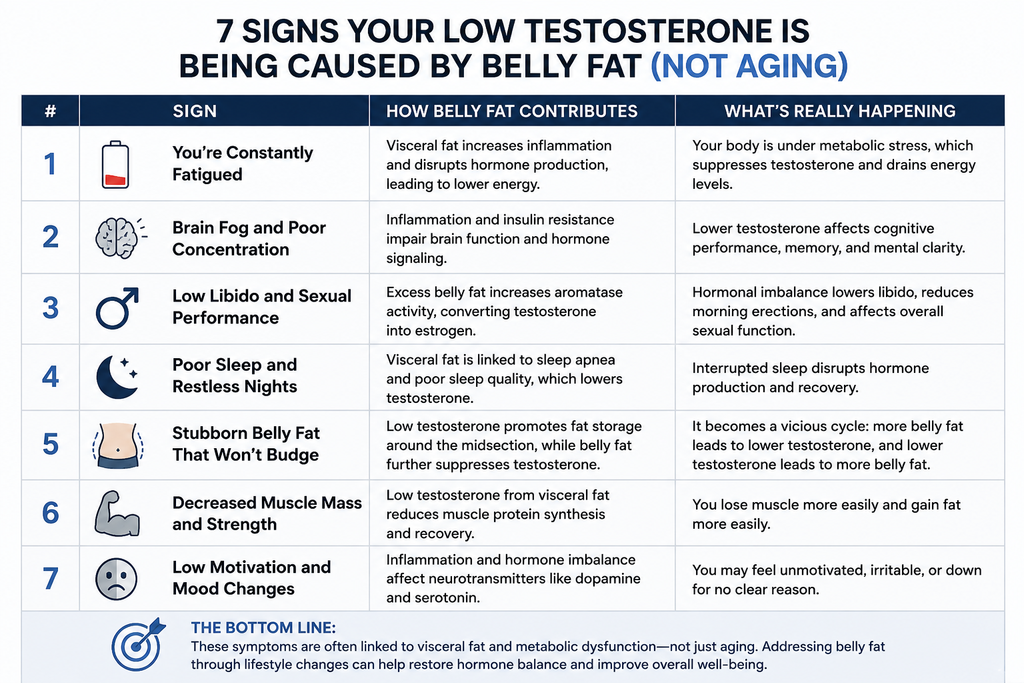
- The loop closes. Lower testosterone makes muscle harder to keep and fat easier to store, which brings you back to the top of the list.
The 7 signs
1. Meals knock you out
You eat lunch and spend the next hour in a fog. Food you used to handle fine now feels like a sedative.
This is the least specific sign on the list. Post-meal sleepiness has plenty of causes, from a big carb-heavy lunch to short sleep the night before. Where it gets more interesting is when it shows up next to a growing waist, because that combination can point toward insulin resistance, which often travels with visceral fat and lower testosterone.
Worth asking about: A1C and fasting glucose. They’re cheap, routine, and tell you more than guessing does.
2. Your waist is growing faster than your weight
If the scale barely moves, but your belt has moved up a notch. This is the classic visceral fat pattern, and it’s easy to miss if you only track body weight.
A quick home check is the waist-to-height ratio:
- Stand relaxed and breathe out normally.
- Measure around your waist at belly-button level.
- Divide that number by your height, using the same units.
A result of 0.5 or higher is a common flag for excess central fat. It’s a screening number, not a diagnosis, but it’s a better conversation starter than total weight alone. The American Urological Association’s testosterone guideline lists waist circumference as part of the physical exam for this reason (AUA guideline).
One thing that won’t fix it: endless crunches. You can’t choose where your body burns fat from. Overall fat loss, strength training, and sleep move the waist. Ab work mostly makes the muscle under the fat stronger.
3. Your sex drive dropped faster than you expected
A slow change over decades is normal, but a noticeable drop over a year or two is different. Men often describe it the same way: the interest is still there in their head, but the automatic pull is quieter. Morning erections show up less often.
Low libido and fewer morning erections are among the symptoms most closely tied to low testosterone. They also have other causes worth ruling out, including stress, depression, relationship strain, alcohol, and some common medications such as certain antidepressants.
If erectile problems are part of the picture, mention them to your doctor even if you’d rather not. ED can be an early sign of heart and blood vessel disease, and that’s worth catching on its own.
4. You’re training consistently and still losing ground
You show up. You lift. Yet recovery takes longer, strength stalls for months, and the muscle you built seems to fade faster between sessions.
Testosterone helps the body build and hold muscle, so a drop can make the same training produce less. Poor sleep and insulin resistance can slow recovery too.
The common reaction is to push harder: more volume, more cardio, stricter dieting. That often adds fatigue without adding results. Men who turn this around usually do it by getting more consistent rather than more extreme, with steady resistance training, enough protein, and better sleep.
5. Your mood has gone flat
This one rarely gets connected to hormones. It’s less like sadness and more like the color got turned down. Less drive, less competitiveness, less interest in goals you used to care about. Small annoyances land harder.
Low testosterone can contribute to low mood and low energy. So can depression, which is common, very treatable, and easy to write off as burnout. If the flatness has lasted more than a couple of weeks, ask your clinician to screen for depression as well as check hormones. They aren’t either/or.
If you’re having thoughts of harming yourself, call or text 988 (Suicide & Crisis Lifeline, US) to reach someone right away.
6. You snore, wake up tired, and sleep never feels like enough
This is the sign with the clearest research behind it.
Most of a man’s daily testosterone is released during sleep, and both broken-up sleep and obstructive sleep apnea are linked to lower levels (Leproult & Van Cauter, JAMA, 2011). In that same study, healthy young men who were limited to five hours of sleep a night for one week had daytime testosterone 10 to 15% lower than when they slept fully. It was a small study of 10 men, so treat the exact number with caution, but the direction is consistent with other research.
Abdominal fat raises the risk of sleep apnea, which fragments sleep, which can lower testosterone and make fat easier to gain. Signs to take seriously:
- Loud snoring, especially if a partner has noticed you stop breathing
- Waking up unrefreshed or with a headache or dry mouth
- Falling asleep easily during the day
Worth asking about: a sleep study. Untreated sleep apnea carries its own heart and blood pressure risks, separate from anything to do with testosterone.
7. Your labs came back “normal,” and you still feel off
This is where a lot of men get stuck. They finally get tested, the result comes back in range, and the conversation ends.
A few things are worth knowing:
- Timing matters. Testosterone runs highest in the morning. The AUA guideline says low testosterone should only be diagnosed after two total testosterone tests on separate days, both taken in the early morning. It uses a level below 300 ng/dL as a reasonable cutoff, and it requires symptoms as well as a low number (AUA guideline). A single afternoon test can miss the picture.
- If repeated morning tests are normal, testosterone therapy isn’t the answer. At that point the better questions are about sleep, thyroid function, mood, medications, and metabolic health.
- The rest of your labs matter too. Waist size, A1C, fasting glucose, triglycerides, and blood pressure often explain more about how you feel than a single hormone value does.
What to bring to your appointment
A ten-minute visit goes much further with a bit of prep. Before you go, write down:
- When things changed. Roughly when energy, libido, sleep, or your waistline shifted, and whether anything else changed around then (new job, new medication, weight gain, less training).
- Your waist-to-height ratio from the home check above.
- Sleep notes. Snoring, waking up gasping, daytime sleepiness. Ask a partner if you can.
- Everything you take. Prescriptions, supplements, and anything bought online. Opioids, steroids, and some other medications can affect testosterone.
- Whether you want kids in the future. This changes which treatments make sense (see below).
Questions you can ask directly:
- “Can we do two early-morning total testosterone tests on different days?”
- “Should we check A1C, fasting glucose, a lipid panel, and LH?”
- “Do my symptoms warrant a sleep study?”
Treatment options, without the hype
Weight loss and lifestyle changes come first when excess fat is part of the picture. The evidence that losing weight can raise testosterone is solid (Corona et al., 2013). The changes that tend to stick are unglamorous: strength training a few times a week, enough protein, less alcohol, fewer ultra-processed foods, and protected sleep. Progress usually takes months, which is why a lot of people quit early.
GLP-1 medications such as semaglutide are prescription drugs approved for weight management in certain adults. They can help with appetite and weight loss, and they come with real considerations: stomach side effects such as nausea are common, they aren’t appropriate for everyone (including people with a personal or family history of certain thyroid cancers), and their direct effect on testosterone is still being studied. Whether one is right for you is a decision to make with a prescriber who has your full history.
Testosterone replacement therapy (TRT) can help men with confirmed testosterone deficiency. It also has trade-offs you should hear before you start:
- Fertility. TRT can suppress sperm production and may cause infertility. The AUA recommends that men interested in fertility have a reproductive health evaluation before treatment (AUA guideline).
- Heart safety. The TRAVERSE trial, published in the New England Journal of Medicine in 2023, followed men aged 45 to 80 with low testosterone and existing or high heart risk. Major cardiac events were no more common with testosterone than with placebo (Lincoff et al., 2023). The trial also reported higher rates of some other events, including atrial fibrillation, in the testosterone group, so monitoring still matters.
- Monitoring. TRT can raise red blood cell counts, so ongoing blood work is part of treatment, not an optional extra.
- Expectations. TRT doesn’t remove visceral fat or fix sleep apnea on its own. If those are driving the problem, they still need attention.
When to see a doctor sooner rather than later
Don’t wait on a routine appointment if you notice:
- New breast swelling or tenderness
- Headaches together with changes in your vision
- A lump, swelling, or change in a testicle
- Chest pain or shortness of breath with exertion, especially alongside erectile problems
- Someone has seen you stop breathing during sleep
Quick answers
Can belly fat lower testosterone? Yes. Visceral fat is linked to lower testosterone through increased conversion to estradiol, inflammation, and related problems like sleep apnea and insulin resistance. The relationship goes both ways.
Can losing belly fat raise testosterone? Often, yes. Research shows weight loss is associated with higher testosterone, and larger losses tend to bring larger increases. It doesn’t work for every cause of low testosterone, and it takes time.
How is low testosterone diagnosed? With symptoms plus two early-morning total testosterone tests on separate days, according to AUA guidance. One test, or a symptom checklist on its own, isn’t enough.
Should I start TRT if I have symptoms? Not before confirmed testing and a full conversation about fertility, monitoring, and what else might be causing your symptoms.
Sources
- Mulhall JP, et al. Evaluation and Management of Testosterone Deficiency: AUA Guideline. J Urol. 2018;200:423. Reviewed and validity confirmed 2024.
- Corona G, et al. Body weight loss reverts obesity-associated hypogonadotropic hypogonadism: a systematic review and meta-analysis. Eur J Endocrinol. 2013;168(6):829-843.
- Leproult R, Van Cauter E. Effect of 1 week of sleep restriction on testosterone levels in young healthy men. JAMA. 2011;305(21):2173-2174.
- Lincoff AM, et al. Cardiovascular Safety of Testosterone-Replacement Therapy. N Engl J Med. 2023;389(2):107-117.
- Obesity and late-onset hypogonadism (review abstract, UroToday).
Publishing notes (delete before publishing)
YMYL / E-E-A-T
- Fill in the author byline and the medical reviewer (name, credential, link to bio page). Add
reviewedByandlastReviewedto the MedicalWebPage schema. - Have the reviewer confirm the TRAVERSE secondary-outcomes line and the GLP-1 paragraph against current labeling before publish.
- Swap source 5 for the full journal citation if you can get it; a primary journal link is stronger than an abstract aggregator.
- If you add an internal link to a TRT or GLP-1 service page, keep it informational (“learn how evaluation works”) rather than a buy-now CTA inside the clinical sections.
HIPAA / privacy
- No patient stories, quotes, photos, or before/after results unless you have signed HIPAA authorization. If you want a case example, write a clearly labeled composite with no identifying details.
- If this page gets a symptom quiz, calculator, or lead form, don’t send its answers to ad pixels (Meta, Google Ads, TikTok). Route form data only through vendors that will sign a BAA.
- Avoid retargeting audiences built from visits to this page or its quiz results.
Template-proofing
- Original elements already in: the waist-to-height self-check, the appointment prep list, and the “when to see a doctor sooner” list. A short quote from the reviewing clinician (one or two sentences on what they look for first) would add more first-hand experience than anything else you could add.