


The blood test comes back. Low testosterone.
Now you’re standing at a fork in the road with two signs:
- TRT
- Enclomiphene
Both promise to help. Both speak in the calm, confident tone of modern medicine. But they are not the same thing, and the difference matters.
TRT: The Direct Approach
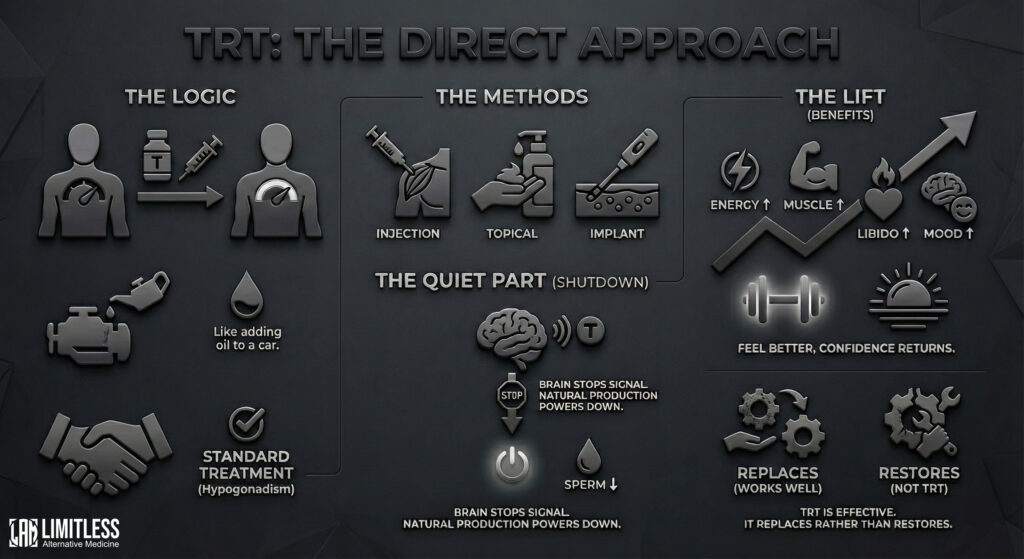
Testosterone Replacement Therapy, or TRT, is straightforward. Your body isn’t making enough testosterone, so you add some from the outside.
It’s clean logic. Like if your car is low on oil, you add oil.
Organizations like the American Urological Association and the Endocrine Society recognize TRT as a standard treatment for men diagnosed with hypogonadism. The Mayo Clinic explains it plainly: TRT can improve energy, muscle mass, libido, and mood in men whose levels are genuinely low.
You inject it. Or rub it on. Or have pellets inserted under your skin.
And often, fairly quickly, you feel better.
There’s a lift. A sharpening. You look at the barbell and it looks back at you with less hostility. You wake up in the morning with something resembling the old confidence.
But here’s the quiet part.
When you bring testosterone in from the outside, your brain takes the hint. “Ah,” it says. “We’re good here.” And it stops telling your testicles to produce their own. Natural production shuts down. Sperm production drops. Testicles may shrink.
The system powers down because it assumes its job is done.
TRT works. It works well. But it replaces rather than restores.
For a full guide see: TRT Guide: Everything You Need to Know About Testosterone Replacement Therapy
Enclomiphene: The Nudge
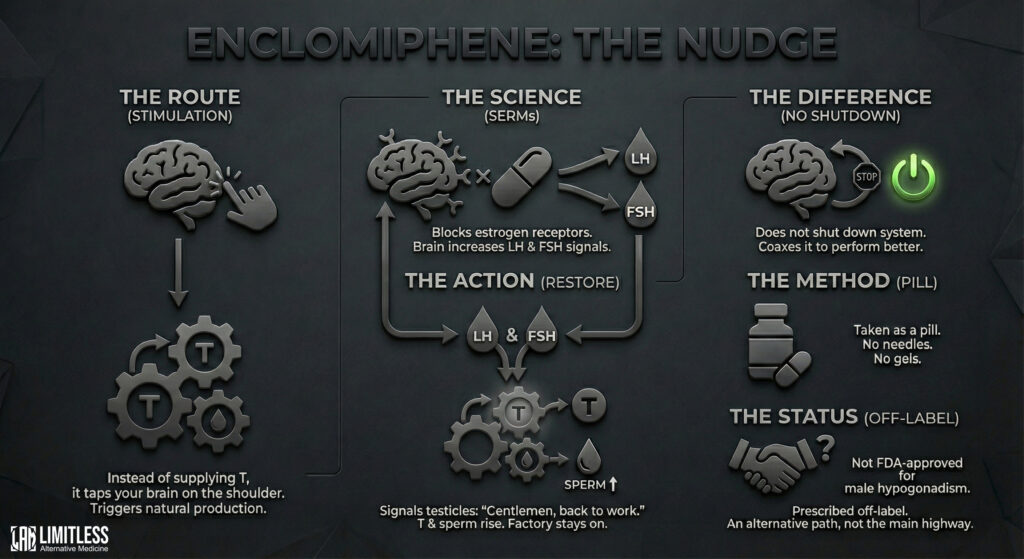
Enclomiphene takes a different route. Instead of supplying testosterone, it taps your brain on the shoulder.
It belongs to a class of drugs called SERMs. According to research reviewed by the National Institutes of Health, it blocks certain estrogen receptors in the brain. The brain, thinking estrogen activity is low, increases luteinizing hormone and follicle-stimulating hormone.
Those hormones go to your testicles and say, in effect, “Gentlemen, back to work.”
Testosterone rises. Sperm production rises. The factory lights stay on.
Unlike TRT, enclomiphene does not shut down your system. It tries to coax it into performing better.
It’s taken as a pill. No needles. No gels.
It is not FDA-approved specifically for male hypogonadism, so it’s prescribed off-label. That fact doesn’t make it unsafe, but it does mean you’re stepping slightly outside the main highway of standard protocol.

Enclomiphene vs TRT: The Key Differences
Here’s where most guys start to get clarity — once you see them side by side.
| Feature | TRT | Enclomiphene |
| Mechanism | Replaces testosterone directly | Stimulates natural testosterone production |
| Fertility | Often decreases sperm count | Preserves or improves sperm production |
| Delivery | Injections, gels, pellets | Oral capsule |
| Maintenance | Ongoing, lifelong in many cases | Can be cycled or used short-term |
| Lab Monitoring | Required for safety | Also required, but typically less intensive |
| Natural Feel | Strong and immediate | Gradual, more balanced |
| Shutdown Risk | High (your body stops producing T) | Low |
| Cost | Moderate to high | Usually lower |
| Convenience | Injections or office visits | Simple daily pill |
In short: TRT delivers fast, powerful results — but at the cost of dependency.
Enclomiphene takes the slower route, coaxing your body to handle things on its own.

The Fertility Question
If you want children, TRT complicates the story. Because it suppresses sperm production, many men on TRT become infertile unless additional medications are added.
Studies indexed in PubMed show that enclomiphene can increase testosterone while preserving or even increasing sperm counts.
So if you’re thirty-five, or forty, or even forty-five, and not entirely sure your family is complete, this detail lands differently.
Speed vs. Patience
TRT tends to work fast. Some men notice changes within a week or two. Energy improves. Libido returns. The fog thins.
Enclomiphene is slower. Four to six weeks is common before the full effects show up. Because it relies on your own hormonal machinery, it takes time.
This becomes a temperament question.
Do you want the immediate correction? Or are you willing to wait while your body recalibrates?
There is no moral high ground here. Just preference.
What to Expect from Each
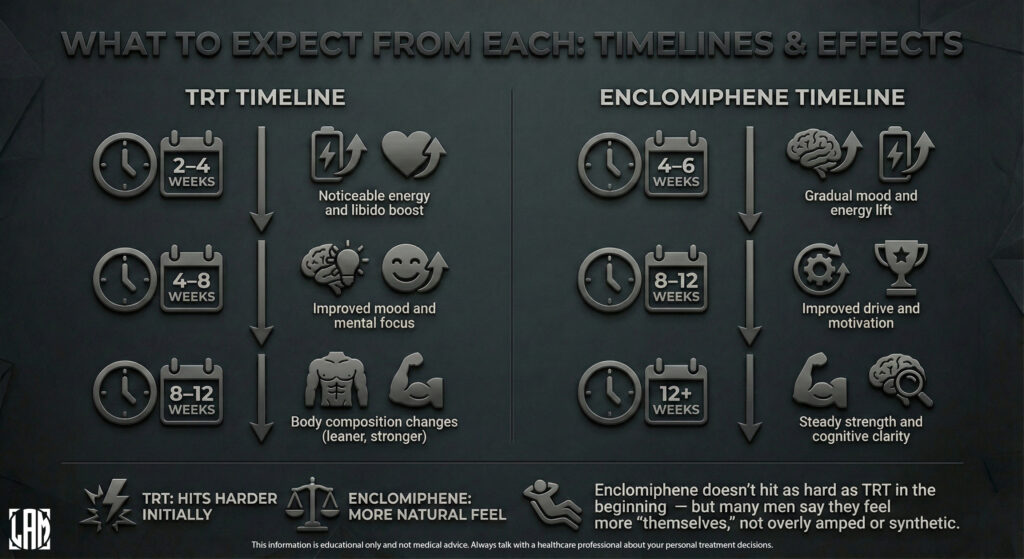
TRT timeline:
- 2–4 weeks: noticeable energy and libido boost
- 4–8 weeks: improved mood and mental focus
- 8–12 weeks: body composition changes (leaner, stronger)
Enclomiphene timeline:
- 4–6 weeks: gradual mood and energy lift
- 8–12 weeks: improved drive and motivation
- 12+ weeks: steady strength and cognitive clarity
Enclomiphene doesn’t hit as hard as TRT in the beginning — but many men say they feel more “themselves,” not overly amped or synthetic.
Commitment
Once you start TRT, your natural production is suppressed. If you stop abruptly, your testosterone can drop hard before your body recovers, and recovery can take months.
With enclomiphene, because natural production remains active, stopping the medication usually returns you to baseline rather than dropping you into a hormonal basement.
So the question becomes: are you comfortable stepping onto something that may be long term?
For some men, the answer is yes. Relief is worth it. For others, the idea of lifelong external hormone replacement feels heavy.
Side Effects: The Tradeoffs
TRT can increase red blood cell count, worsen sleep apnea, cause acne, hair loss, or gynecomastia. Monitoring is necessary. Blood work is not optional.
Enclomiphene can cause headaches, mood shifts, nausea, joint discomfort. Because it modifies estrogen signaling in the brain, some men report emotional changes or visual disturbances.
Neither option is magic. Both require supervision. Both involve tradeoffs.
A More Human Way to Think About It
This isn’t really a biochemical decision. Not only that.
It’s about identity.
Do you see yourself as someone who replaces what’s missing? Or someone who tries to restore what’s still there?
TRT says, “We will supply what you lack.”
Enclomiphene says, “Let’s see if your body can rise to the occasion.”
Both can be right.
The real mistake is choosing without understanding what you’re signing up for. Or chasing numbers on a lab report without thinking about the larger arc of your life. Kids. Marriage. Health at sixty-five. Energy at seventy.
Low testosterone feels urgent. And in many ways, it is. But urgency is not the same as clarity.
Get thorough labs. Talk to a physician who treats hormones seriously. Ask about fertility, about long-term plans and what happens if you stop.
Then choose.Not the option that sounds strongest.
Not the one that promises the fastest glow.
But the one that fits the man you are trying to become.
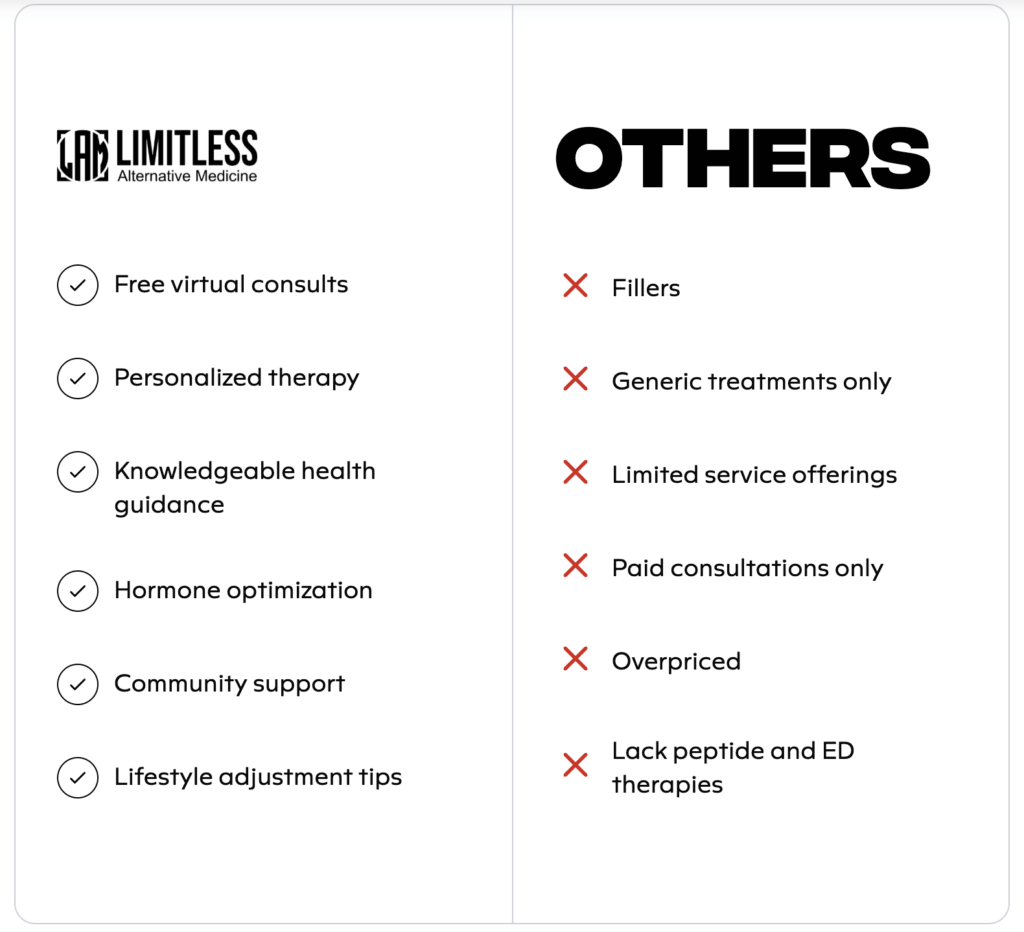
At Limitless Alternative Medicine, we specialize in hormone optimization and peptide therapy , with pure, research-backed ingredients.
Our three-part process boosts strength, metabolism, and stamina for peak results.
We offer free consultations and community support for a holistic path.
Medical Disclaimer: This blog post and the entire limitlessaltmed.com website are for informational and educational purposes only and are not a substitute for professional medical advice, diagnosis, or treatment.