


How much testosterone should I take to feel normal again without wrecking my health?
Too little and you feel nothing.
Too much and you risk side effects, mood swings, and long-term issues.
Finding the right TRT dosage isn’t about chasing high numbers. It’s about steady levels, symptom relief, and lab results that make sense.
There’s no single “perfect” number that works for everyone.
Age, body fat, metabolism, and delivery method all change your ideal TRT dosage.
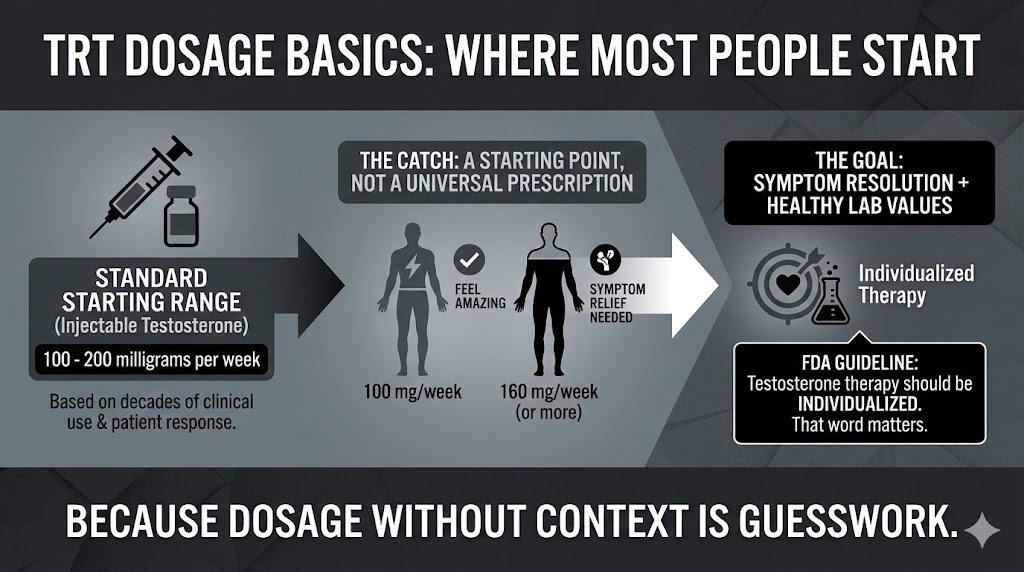
TRT Dosage Basics: Where Most People Start
If you’re brand new to therapy, you’ll notice that most providers begin with a standard TRT dosage range. For injectable testosterone, that often means 100 to 200 milligrams per week. That’s not random. It’s based on decades of clinical use and patient response.
But here’s the catch. That range isn’t a prescription for everyone. It’s a starting point. Some men feel amazing at 100 mg per week. Others need closer to 160 mg to see symptom relief. The goal isn’t the dose itself. The goal is symptom resolution with healthy lab values.
According to prescribing guidelines from the U.S. Food and Drug Administration, testosterone therapy should be individualized.
That word matters. Individualized.
Because dosage without context is guesswork.

TRT Dosage by Administration Method
Not all testosterone delivery systems behave the same. Your TRT dosage depends heavily on how you administer it.
With injections, weekly dosing is common. Many patients split their weekly TRT dosage into two smaller injections to keep levels steady. For example, instead of 160 mg once per week, they inject 80 mg twice weekly. That often reduces mood swings and energy crashes.
Topical gels are different. A typical gel TRT dosage might range from 50 to 100 mg applied daily. Absorption varies by person, so bloodwork becomes even more important.
Pellets work on longer cycles. Providers calculate pellet insertion amounts based on body weight and baseline testosterone levels. Adjustments only happen every few months.
Clinical studies show absorption variability across methods:
Comparison of the Effects of Testosterone Gels, Injections, and Pellets on Serum Hormones, Erythrocytosis, Lipids, and Prostate-Specific Antigen
If you’re unsure which route fits you, review Full TRT delivery guide
TRT Dosage and Bloodwork: The Numbers That Actually Matter
Here’s where people mess up.
They chase a high number on their lab sheet instead of dialing in the right TRT dosage for their body. Total testosterone matters, yes. But so do free testosterone, estradiol, hematocrit, and SHBG.
Most providers aim for total testosterone levels between 600 and 900 ng/dL. That’s a common target zone. But some men feel their best at 550. Others don’t feel relief until 850. That’s why adjusting TRT dosage based on symptoms plus labs makes more sense than labs alone.
The Endocrine Society recommends regular monitoring during therapy.
Testing every three to six months keeps you safe.
If you’re not sure which labs to request, check: Complete TRT bloodwork checklist
Because guessing your TRT dosage without labs is like driving blindfolded. It might work for a mile. Then it won’t.
Adjusting TRT Dosage: When and Why Changes Happen
Most people don’t nail their ideal TRT dosage on day one. And that’s normal.
Adjustments happen for three main reasons. First, symptoms persist. Maybe energy improved but libido didn’t. Second, labs drift out of range. Hematocrit might climb. Estradiol might spike. Third, side effects appear.
When that happens, providers don’t usually double your dose. They tweak it. A small 10 to 20 mg shift in weekly TRT dosage can make a big difference. Patience matters here. Hormone levels stabilize over weeks, not days.
That transition period is where most confusion happens.
And here’s my hot take. If a clinic never checks your labs or never adjusts your TRT dosage, that’s a red flag. Therapy should evolve with you.
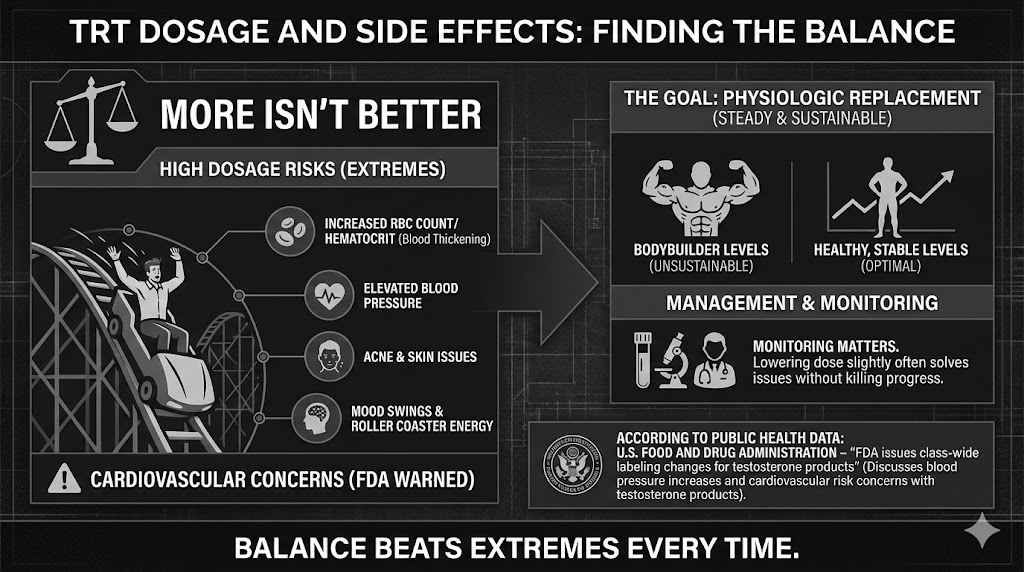
TRT Dosage and Side Effects: Finding the Balance
More isn’t better. I’ll say it again. More isn’t better.
High TRT dosage levels can increase red blood cell count, blood pressure, acne, and mood swings. You might feel strong for a while. Then you feel irritable. Or tired again. That roller coaster usually points to dosing issues.
Elevated hematocrit is common with aggressive TRT dosage plans. That’s why monitoring matters. Sometimes lowering the dose slightly solves the problem without killing your progress.
According to public health data:
U.S. Food and Drug Administration – “FDA issues class-wide labeling changes for testosterone products” (discusses blood pressure increases and cardiovascular risk concerns with testosterone products)
Extremely high testosterone levels carry cardiovascular concerns.
Your goal isn’t bodybuilder levels. It’s physiologic replacement. Steady. Sustainable.
Balance beats extremes every time.
TRT Dosage for Different Age Groups
Age plays a role in how your body responds to TRT dosage, but not in the way most people assume.
Younger men with clinically low testosterone may respond quickly to moderate dosing. Older men often metabolize hormones differently and may require smaller adjustments to maintain stable levels.
That doesn’t mean older patients automatically need less TRT dosage. It means monitoring becomes even more important. Liver function, cardiovascular risk, and overall health shape dosing decisions.
Some providers use weight-based formulas when calculating initial TRT dosage, especially for pellets. Others prefer symptom-driven titration.
TRT Dosage Myths
Myth one: Higher TRT dosage equals faster muscle gain. Not true. Gains depend on training, diet, sleep, and genetics. Testosterone helps, but it’s not magic.
Myth two: Everyone should aim for 1,000 ng/dL. Why? That number looks impressive. But it’s not required for symptom relief in most men.
Myth three: You should feel amazing in one week. Hormones take time. Your body needs weeks to adapt to a new TRT dosage.
Here’s the truth. Smart therapy is boring. Consistent labs. Small adjustments. Gradual improvement.
Because guessing leads to frustration. Strategy leads to results.
Conclusion: TRT Dosage Is Personal, Not One-Size-Fits-All
If you take one thing from this guide, let it be this: TRT dosage is not a fixed number. It’s a process.
Your ideal TRT dosage depends on symptoms, labs, delivery method, and how your body responds over time. Most men start between 100 and 200 mg per week with injections, or equivalent dosing in gels or pellets. From there, small adjustments shape the outcome.
Don’t chase extreme numbers. Don’t compare your dose to someone on a forum. Focus on steady energy, improved mood, healthy labs, and long-term safety.
Work with a provider who monitors you. Test regularly. Adjust patiently.
Because the right TRT dosage isn’t about being high. It’s about feeling like yourself again — consistently, safely, and for the long run.