Everything You Need, Right Here
If you’re Googling testosterone clinics because something feels off and you want answers, not a 4,000 word runaround. So here it is.
Can you get TRT through telehealth? Yes. Is it legal to order TRT online? Also yes, as long as a licensed doctor prescribes it after real bloodwork. Are all online TRT clinics legit? God, no. Some are terrific. Some are a guy with a laptop and a dream.
We spent weeks looking at pricing, doctor credentials, lab protocols, and treatment options:
| # | Clinic | Best For | Starting Price | Delivery Methods |
| 1 | Hims | Brand recognition + accessibility | $99/mo | Enclomiphene, oral T (2026) |
| 2 | Hone Health | Longevity-focused optimization | $177/mo | Injections, creams, troches |
| 3 | Limitless Alt Med | Peak performance protocols | Free consult, Varies | Injections, troches, creams |
| 4 | Ulo | Streamlined onboarding | $159/mo | Injections, gels, oral |
| 5 | TRT Nation | Budget-friendly TRT | $99/mo | Injections only |
| 6 | Defy Medical | Complex hormone cases | ~$200-250/mo | Injections, creams, pellets |
| 7 | PeterMD | Fast prescriptions | $89-99/mo | Injections |
| 8 | Evolve Telemedicine | Flexible treatment plans | Varies | Injections, creams, peptides |
| 9 | Henry Meds | All-in-one telehealth | $129/mo | Injections, creams |
If you want the full story on each clinic, why they made the cut, and how to avoid the ones that didn’t, keep reading. We’ll also cover legality, red flags, delivery methods, costs, and every other question that’s been rattling around your head.
Is It Legal to Get TRT Online in 2026?
Yes. Getting TRT through telehealth is legal. Testosterone is a Schedule III controlled substance, which just means you need a real prescription from a real doctor. The DEA is fine with telehealth prescribing as long as certain boxes get checked: the doctor has to be licensed in your state, there has to be a legitimate patient-provider relationship (video consult, lab review), and the prescription has to come from a regulated U.S. pharmacy.
Federal Telehealth Prescribing Rules for Controlled Substances
There’s a law called the Ryan Haight Act that used to require an in-person visit before anyone could prescribe controlled substances online. COVID changed that. The DEA loosened the rules, and as of 2026, various telehealth flexibilities remain in effect. The specifics shift depending on the substance and your state, but every legitimate online TRT clinic already operates within these guidelines. That’s sort of the whole point of being legitimate.
Here’s the easy test: if a clinic requires labs, makes you talk to an actual doctor, and ships from a licensed pharmacy, you’re fine. If any of those three pieces are missing, you’re not dealing with telehealth. You’re dealing with something else.
How Legitimate Clinics Stay Compliant vs. Gray-Market Providers
Real clinics require bloodwork showing clinically low testosterone. The American Urological Association sets the bar at below 300 ng/dL on two separate morning draws. Real clinics use licensed physicians, dispense through FDA-registered pharmacies and keep HIPAA-compliant records.
Gray-market operations? They skip the labs, use overseas pharmacies, sell testosterone as a “supplement” which, if you think about it for even a second, makes no sense because testosterone is a controlled substance, not a vitamin.
How We Evaluated These Online TRT Clinics
We’re not going to pretend we have a 47-point proprietary scoring algorithm. We looked at seven things that matter, and we weighted them the way a reasonable person would.
Doctor credentials. Who’s actually making the prescribing decisions? Board-certified MDs? Nurse practitioners? A guy named Todd with a certificate he printed at Kinkos? This matters more than anything else on the list.
Lab requirements. Does the clinic make you get bloodwork before prescribing? Do they retest? If a clinic will prescribe testosterone based on a symptom quiz alone, they are not practicing medicine. They are practicing commerce.
Treatment options. Injections only, or do they also offer gels, creams, oral options, and ancillary meds like HCG or enclomiphene? More options means your protocol can actually be tailored to your body and your life.
Pricing transparency. Is that $99/month number real, or does it turn into $250 once you add labs, shipping, and the privilege of asking your doctor a question?
Ongoing monitoring. Are they tracking hematocrit, PSA, estradiol, and lipids? How often? A clinic that writes a script and disappears is not a clinic. It’s a vending machine.
Patient support. Can you reach a human being when something feels wrong, or are you yelling into a chatbot void?
Fertility preservation. Do they offer HCG or enclomiphene for men who want to keep their sperm production intact while on TRT? Not everyone thinks about this upfront, but you should.
No clinic aces all seven. The goal here was to find the ones that do more things right than wrong and don’t lie about the tradeoffs.

1. Hims: Best for Brand Recognition and Accessibility
Who It’s Best For
The guy who wants a name he recognizes. They’ve spent an absurd amount of money on advertising, they’re publicly traded, and you probably have seen them mentioned at least once. For a lot of men, that familiarity lowers the activation energy of actually doing something about low T. And honestly? That counts for something.
Treatment Options and Delivery Methods
Here’s the thing about Hims that surprises people: they don’t actually offer traditional TRT injections yet. What they do offer is enclomiphene citrate, which works differently. Instead of putting testosterone into your body from the outside, enclomiphene nudges your body into making more of its own. They also have an enclomiphene + tadalafil combo for guys dealing with both low T and bedroom performance issues. Hims has announced plans to roll out injectable testosterone and an FDA-approved oral option called Kyzatrex in 2026, but as of this writing, those aren’t live yet.
Pricing and What’s Included
Plans start at $99/month on a 10-month plan, paid upfront. That covers medication, lab work, provider messaging, and shipping. No surprise charges. No separate fee to talk to your doctor. Most of the care happens asynchronously (you message a provider rather than doing a video call), though some states require video visits. Shorter-term plans cost more per month, which is the same trick your gym uses and somehow it still works on all of us.
Monitoring and Follow-Up Protocol
Labs are included and processed through CLIA-certified facilities. A licensed provider reviews your results before prescribing anything. Follow-up monitoring happens through the platform. It’s adequate, but if you’re the kind of person who wants a 40-marker blood panel and a 30-minute deep dive with your doctor every quarter, Hims probably isn’t going to scratch that itch.
Bottom line: Hims is the front door to testosterone support. Polished app, clear pricing, massive brand. The limitation is they’re not doing traditional TRT yet, and the care model favors convenience over clinical depth. Perfect starting point for men dipping their toes in. Less ideal for the guy who already knows his total T is 187 and wants a needle in his hand by next Tuesday.
2. Hone Health: Best for Longevity-Focused Hormone Optimization
Who It’s Best For
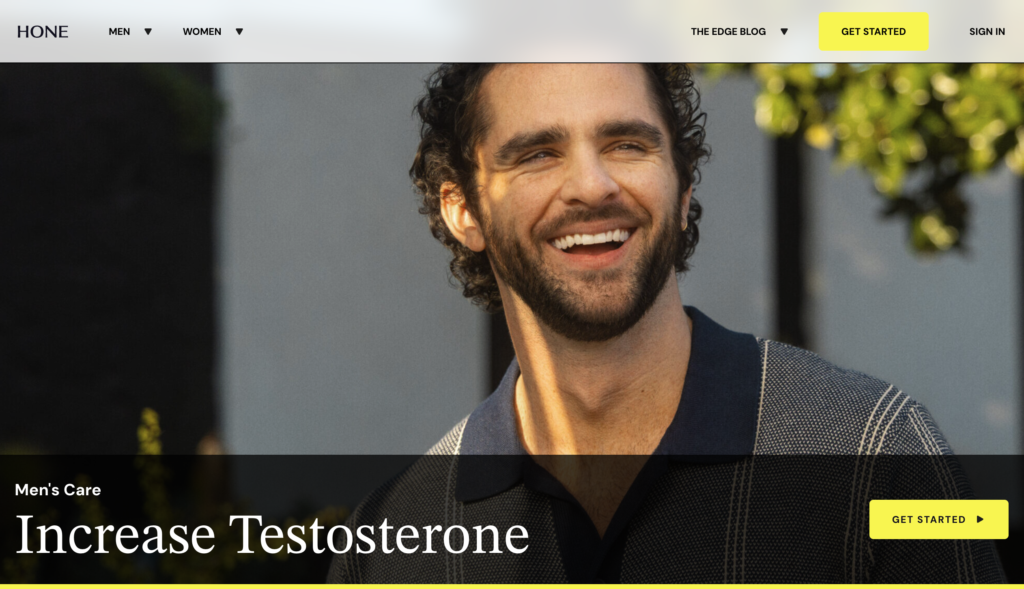
Hone is built for men who want every decision backed by numbers. If you’d be uncomfortable with a doctor saying “let’s just see how you feel in a month,” Hone is your people.
Treatment Options and Delivery Methods
Unlike Hims, Hone offers actual testosterone replacement. Injections, creams, troches (those are dissolvable tablets you put under your tongue, which sounds weird until you try it). They also prescribe clomiphene citrate and anastrozole, which gives providers real tools to fine-tune your protocol rather than just cranking up the testosterone and hoping for the best.
Pricing and What’s Included
This is where it gets a little complicated. Hone separates membership from medication. The Basic plan is $25/month and gets you discounted meds without lab testing. The Premium plan is $149/month and includes regular labs, physician consults, and medication management. Since TRT requires lab work (or should, anyway), most guys end up on Premium. That puts you around $177/month for injectable TRT once you factor in the medication cost. The initial at-home hormone assessment runs $55-65 and includes a physician video consultation.
Monitoring and Follow-Up Protocol
This is Hone’s bread and butter. They run broad biomarker panels, often testing 40+ markers on initial draws. You get retested every three months during year one, then every six months once your levels stabilize. All of those ongoing labs are covered under Premium. Your protocol gets adjusted based on what your blood actually shows, not a vague check-in where someone asks if you “feel better.”
Bottom line: Hone is the best choice for men who want their TRT anchored to data. The membership model adds cost compared to barebones clinics, but the frequency and depth of monitoring is genuinely hard to find elsewhere. If you’re going to put synthetic testosterone in your body, you might as well know exactly what it’s doing in there.

3. Limitless Alternative Medicine: Best for Peak Performance Protocols
Who It’s Best For
Alright, this one’s for the guys who want more than just “normal” testosterone levels. Limitless Alternative Medicine (limitlessaltmed.com) doesn’t treat testosterone in a vacuum. They look at the full picture: peptides, weight management, hormone optimization across the board. This is the clinic for the man who’s already doing the work in the gym and the kitchen but knows something biochemical is holding him back. You don’t want normal. You want operating at your ceiling.
Treatment Options and Delivery Methods
Limitless offers TRT through injections and oral enclomiphene citrate therapy. But here’s where they diverge from most of this list: they also run peptide protocols, weight loss programs, and full hormone replacement services. Most online clinics treat testosterone like it exists on an island. Your T is low, here’s a vial, good luck. Limitless treats it like one piece of a bigger machine. If your thyroid’s dragging, your cortisol is wrecked, or your body composition needs an overhaul alongside TRT, they address it all under one roof. They also fold in nutritional counseling, which is surprisingly rare in telehealth.
Pricing and What’s Included
The consultation is free. Which, right off the bat, separates them from clinics that charge $50-250 before you’ve even established whether you qualify. Bloodwork and testing are part of the evaluation. Treatment pricing gets discussed after your clinical assessment, so the protocol actually matches what your body needs rather than slotting you into a generic subscription tier. They position themselves as affordable compared to the premium players while keeping the whole thing physician-led. No bait-and-switch.
Monitoring and Follow-Up Protocol
Limitless uses a three-phase approach: assess, treat, optimize. Your bloodwork tells them where you’re starting. A custom protocol gets built around your labs and symptoms. Then ongoing monitoring keeps your levels dialed in over time. The emphasis is on physician-directed care with regular follow-ups, not the “prescribe and ghost” model that cheaper providers love so much. Everything runs through a HIPAA-compliant telehealth platform, so you’re handling this from your couch, not a waiting room.
Bottom line: If the goal is peak performance and not just getting your T levels into some lab reference range, Limitless Alternative Medicine is the one to look at. TRT plus peptides plus weight management plus nutritional guidance, all under physician oversight. The free consultation makes it zero-risk to find out if it’s the right fit. For men who want a performance protocol, not just a prescription, this is the clinic.
4. Ulo: Best for Streamlined Onboarding
Who It’s Best For
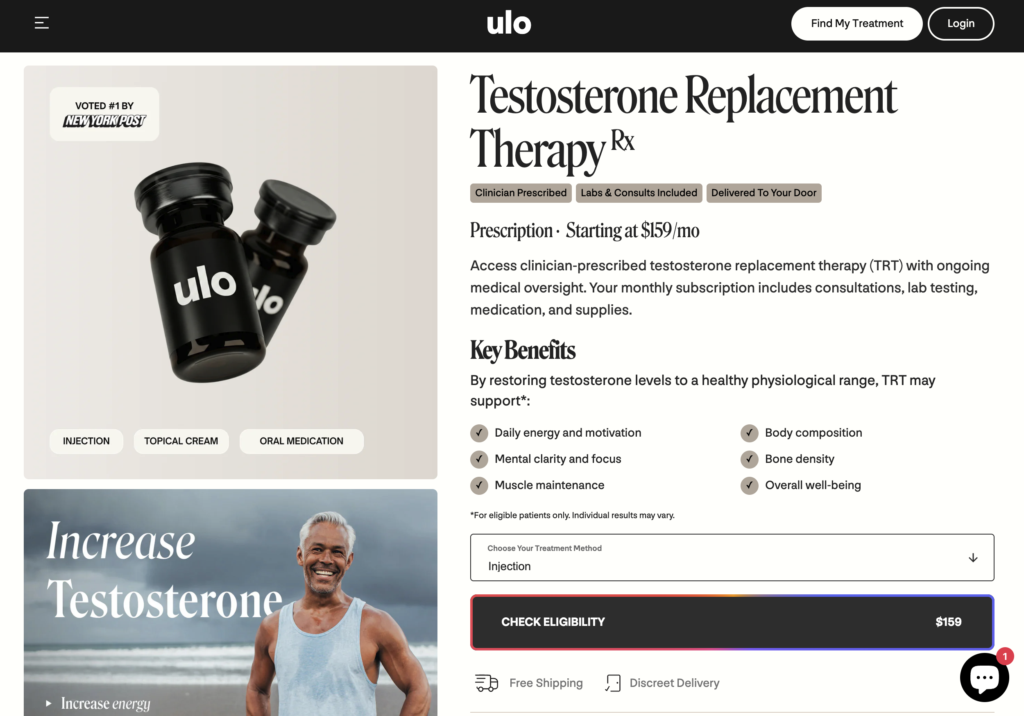
Guys who appreciate a well-designed experience. Ulo started in the hair loss world and brought that same obsessive attention to product design into the hormone space. If you’ve ever been frustrated by a clunky medical portal that feels like it was built in 2008, Ulo will feel like a relief. The process is clean, the app is intuitive, and the clinical side doesn’t get sacrificed for the sake of looking pretty.
Treatment Options and Delivery Methods
Ulo gives you options: injectable testosterone, topical gels, or oral medication. That flexibility matters because not every guy wants to self-inject, and not every guy wants to rub gel on his shoulders every morning and worry about transferring it to his kids. They use FDA-approved medications and custom-compounded prescriptions from certified pharmacies.
Pricing and What’s Included
Injections start at $159/month, gels at $169/month, and oral at $189/month. The initial blood test is $50, which gets credited toward your first month of treatment. And here’s the part I actually like: you don’t pay for treatment until your prescription is approved. So if the doctor looks at your labs and says you don’t qualify, you’re only out the cost of the blood test. That matters for guys who aren’t sure yet whether TRT is even on the table.
Monitoring and Follow-Up Protocol
They accept recent lab results (up to 6 months old) from accredited labs, or they’ll order new bloodwork for you. A licensed provider reviews everything before recommending a plan. Their clinical team stays reachable for dose adjustments and questions, which sounds basic but is genuinely not guaranteed at some of the places on this list.
Bottom line: Ulo is the smoothest experience on this list. The “pay only if approved” model removes the financial risk of exploring TRT. Multiple delivery methods. Clean platform. It’s not the cheapest, but you’re paying for a process that respects your time and doesn’t feel like a medical bureaucracy.

5. TRT Nation: Best Budget-Friendly Option
Who It’s Best For
The straight shooter. You’ve had your bloodwork done. You know your testosterone is low. You want injectable TRT at a fair price without anyone trying to upsell you on a $300/month longevity membership. TRT Nation is the no-nonsense answer.
Treatment Options and Delivery Methods
Primarily testosterone cypionate injections. They also offer HCG, anastrozole, enclomiphene, and a growing menu of add-ons: BPC-157, nandrolone, tadalafil, and more. The catch (and it’s a real one) is they don’t offer gels, creams, or oral testosterone. If needles aren’t your thing, this isn’t your clinic. Full stop.
Pricing and What’s Included
$99/month. That covers testosterone cypionate, injection supplies, shipping, and unlimited physician consultations. No enrollment fees. No contracts. Cancel anytime. Labs are included every 6 months. They also accept outside lab work that’s less than 6 months old, so you might save on initial testing. Annual spend: roughly $1,188. That’s less than half of what most competitors charge for the same medication.
Monitoring and Follow-Up Protocol
Labs every 6 months. Unlimited consultations at no extra charge. The monitoring cadence is lighter than what you’d get at Hone or Defy, but for a standard TRT protocol that doesn’t involve any complications, it’s enough. The unlimited consult access is genuinely useful, too. Some clinics charge $100+ every time you want to ask your doctor a question. Here, you just… ask.
Bottom line: Best dollar-for-dollar value on this list. If your needs are straightforward (injectable TRT, reliable supply, access to a doctor when you need one), TRT Nation delivers all of that for less than your monthly coffee habit. The limitations are real but narrow: injectables only, lighter monitoring. For most guys on standard TRT, those won’t matter.

6. Defy Medical: Best for Complex Hormone Cases
Who It’s Best For
The complicated case. Maybe you ran a cycle in your twenties and never fully recovered or, you’ve got thyroid issues alongside low T. Maybe you’ve tried two other clinics and neither one could get your numbers right. Defy has been around since 2013, which makes them ancient by telehealth standards. They’ve seen the weird cases, the tricky cases, and the “how is this guy even functioning” cases.
Treatment Options and Delivery Methods
The medication menu here is the longest on this list. Testosterone cypionate, testosterone cream, HCG, anastrozole, DHEA, pregnenolone, thyroid meds, peptide therapy, and custom compounding. They also offer both telehealth and in-person visits at their Tampa clinic, which is a hybrid setup that’s rare in this space. If you need something unusual or something that requires a delicate touch, Defy probably has it.
Pricing and What’s Included
This is where people flinch. Defy uses pay-per-service pricing, not a flat subscription. Initial consultation: $250-350. Follow-ups: $100-200. Lab work through LabCorp, priced separately. Medications priced individually. Monthly spend averages $200-250, and annual costs land around $2,400-3,000 depending on how involved your protocol gets. It’s not cheap. But if you’re reading this section because the cheaper options couldn’t handle your situation, the cost probably makes sense.
Monitoring and Follow-Up Protocol
Labs at intake, again at 90 days, then every 3-6 months depending on stability. Full hormone panels, not just total T. Extended consultations where the provider actually walks through every number with you. If you’ve been burned by 10-minute phone calls where the doctor barely glanced at your chart, Defy is the opposite experience. Over 3,700 Trustpilot reviews back that up.
Bottom line: Defy is the old pro. Higher price, more involved process, no flashy app. But if your hormonal situation is complicated and other clinics have let you down, this is where you go. A decade of experience counts for something, especially when your body isn’t following the textbook.
7. PeterMD: Best for Fast Prescriptions
Who It’s Best For
The guy who already gets it. You’ve done the research. You’ve had the labs. You know you need TRT and you don’t want to sit through a 45-minute educational video call explaining what testosterone does. PeterMD keeps things lean and fast.
Treatment Options and Delivery Methods
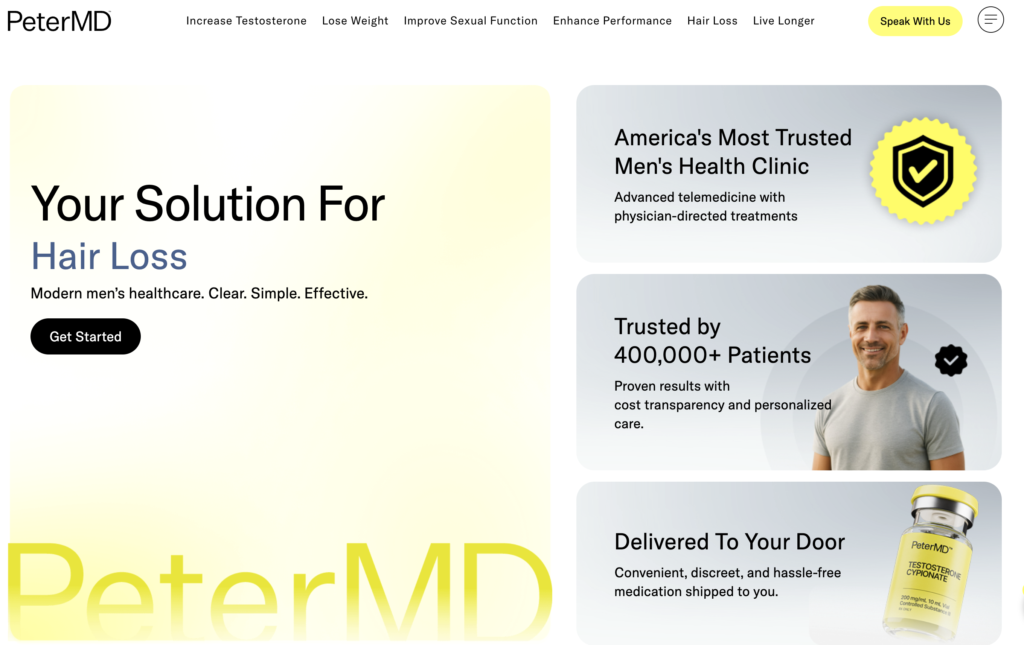
Injectable testosterone therapy, built around your lab results and health history. They don’t bundle in wellness coaching, sleep optimization seminars. It’s TRT. That’s the product.
Pricing and What’s Included
Plans start at $89-99/month, which puts PeterMD at the budget end of the spectrum. Some plans require upfront payment for longer commitments to hit that floor price. Labs and certain add-ons may cost extra, so ask exactly what’s included before entering your credit card number. Cheap is only a good deal if it’s actually cheap after all the line items.
Monitoring and Follow-Up Protocol
Bloodwork is required before prescribing. Follow-up consultations happen to review progress. The monitoring schedule covers the basics but isn’t going to rival what you’d get from Hone or Defy. For a standard, uncomplicated TRT protocol, it works.
Bottom line: PeterMD is for men who don’t need or want the hand-holding. Affordable, fast, medically sound. Just don’t expect the deep-dive clinical experience. You’re getting efficient care, not concierge care, and for a lot of guys, efficient is exactly what they want.

8. Evolve Telemedicine: Best for Flexible Treatment Plans
Who It’s Best For
Men who want their TRT woven into a bigger-picture health strategy. Evolve doesn’t just look at your testosterone number and prescribe. They pull in metabolic markers, lifestyle factors, and long-term risk data. It’s less “fix the symptom” and more “understand the whole patient.” That appeals to a certain type of person, and if you’re that person, you probably already know it.
Treatment Options and Delivery Methods
Injectable testosterone, creams, and peptide therapy. The model goes beyond standard TRT to incorporate whole-body wellness markers, which positions Evolve at a premium price point but with more clinical context than the bare-bones providers.
Pricing and What’s Included
This one’s hard to pin down because pricing varies by protocol and bundled services. Some plans tack on an annual membership fee. Labs and shipping may carry separate charges. Before you commit, get a clear total cost estimate in writing. Surprises are only fun at birthday parties.
Monitoring and Follow-Up Protocol
Evolve leans into frequent monitoring and prevention-minded lab work. Their follow-up game is stronger than most telehealth TRT clinics, which matters if you want a provider who’s tracking your full metabolic picture and not just your testosterone trough.
Bottom line: Evolve is a solid choice for the wellness-minded TRT patient. The flexible approach is a genuine strength. The variable pricing is a genuine weakness. Know what you’re paying before you start, and this could be a great fit.

9. Henry Meds: Best for All-in-One Telehealth Services
Who It’s Best For
The consolidator. Maybe you’re looking at TRT, but you also want to address weight loss, ED, or both. Henry Meds runs as a one-stop telehealth platform, so you’re managing everything through a single provider rather than juggling three different apps with three different logins and three different billing cycles. There’s something to be said for simplicity.
Treatment Options and Delivery Methods
Testosterone through injections and creams, plus additional medications for weight management, sexual health, and other concerns. The platform wraps TRT into a broader telehealth offering rather than treating it as a standalone service.
Pricing and What’s Included
Plans start around $129/month. That covers consultations, medication, and provider access. Some plans require prepayment, and certain labs or shipping might cost extra. Mid-range pricing. Not the cheapest, not the priciest. Sort of the Honda Accord of online TRT.
Monitoring and Follow-Up Protocol
Follow-up consultations and lab monitoring are baked into the service. The platform is clean and easy to navigate. Communication with providers is straightforward.
Bottom line: Henry Meds works best when you’re stacking multiple health services. If TRT is your only need, other clinics on this list probably do it better or cheaper. But if you want one platform handling testosterone, weight loss, and ED? Henry Meds saves you from app-juggling hell.
How to Tell if an Online TRT Clinic Is Legitimate
Alright, the fun part. The telehealth TRT space has exploded, and when money floods into any industry, the quality curve gets… uneven. Here’s how to figure out who’s real.
Board-Certified Physicians vs. Wellness Coaches
A legitimate TRT clinic has licensed physicians (MDs or DOs) or advanced practice providers (NPs or PAs) making the prescribing decisions. If the person running your consultation calls themselves a “wellness coach” or a “health optimizer” and there’s a doctor’s name hidden somewhere in the legal fine print that nobody has actually met, that’s not medical care. That’s a subscription box with a stethoscope logo.
Lab Requirements That Separate Real Clinics from Pill Mills
Say it with me: any clinic that prescribes testosterone without bloodwork is not practicing medicine. At minimum, you should see total testosterone, free testosterone, estradiol, hematocrit, PSA, and a metabolic panel before anyone writes you a prescription. A symptom questionnaire is not a blood test. A symptom questionnaire is a symptom questionnaire. Those are different things.
Red Flags That Should Make You Walk Away
No lab work before prescribing. No video or phone consult with a licensed provider. Testosterone marketed as a “supplement.” Pricing that looks too good to be real with zero explanation of what’s included. Overseas pharmacies. Specific result guarantees before any evaluation. High-pressure sales tactics. If you encounter any of these, close the browser tab. Not slowly. Quickly.
HIPAA Compliance and Pharmacy Verification
Your health information should be protected under HIPAA. That means encrypted communications and secure patient portals, not someone emailing your lab results as a PDF attachment. Medications should ship from FDA-registered U.S. pharmacies. Ask where your testosterone is being filled. If they can’t answer that question, or won’t, you have your answer.
TRT Delivery Methods Compared: Which One Fits Your Life?
How you take testosterone actually matters quite a bit. Different methods mean different costs, different daily routines, and different absorption profiles. Here’s the honest breakdown.
| Method | Frequency | Cost Range | Pros | Cons |
| Injections (cypionate) | 1-2x/week | $20-100/mo | Most affordable, reliable absorption, precise dosing | Needles, soreness, peaks and troughs |
| Topical gels/creams | Daily | $150-300/mo | Steady levels, needle-free | Skin transfer risk, daily chore, pricier |
| Oral testosterone | 1-2x/day | $189-400/mo | No needles, no transfer risk | Newer, limited availability, highest cost |
| Pellets | Every 3-6 months | $500-1000/insertion | Set and forget, very steady levels | Minor procedure, can’t undo between insertions |
Which Method Most Patients Prefer and Why
Injectable testosterone cypionate wins by a landslide. It’s the most studied, most affordable, and gives providers the widest latitude for dosing adjustments. Most men self-inject at home once or twice a week with a small subcutaneous needle. The learning curve is about two minutes and a YouTube video. Gels and creams work fine for men who genuinely cannot do needles, but the daily application gets old, and the transfer risk (to partners, children, pets through skin contact) is a real thing you have to think about.
What Does the Online TRT Process Actually Look Like?
If you’ve never done this before, the mystery of the process is half the reason you haven’t started yet. So here’s what actually happens, step by step, at most reputable online clinics.
Step 1: Health Assessment and Symptom Screening
You fill out a form. Symptoms (fatigue, low libido, brain fog, mood swings, trouble building muscle despite training), health history, medications, goals. It takes maybe 10 minutes. Nobody’s going to judge what you write. The whole point is to give your future provider context before they look at any numbers.
Step 2: Bloodwork and Lab Panel Review
You’ll either visit a local lab (Quest, LabCorp) with an order from the clinic, use an at-home collection kit, or submit recent results if they’re less than 6 months old. Standard panels include total testosterone, free testosterone, estradiol, hematocrit, PSA, CBC, and a metabolic panel. The thorough clinics test 40+ markers on the first draw. This is the step that separates real medicine from a vending machine.
Step 3: Physician Consultation and Treatment Plan
A licensed provider reviews your labs and health history, usually over video. They tell you whether you qualify, what delivery method they recommend, what to expect in terms of timeline and side effects, and how monitoring will work going forward. This should feel like talking to a doctor, not sitting through a sales pitch.
Step 4: Prescription Fulfillment and Home Delivery
If approved, the clinic sends your prescription to a partner pharmacy. Medication, syringes, alcohol swabs, and supplies ship to your front door. Usually arrives within a few business days. Most clinics auto-refill monthly so you don’t have to remember to reorder. You just… open the box and follow the instructions.
Step 5: Ongoing Labs and Dose Optimization
This is where the good clinics earn their money. Follow-up labs at 60-90 days, then every 3-6 months. Your provider tracks hematocrit (blood thickening), estradiol (estrogen conversion), PSA (prostate), and testosterone levels to fine-tune your dose. The process is iterative. You’re not supposed to nail it on the first try. You’re supposed to get close and adjust.
If a clinic writes the initial script and you never hear from them again? That’s not optimization. That’s abandonment. Switch providers.
How Much Does Online TRT Cost in 2026?
Monthly Subscription vs. Pay-Per-Visit Pricing
Two models dominate. Subscription clinics charge a flat monthly fee ($99-200) that bundles consultations, meds, supplies, and sometimes labs. Pay-per-service clinics like Defy charge separately for each item. Subscriptions are easier to budget. Pay-per-service can run cheaper for simple cases or far more expensive for complex ones. Know which model you’re signing up for.
What’s Typically Included and What’s Extra
At $99/month (TRT Nation, PeterMD), expect injectable testosterone, supplies, shipping, and basic consultations. Labs might be included semi-annually or charged at $100-150 a pop. At $150-200/month (Hone, Ulo, Henry Meds), you get more frequent labs, broader panels, and more delivery options. Above $200 (Defy), you’re in specialist territory with extended consults and custom compounding. The tiers exist for a reason. Pick the one that matches your actual needs, not the one with the lowest number on the pricing page.
Insurance Coverage for Telehealth TRT
Most online TRT clinics are cash-pay. They don’t bill insurance. Some will hand you a superbill you can submit to your insurer and hope for the best. Traditional insurance may cover TRT if it’s deemed medically necessary, but “my testosterone is low because I’m getting older” often doesn’t meet that bar. If insurance matters to you, call your plan before committing to a cash-pay clinic. Also worth noting: many TRT charges qualify for HSA or FSA spending, which at least gives you a tax advantage.
Why the Cheapest Clinic Usually Costs More Long-Term
I know this sounds like something a salesman would say, but hear me out. A clinic charging $79/month that skips regular labs, doesn’t watch your hematocrit, and never adjusts your dose isn’t saving you money. It’s setting you up for side effects and health problems that’ll cost real money to fix later. The $99-200/month range is where medical oversight actually exists. Below that, you’re often getting a prescription service disguised as a clinic.
Frequently Asked Questions About Online TRT Clinics
Is it legal to order testosterone online?
Yes. Provided a licensed physician prescribes it after a proper evaluation, and it’s dispensed from a regulated U.S. pharmacy. Buying testosterone without a prescription, from overseas, or from unregulated sellers is illegal and dangerous. There’s no middle ground here.
Are online TRT clinics as good as seeing a local doctor?
For standard low testosterone cases, often better. Most primary care doctors have limited experience with TRT and may not monitor the right markers. A dedicated TRT clinic does this all day, every day. That specialization counts. For complex situations involving multiple conditions, combining online TRT with a local specialist can be the best of both worlds.
How quickly can I start TRT through telehealth?
Most clinics have you up and running in 1-2 weeks. The bottleneck is usually bloodwork. Get your labs done fast, and the rest moves quickly. Some clinics can prescribe within days of receiving your results.
Do online TRT clinics accept insurance?
Mostly, no. Cash-pay is the standard model. Some offer superbills for reimbursement. HSA and FSA accounts often work. Confirm with your specific clinic before enrolling.
What lab values do I need before starting TRT?
At a bare minimum: total testosterone, free testosterone, estradiol, hematocrit/CBC, PSA, and a basic metabolic panel. Good clinics also test SHBG, LH, FSH, thyroid markers, lipids, and liver function. These numbers establish your starting line and tell your provider whether TRT is appropriate and safe for you specifically.
Can I switch from a local provider to an online TRT clinic?
Absolutely. Most online clinics accept recent lab work (under 6 months) and can pick up where your previous provider left off. You’ll need a new consultation to establish the relationship, and your dosing might shift based on their review, but the transition is usually painless.
What happens if my testosterone levels don’t improve?
A good provider investigates absorption issues, incorrect dosing, lifestyle factors, underlying conditions that weren’t caught. The fix usually involves protocol adjustments, switching delivery methods, or adding ancillary medications. If your clinic’s response is a shrug and “give it more time” without running follow-up labs, that’s not medical care.
What types of doctors should oversee TRT treatment?
Board-certified MDs or DOs with experience in endocrinology, urology, or men’s health. Nurse practitioners and physician assistants can manage TRT well when they’re supervised by experienced physicians. The non-negotiable part is that whoever’s managing your care actually understands hormones. A family doctor who prescribes TRT once a year and a hormone specialist who does it 40 times a week are not interchangeable, even if they have the same letters after their names.
Finding the Right Online TRT Clinic for You
Here’s the truth nobody in this industry wants to say out loud: there is no single “best” clinic. There’s the best clinic for you, which depends on what you actually need.
Want simplicity and brand trust? Hims. Want data and frequent labs? Hone. Want a full performance protocol that goes beyond just testosterone? Limitless Alternative Medicine. Want the lowest monthly cost? TRT Nation. Got a complicated case? Defy Medical.
But no matter which one you choose, make sure three things are true before you hand over a credit card: licensed physicians are making the decisions, bloodwork is required, and ongoing monitoring is part of the plan. Those three things are the floor. Below that floor, you’re not doing TRT. You’re doing something reckless that looks like TRT from across the room.
Get those three right, and telehealth TRT is one of the smartest health moves you can make.
References and Expert Resources
- Bhasin S, Brito JP, Cunningham GR, et al. “Testosterone Therapy in Men With Hypogonadism: An Endocrine Society Clinical Practice Guideline.” The Journal of Clinical Endocrinology & Metabolism, Volume 103, Issue 5, May 2018, Pages 1715-1744. https://academic.oup.com/jcem/article/103/5/1715/4939465
- Mulhall JP, Trost LW, Brannigan RE, et al. “Evaluation and Management of Testosterone Deficiency: AUA Guideline.” The Journal of Urology, Volume 200, Issue 2, August 2018, Pages 423-432. https://www.auajournals.org/doi/10.1016/j.juro.2018.03.115
- American Urological Association. Testosterone Deficiency Guideline (with 2024 update). https://www.auanet.org/guidelines-and-quality/guidelines/testosterone-deficiency-guideline
- Endocrine Society. Testosterone Therapy for Hypogonadism Guideline Resources. https://www.endocrine.org/clinical-practice-guidelines/testosterone-therapy
- Jayasena CN, Anderson RA, Llahana S, et al. “Society for Endocrinology Guidelines for Testosterone Replacement Therapy in Male Hypogonadism.” Clinical Endocrinology, Volume 96, Issue 2, February 2022, Pages 200-219. https://pubmed.ncbi.nlm.nih.gov/34811785/
- U.S. Drug Enforcement Administration (DEA). Telemedicine Prescribing of Controlled Substances When the Practitioner and the Patient Have Not Had a Prior In-Person Medical Evaluation (Final Rule). https://www.deadiversion.usdoj.gov/fed_regs/rules/2025/fr0129.htm
- U.S. Food & Drug Administration (FDA). FDA-Approved Testosterone Products Information. https://www.fda.gov/drugs/drug-safety-and-availability/fda-drug-safety-communication-fda-cautions-about-using-testosterone-products-low-testosterone-due
- Zhu A, Andino J, Daignault-Newton S, et al. “What Is a Normal Testosterone Level for Young Men? Rethinking the 300 ng/dL Cutoff for Testosterone Deficiency in Men 20-44 Years Old.” The Journal of Urology, Volume 208, Issue 6, December 2022, Pages 1295-1302. https://auanews.net/issues/articles/2023/november-extra-2023/what-is-a-normal-testosterone-level-for-young-men
- Dubin JM, Jesse E, Fantus RJ, et al. “Guideline-Discordant Care Among Direct-to-Consumer Testosterone Therapy Platforms.” JAMA Internal Medicine, Volume 182, Issue 12, December 2022, Pages 1321-1323.
- HIPAA Journal. HIPAA Compliance for Telehealth Providers. https://www.hipaajournal.com/hipaa-compliant-telehealth/
Medical Disclaimer: This article is for informational purposes only and does not constitute medical advice, diagnosis, or treatment. Testosterone replacement therapy requires evaluation and approval by a licensed healthcare provider. Individual results vary. Always consult a qualified physician before starting any hormone therapy program.