
If you’re Googling, watching YouTube videos and searching around Reddit on “what are peptides?” at 2 a.m., you’re not alone.
This Peptide Therapy Guide is for anyone who is curious, maybe overwhelmed, and even a bit skeptical.
Peptides sound highly scientific and complex, however, most people have no clue how they actually work.
Honestly, It can feel like you’re trying to decode a biology textbook just to understand what these peptides are, and what to take.
To start you off, Peptide therapy isn’t hype.
When used correctly, peptides can be a real game changer. With measurable changes in energy, fat loss, recovery, and skin health. But make sure to educate yourself on what you’re thinking of taking.
That’s exactly what this Peptide Therapy Guide breaks down for you.
What This Peptide Therapy Guide Actually Covers
Experts overcomplicate this. I’m going to keep it simple.
Peptides? They’re just short chains of amino acids. Smaller versions of proteins. Your body already uses them every single day as messengers between cells.
They tell your muscles “hey, repair this tear.” They signal your skin to pump out more collagen. They help you crash at night or torch extra calories. This peptide therapy guide breaks down how all that works.
Most people hear “peptide injections” and think it sounds hardcore. Maybe even sketchy. But listen—these aren’t lab-made Frankenstein molecules. Most therapeutic peptides copy hormones and signals your body already produces naturally.
BPC-157 for a jacked-up tendon? Your body gets it. CJC-1295 for growth hormone? Same deal. These work with your biology.
And yeah, the science backs this up. Studies prove GHK-Cu helps wounds heal and skin bounce back see here. Real research, not Instagram claims.
What Peptide Therapy Can Really Do
You’re tired of guides that promise the moon, right?
Same. Let’s be real about what peptides actually do.
They’re not magic bullets. They’re precision tools. When you use them correctly, here’s what happens:
1. Muscle Recovery & Performance
Athletes swear by BPC-157 and TB-500. Why? They cut recovery time from strains, sketchy tendons, and those annoying microtears that refuse to heal.
Doesn’t matter if you’re deadlifting heavy or just tweaked something moving furniture. These recovery peptides help tissue repair faster. Sometimes way faster.
2. Fat Loss & Metabolism Support
Real talk: most people get into peptides because they heard it melts fat. And yeah, some do help. CJC-1295 paired with Ipamorelin kicks your natural growth hormone into gear, which supports fat burning and lean muscle.
Will it replace diet and training? Hell no. But it makes your body way more responsive to the work you’re already putting in.
Here’s the thing—research shows hormonal decline and chronic stress make weight loss brutal as you age, Ref. https://www.niddk.nih.gov/health-information/health-statistics/endocrine-metabolic-diseases Peptides target that root problem.
3. Better Skin, Hair & Aging Support
Looking for healthier skin or thicker hair? Peptides deliver. Especially collagen boosters like GHK-Cu and Matrixyl. They improve elasticity, hydration, and how fast your cells turn over.
You can stack these with medical-grade skincare too.
4. Improved Sleep & Mood
Some peptides mess with sleep quality in a good way. Better REM cycles. Lower stress response. DSIP (Delta Sleep-Inducing Peptide) help do that, example: Sermorelin.
Garbage sleep wrecks everything. Fat loss? Gone. Hormones? Shot. Mood? Terrible. Fix your sleep and suddenly progress that was stuck starts moving.
5. Longevity & Overall Wellness
This is where most people miss the point. Some peptides don’t just patch problems—they optimize how your body functions long-term. Immune support. Cellular repair. Less inflammation.
Types of Peptides Explained
Feeling buried under peptide names? I get it. There’s a million of them.
This section keeps it stupid simple. No need to read 40 Wikipedia pages.
1. Healing & Recovery Peptides
BPC-157
The most talked-about peptide online. Probably for good reason. People report faster tendon healing, less gut inflammation, better joint function. It’s everywhere in athlete circles.
TB-500 (Thymosin Beta 4)
Kills it for soft-tissue recovery. Improves circulation. Reduces stiffness.
2. Growth Hormone Peptides
CJC-1295 (with or without DAC)
Pushes your natural GH higher. Helps with fat loss, muscle building, better sleep.
Ipamorelin
Gentle GH booster. Usually stacked with CJC for bigger results.
3. Cosmetic & Anti-Aging Peptides
GHK-Cu
Copper peptide. Known for skin regeneration and hair growth.
Matrixyl & Argireline
Common in anti-wrinkle creams. You’ve probably seen them in ingredient lists.
4. Cognitive & Sleep Peptides
DSIP
Supports sleep cycles.
Semax & Selank
Russian-developed. Big following for mood, focus, and stress management.
5. Weight-Loss Peptides
AOD-9604
Modified GH fragment. Targets fat metabolism specifically.
Tesofensine (not technically a peptide but gets lumped in)
Appetite suppressant.
Clinical research on neuropeptides shows real promise for long-term cognitive performance: neuropeptide research from Queensland University
How Peptide Therapy Works in the Body
Simple Version:
Look. Most guides turn this into a biochemistry lecture. I’m not doing that.
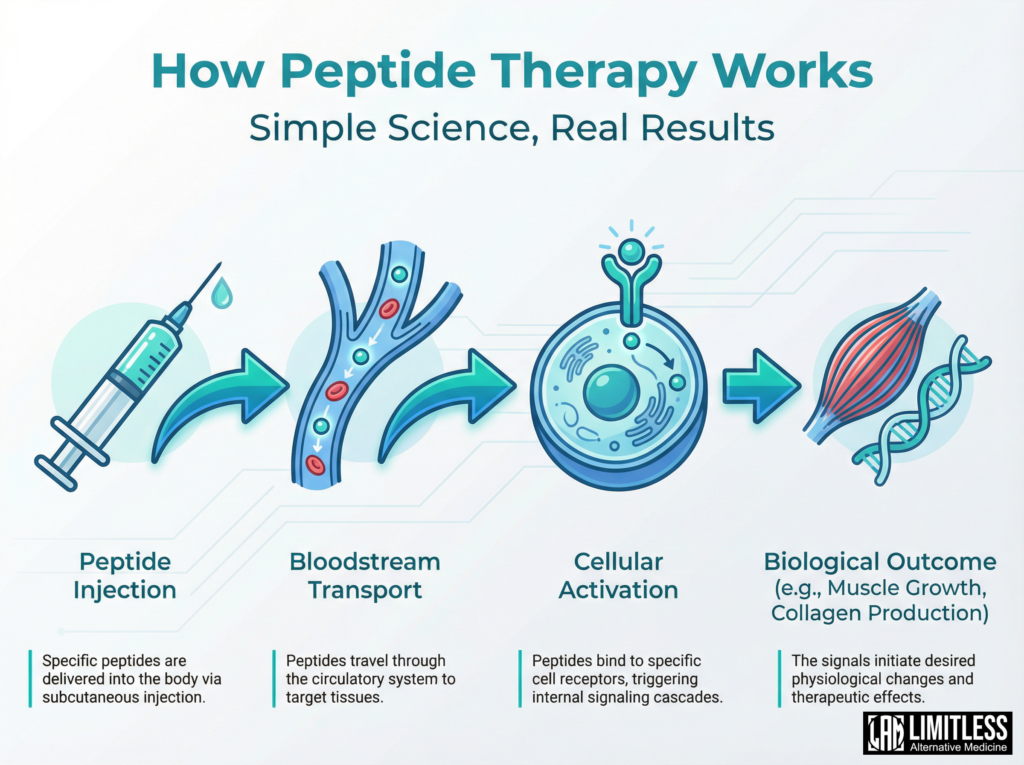
Peptide therapy is targeted communication. You’re basically texting your cells.
You inject a peptide—it tells your body “do more of this specific thing.” Like if you need collagen, the peptide tells fibroblasts “hey get to work.” That’s it. Not complicated.
I made this guide because everyone makes peptides sound either like science fiction or snake oil. Neither’s true. They’re just signaling molecules. Your body already uses them. We’re just adding more of specific ones to get specific results.
Fat loss peptide? Signals growth hormone pathways. Recovery peptide? Tells tissue to repair faster.
But here’s what nobody wants to admit—peptides don’t fix a trash lifestyle. You sleeping 4 hours a night? Eating gas station food? Never exercising? Yeah, no peptide’s gonna save you. They amplify good habits. They don’t create them out of thin air.
Think of it like this—peptides are the turbo in a car. But if your engine’s already broken, adding a turbo just breaks it faster.
How to Start Peptide Therapy Safely
(This Part Really Matters)
Okay so peptides work great. When you’re not buying complete garbage off the internet.
First rule—don’t buy peptides from sketchy websites. I know it’s cheaper. I know it’s easier. Don’t do it.
If the site has “for research purposes only” or “not for human consumption” anywhere? Close that tab. Now.
Here’s what you actually do:
1. Work with a licensed medical professional
Get a doctor. Get labs done. Get real dosing advice.
Don’t dose yourself based on what some guy on Reddit said worked for him. That guy could be 6’4″ and 240 pounds. You might be 5’6″ and 150. See the problem?
2. Start with a clear goal
What are you even trying to do here?
Lose fat? Fix a jacked-up knee? Actually sleep through the night for once? Make your skin not look like you aged 10 years in the past 2?
Figure that out first. Different peptides do different things. You can’t just take random ones and hope for the best.
3. Choose medically compounded peptides
This is where people mess up the most.
You need regulated stuff. From an actual pharmacy. Not powder from some website that also sells workout supplements and “experimental research compounds.”
I’ve seen people buy peptides that were basically just saline solution. Or worse—contaminated with who knows what.
Don’t be that person.
4. Understand dosing & timing
Some peptides you take at night. Some in the morning on an empty stomach. Some you cycle on and off every few weeks.
This is exactly why you need someone who knows what they’re doing. Timing matters. Dosing matters. Frequency matters.
5. Track your results
Write stuff down.
Better sleep? Note it. Less joint pain? Track it. Recovering faster? Compare your workouts week by week.
Peptides work but you gotta actually pay attention to what’s changing.
Risks, Side Effects & My Honest Opinion
I’m not gonna lie to you—peptides aren’t 100% safe. Nothing is.
But done correctly? Side effects are usually pretty minor.
Might get:
- Little red bumps where you inject (goes away quick)
- Holding a bit of water
- Really vivid dreams—honestly I kinda liked this when it happened
- Appetite going up or down
- Feeling tired the first couple days
The horror stories you hear? Almost always from people who either bought fake peptides or dosed themselves with zero guidance.
Here’s my actual opinion. Peptide therapy is safe if you treat it like medicine. Because it is medicine. Get a doctor involved. Do bloodwork. Follow a real protocol.
Not something you cobbled together from YouTube videos and forum posts.
Who Should Consider Peptide Therapy?
The Peptide Therapy Guide Breakdown
This isn’t just for athletes or biohackers. It’s for normal people whose bodies aren’t cooperating anymore.
You might be a good fit if:
- Everything takes forever to heal. Tweaked your back 3 weeks ago? Still hurts.
- You’ve been trying to lose fat for months. Eating right. Training. Scale won’t budge.
- You’re past 30 and everything feels different. Energy’s lower. Sleep’s worse. Hormones doing weird things.
- Recovering from surgery or injury. It’s taking way longer than it should.
- Skin looks tired. You want to age better without going the Botox route.
- Your job’s stressful. You sleep like garbage. Mood swings all over the place.
If any of that sounds familiar—peptides might actually help.
Conclusion: Is Peptide Therapy Worth It?
Alright let’s wrap this up.
Peptide therapy isn’t magic. Won’t fix everything overnight. You definitely need a plan and medical supervision.
But if you want legit improvements in energy, recovery, sleep, skin, or metabolism? Peptides deliver. Just not how the Instagram ads promise with before/after photos that are obviously fake.
What I like about peptides is how specific they are. You’re not taking some one-size-fits-all supplement. You’re using compounds that target exact biological processes.
Do that with a good doctor and consistent habits? Results show up. Sometimes faster than you’d expect.
So if you’ve been looking for a straight answer about peptides—no hype, no BS—hopefully this helped. If you move forward, find a clinic that actually gives a damn about doing things right.
Whatever your goal is—recovery, fat loss, sleep, aging—this guide should get you started. You know what you need to know. Rest is up to you.
Ready to start peptide therapy the right way? Limitless Alternative Medicine offers medical-grade peptides with physician oversight, lab testing, and personalized protocols. No sketchy research chemicals. No guessing. Just real results backed by real doctors.

FAQ
Peptide therapy uses short chains of amino acids (peptides) to signal specific biological responses in the body. Depending on the peptide, it can support fat loss, healing, recovery, sleep, skin health, inflammation reduction, or hormone balance.
Yes—when medically supervised and purchased from a legitimate compounding pharmacy. Risks increase dramatically when using unregulated “research peptides” from online vendors.
Most people notice changes within 2–6 weeks depending on the peptide. Recovery and sleep peptides tend to show results sooner, while fat-loss and anti-aging peptides take longer.
Some do, yes. Peptides like CJC-1295, Ipamorelin, AOD-9604, and MOTS-C support fat metabolism and energy production. They work best when paired with a solid nutrition and training plan.
Some peptides come in topical, oral, or nasal forms—like GHK-Cu cream or Selank nasal spray. But the most effective peptides are injectable due to better absorption.
Medical-grade peptides prescribed by licensed clinicians are legal. Unregulated peptides sold as “research chemicals” are not approved for human use.
Look for licensed medical providers, access to a certified compounding pharmacy, lab testing, personalized protocols, and transparent safety procedures. Avoid clinics that skip bloodwork.
Peptides send signals to enhance natural functions. Steroids directly replace hormones and often suppress natural production. Peptides tend to be milder, safer, and more targeted.